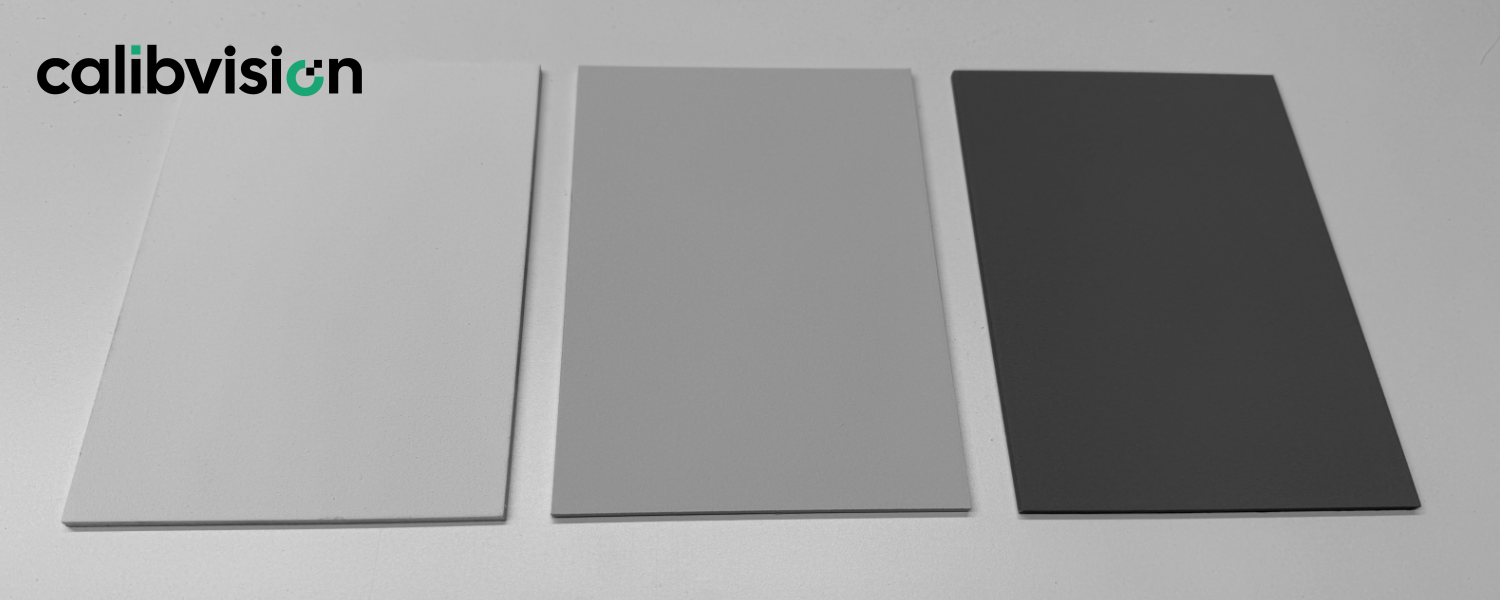
Understanding Lambertian Reflectance: The Science Behind Diffuse Reflectance Standards

Last Updated: January 2025 | Reading Time: 12 minutes

Table of Contents hide

Introduction

When you shine a flashlight at a mirror, the reflected beam bounces back at a precise angle—miss that angle by a degree, and you see nothing. Point the same flashlight at a white wall, and it illuminates the entire room regardless of where you stand. This fundamental difference between specular (mirror-like) and diffuse (scattered) reflection is what makes diffuse reflectance standards possible—and essential for modern sensor calibration.

At the heart of every quality reflectance standard lies a special property called Lambertian reflection. Named after 18th-century mathematician Johann Heinrich Lambert, this principle describes an ideal diffuse surface that reflects light uniformly in all directions. Understanding Lambertian reflectance isn’t just academic—it’s the key to knowing why some calibration targets work reliably while others fail unpredictably.

This article explores the physics behind Lambertian surfaces, why they matter for LiDAR and camera calibration, and how to identify truly Lambertian reflectance standards.

What you’ll learn:

  • The fundamental physics of diffuse vs. specular reflection
  • Lambert’s cosine law and why it matters for calibration
  • How to measure and verify Lambertian properties
  • Real-world deviations from ideal behavior
  • Why poor Lambertian conformity causes measurement errors

<a name=”two-types”></a>

1. The Two Types of Reflection

All reflection falls on a spectrum between two extremes: specular and diffuse.

Specular Reflection: The Mirror Effect

Characteristics:

  • Light reflects at a single angle (angle of incidence = angle of reflection)
  • Surface appears shiny, glossy, or mirror-like
  • Viewing angle dramatically affects perceived brightness
  • Creates highlights and glare

Examples:

  • Polished metal
  • Glass
  • Calm water surface
  • Glossy paint
  • Smartphone screens

Mathematical description: Specular reflection follows the law of reflection:

θᵢ = θᵣ

Where θᵢ is incident angle and θᵣ is reflected angle (both measured from surface normal).

Practical problem: For calibration, specular surfaces are disastrous. A LiDAR sensor hitting a specular target at 89° would receive almost no return signal (light reflects away at 89° on the opposite side). At 90° (perpendicular), it gets maximum return. This extreme angle-dependency makes calibration impossible.

Diffuse Reflection: The Matte Effect

Characteristics:

  • Light scatters in all directions
  • Surface appears matte, non-reflective
  • Brightness relatively constant across viewing angles
  • No highlights or mirror images

Examples:

  • Unglazed ceramic
  • Matte paint
  • Paper
  • Fabric
  • Fresh snow
  • Plaster walls

Mathematical description: Ideal diffuse reflection follows Lambert’s cosine law (explained in detail below).

Practical advantage: Diffuse surfaces return light to the sensor regardless of exact mounting angle or sensor position. This angle-independence is what makes diffuse reflectance standards reliable for calibration.

The Reality: Mixed Reflection

Most real-world surfaces exhibit both specular and diffuse components:

Total Reflection = Diffuse Component + Specular Component

Examples:

SurfaceDiffuse %Specular %Character
Perfect mirror0%100%Pure specular
Glossy paint60%40%Mixed (problematic for calibration)
Satin finish85%15%Mostly diffuse
Matte ceramic98%2%Nearly ideal diffuse
Perfect Lambertian100%0%Ideal (theoretical)

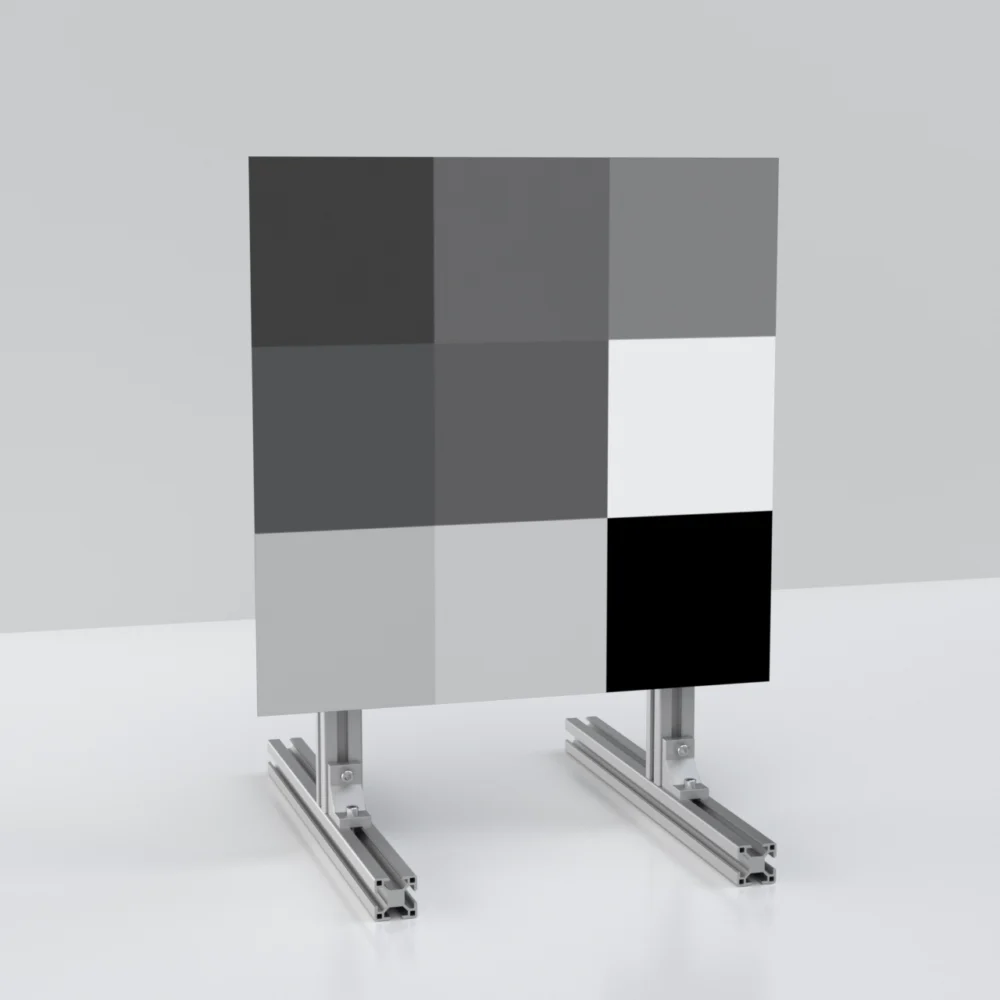
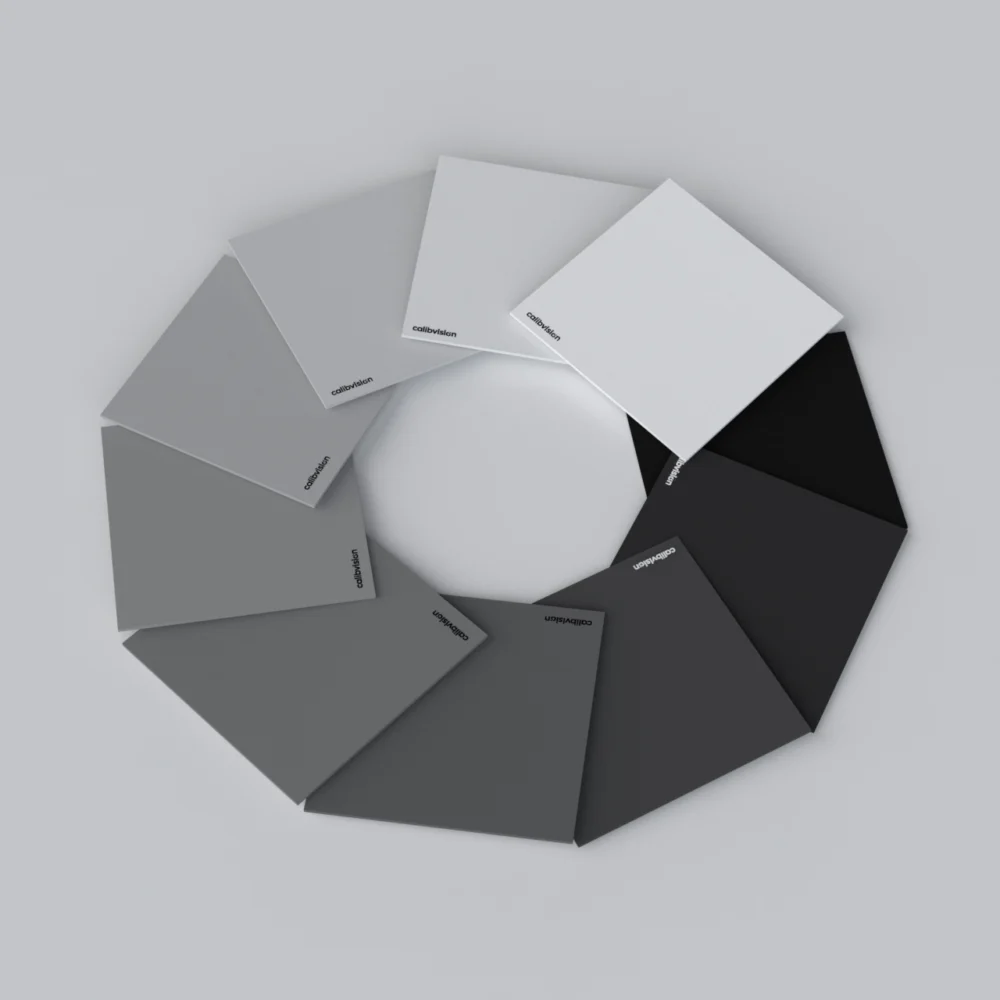
For calibration targets: We want >95% diffuse, <5% specular component.

Visual demonstration:

Imagine photographing a glossy magazine cover:

  • Specular highlight: Bright spot where light source reflects directly to camera
  • Diffuse component: You can still see the image content at all angles

Now photograph a matte printout of the same image:

  • No specular highlight: No bright spot regardless of lighting angle
  • Diffuse only: Image visible equally well from all viewing positions

Quality reflectance standards achieve the matte printout behavior across all wavelengths, not just visible light.


<a name=”what-is-lambertian”></a>

2. What Is Lambertian Reflectance?

A Lambertian surface is an ideal diffuse reflector that obeys Lambert’s cosine law: reflected light intensity depends only on the cosine of the viewing angle, not the surface properties or viewing position.

Formal Definition

A surface is Lambertian if its radiance (brightness per unit area per solid angle) is constant in all directions.

Translation: No matter where you position your eye (or sensor), the surface appears equally bright per unit projected area.

Key Insight: The Projected Area Effect

Why does a Lambertian surface follow the cosine law? It’s not because the surface “knows” the viewing angle—it’s purely geometric.

Thought experiment:

Imagine viewing a glowing square tile from directly above (0° angle):

  • You see the full 1m² surface area
  • Each square meter emits X watts of light
  • Perceived brightness: X watts/m²

Now tilt your viewing angle to 60°:

  • The square appears foreshortened (you see less area)
  • Projected area: 1m² × cos(60°) = 0.5m²
  • The same X watts now appears concentrated in 0.5m²
  • Perceived brightness: X watts / 0.5m² = 2X watts/m²?

No! For a Lambertian emitter (or reflector), the intensity per unit solid angle decreases by exactly cos(60°), canceling the projected area effect.

Result: Brightness per unit apparent area remains constant at all viewing angles.

Why “Lambertian” Is Special

Many diffuse surfaces scatter light, but only Lambertian surfaces scatter with this specific angular distribution. The Lambertian property means:

  1. Predictable angular response – If you know intensity at one angle, you can calculate it at any angle
  2. Calibration independence – Sensor measurements don’t depend on exact target orientation
  3. Mathematical simplicity – Single scalar (reflectance %) fully describes optical behavior

Historical Context

Johann Heinrich Lambert (1728-1777) studied photometry and discovered that certain surfaces exhibited this cosine-law behavior. He published Photometria in 1760, establishing the mathematical foundation for modern optical measurements.

Lambert’s insight: The “perfect matte surface” isn’t just random scattering—it’s a specific mathematical distribution that makes quantitative measurements possible.

Lambertian vs. Other Diffuse Models

Not all diffuse surfaces are Lambertian:

Oren-Nayar Model:

  • Accounts for surface roughness
  • Includes inter-reflection between micro-facets
  • More accurate for rough surfaces like concrete, fabric
  • Reduces to Lambertian for perfectly smooth matte surfaces

Phong Model:

  • Mix of diffuse (Lambertian) + specular components
  • Used in computer graphics
  • Not suitable for calibration (specular component causes angle-dependence)

For reflectance standards: Pure Lambertian model is required. We’ll accept small deviations (<5%), but any significant specular component disqualifies a target.


<a name=”cosine-law”></a>

3. Lambert’s Cosine Law Explained

The Mathematical Statement

For a Lambertian surface, the reflected intensity (radiant power per unit solid angle) in direction θ from the surface normal is:

I(θ) = I₀ × cos(θ)

Where:

  • I(θ) = Intensity in direction θ
  • I₀ = Intensity in normal direction (θ = 0°)
  • θ = Angle from surface normal (0° = perpendicular, 90° = parallel to surface)

Visual Explanation

Picture a Lambertian surface illuminated by a fixed light source:

View from 0° (perpendicular):

  • You see maximum intensity: I₀
  • Full surface area visible

View from 30°:

  • Intensity: I₀ × cos(30°) = I₀ × 0.866 = 86.6% of I₀
  • Surface appears foreshortened

View from 60°:

  • Intensity: I₀ × cos(60°) = I₀ × 0.5 = 50% of I₀
  • Surface highly foreshortened

View from 89°:

  • Intensity: I₀ × cos(89°) = I₀ × 0.017 = 1.7% of I₀
  • Grazing angle, minimal return

View from 90° (edge-on):

  • Intensity: I₀ × cos(90°) = I₀ × 0 = 0%
  • No surface area visible

Practical Example: LiDAR Calibration

You’re testing a 905nm automotive LiDAR with a 50% Lambertian reflectance standard.

Setup:

  • Target positioned at 50m distance
  • LiDAR beam axis at various angles to target normal

Expected intensity returns:

Target Angle (θ)cos(θ)Expected IntensityMeasured (Good Target)Measured (Poor Target)
0° (perpendicular)1.000100%99.8% ✓98%
15°0.96696.6%96.2% ✓102% ⚠️
30°0.86686.6%86.1% ✓79% ⚠️
45°0.70770.7%70.2% ✓58% ❌
60°0.50050.0%49.7% ✓31% ❌

Good target (>95% Lambertian conformity): Measured values track theoretical cosine within ±2%.

Poor target (<80% Lambertian conformity): Deviations increase with angle. At 60°, measured value is 31% vs. expected 50%—a 38% error!

Calibration impact: If you calibrate using the poor target at 0° (where it’s close to correct) and then use the sensor at 45° (where target is 18% low), your calibration is invalid. The sensor will misinterpret reflectance values, potentially classifying a low-reflectance pedestrian as a high-reflectance object.

Why Cosine Specifically?

The cosine relationship isn’t arbitrary—it emerges from:

  1. Energy conservation: Total emitted power must remain constant regardless of how it’s distributed
  2. Solid angle geometry: Area of a projected surface element decreases as cos(θ)
  3. Isotropic radiance: Lambertian assumption means brightness per unit area is constant

Mathematical derivation (simplified):

For a surface element dA emitting radiance L (constant for Lambertian surfaces):

  • Projected area in direction θ: dA × cos(θ)
  • Intensity (power per solid angle) ∝ Projected area
  • Therefore: I(θ) ∝ cos(θ)

Common Misconception: Lambertian ≠ Isotropic

Isotropic scattering: Equal intensity in all directions (I(θ) = constant) Lambertian scattering: Intensity follows cosine law (I(θ) ∝ cos(θ))

These are different! A Lambertian surface does NOT scatter equally in all directions—it scatters more strongly perpendicular to the surface than at grazing angles.

Why the confusion? Because radiance (brightness per unit apparent area) is constant for Lambertian surfaces, but intensity (power per solid angle) follows the cosine law.

Practical implication: If someone claims their calibration target is “isotropic” (equal intensity at all angles), it’s either:

  • Not true (violates energy conservation)
  • Misusing terminology (they mean Lambertian)
  • A hollow sphere light source (truly isotropic, but not a surface)

<a name=”physics”></a>

4. The Physics: Why Surfaces Become Lambertian

What physical processes create Lambertian behavior? Understanding the mechanisms helps evaluate whether a given material can truly achieve Lambertian properties.

Mechanism #1: Surface Roughness (Microscopic)

How it works:

A surface with random microscopic roughness (features much smaller than wavelength) acts as a collection of tiny facets oriented in all directions.

Key requirement: Roughness scale << wavelength

For visible light (λ ≈ 500nm):

  • Roughness features: 50-100nm scale
  • Each micro-facet reflects specularly
  • Aggregate effect: Diffuse reflection

Analogy: Imagine a field of randomly tilted mirrors. Each individual mirror reflects specularly, but the collection produces diffuse-like behavior because reflected rays go in all directions.

Limitations:

  • Wavelength-dependent (roughness may be adequate for visible but inadequate for longer wavelengths)
  • Doesn’t produce perfect Lambertian behavior (typically 85-90% conformity)
  • Works best for moderate roughness (too smooth = specular, too rough = shadowing effects)

Materials using this mechanism:

  • Matte paint (fine pigment particles create roughness)
  • Sandblasted metal
  • Ground glass

Mechanism #2: Volume Scattering

How it works:

Light penetrates a translucent material and scatters multiple times within the volume before re-emerging.

Key requirement: Scattering mean free path ≈ material thickness

Process:

  1. Photon enters surface
  2. Scatters off internal particles/inhomogeneities
  3. Undergoes 5-20 scattering events (random walk)
  4. Exits surface in random direction
  5. Memory of original incident direction lost

Result: Nearly perfect Lambertian behavior (>98% conformity)

Materials using this mechanism:

  • Barium sulfate (BaSO₄) – Gold standard for reflectance standards
  • Spectralon® – Sintered PTFE, used in professional standards
  • Pressed PTFE powder – Cost-effective alternative
  • Milk – Classic example (casein micelles scatter light)

Advantages:

  • Excellent Lambertian conformity
  • Wavelength-independent (if scatterers are appropriate size)
  • High diffuse reflectance possible (BaSO₄ ≈ 98-99%)

Disadvantages:

  • Fragile (powder coatings)
  • Difficult to pattern (can’t create geometric features easily)
  • Requires thick layer (1-2mm minimum)

Mechanism #3: Engineered Microstructures

How it works:

Photolithography or laser etching creates controlled surface patterns designed to scatter light according to desired distribution.

Example: Calibvision approach

Proprietary matte ink coating contains:

  • Pigment particles (absorb fraction of light)
  • Transparent binder matrix
  • Internal scatterers (create volume scattering)
  • Surface texture (controlled roughness)

Result: Hybrid mechanism combining surface roughness + volume scattering

Advantages:

  • Tailored spectral response (optimize for specific wavelength ranges)
  • Durable (ink bonded to substrate)
  • Patternability (can create combination targets with geometry)
  • Environmental stability (sealed coating resists contamination)

Performance:

  • Lambertian conformity: >95% across ±60°
  • Spectral uniformity: <3% variation 400-1550nm
  • Long-term stability: <1% drift over 3 years

Comparison of Mechanisms

MechanismLambertian ConformitySpectral RangeDurabilityCostPatternability
Surface Roughness85-90%LimitedGood$Excellent
Volume Scattering (BaSO₄)98-99%ExcellentPoor$$$Poor
Engineered Coating95-97%ExcellentExcellent$$Good

Why Lambertian Behavior Emerges

Regardless of mechanism, Lambertian behavior results from:

  1. Randomization: Multiple scattering events erase memory of incident direction
  2. Isotropy: Scatterers have no preferred orientation
  3. Statistical averaging: Large number of scatterers per sensor spot size

Critical insight: You cannot create a Lambertian surface with a single scattering event. Multiple scatterings (either within volume or from many surface facets) are essential.

Temperature and Wavelength Dependence

Real Lambertian surfaces have subtle dependencies:

Temperature:

  • Thermal expansion changes micro-structure
  • Material optical properties vary with temperature
  • Quality targets specify: <0.01% per °C

Wavelength:

  • Scattering efficiency depends on particle size vs. wavelength (Mie scattering theory)
  • Optimal Lambertian behavior when: particle size ≈ wavelength / 2
  • For broadband Lambertian behavior: Distribution of particle sizes

Multi-wavelength optimization:

To achieve Lambertian properties from UV (200nm) to NIR (2000nm):

  • Particle size distribution: 100nm – 1000nm
  • Mix of scattering mechanisms (surface + volume)
  • Careful material selection (minimize wavelength-selective absorption)

This is why quality reflectance standards cost more—achieving consistent Lambertian behavior across decades of wavelength is not trivial.


<a name=”brdf”></a>

5. BRDF: The Complete Mathematical Description

For a complete characterization of reflection, we use the Bidirectional Reflectance Distribution Function (BRDF).

What Is BRDF?

Definition: BRDF describes how light reflects off a surface as a function of both incident and viewing angles.

Mathematical form:

BRDF(θᵢ, φᵢ, θᵣ, φᵣ, λ) = dLᵣ(θᵣ, φᵣ) / dEᵢ(θᵢ, φᵢ)

Where:

  • θᵢ, φᵢ = Incident angles (elevation, azimuth)
  • θᵣ, φᵣ = Reflected angles (elevation, azimuth)
  • λ = Wavelength
  • dLᵣ = Differential reflected radiance
  • dEᵢ = Differential incident irradiance

Translation: BRDF tells you “if light comes from direction (θᵢ, φᵢ), how much reflects toward direction (θᵣ, φᵣ)?”

BRDF for an Ideal Lambertian Surface

For a perfect Lambertian surface, BRDF is remarkably simple:

BRDF_Lambertian = ρ / π

Where:

  • ρ = Reflectance (0-1, or 0-100%)
  • π = Mathematical constant

Key insight: BRDF is constant—it doesn’t depend on θᵢ, φᵢ, θᵣ, or φᵣ!

Example: A 50% Lambertian reflector has:

BRDF = 0.50 / π = 0.159 sr⁻¹

This single number completely describes its reflection properties at all angles.

BRDF for Real Surfaces

Real reflectance standards have BRDF that varies slightly with angle:

BRDF_real(θ, φ) ≈ (ρ / π) × [1 + f(θ, φ)]

Where f(θ, φ) represents deviations from ideal Lambertian behavior.

Quality metrics:

| Lambertian Conformity | max|f(θ, φ)| | BRDF Variation | |———————-|————–|—————-| | 99% (exceptional) | <1% | ±0.001 sr⁻¹ | | 95% (professional) | <5% | ±0.008 sr⁻¹ | | 90% (good) | <10% | ±0.016 sr⁻¹ | | 80% (fair) | <20% | ±0.032 sr⁻¹ |

Measuring BRDF

Equipment required:

  1. Goniometric spectrometer:
    • Rotational stages (θ and φ control)
    • Collimated light source (known incident angle)
    • Detector on movable arm (measures reflected intensity at various angles)
    • Computer control and data acquisition
  2. Procedure:
    • Fix incident angle (e.g., θᵢ = 0°, perpendicular)
    • Sweep viewing angle: θᵣ = 0° to 85° in 5° increments
    • Rotate azimuth: φᵣ = 0° to 360° in 30° increments
    • Record intensity at each (θᵣ, φᵣ) position
    • Repeat for multiple incident angles
    • Process data to generate full BRDF

Measurement time: 2-4 hours for complete characterization

Cost: BRDF measurement systems: $50K-500K

Why so expensive?

  • Precision rotation stages (±0.01° accuracy)
  • Stable light sources (±0.1% intensity)
  • Low-noise detectors
  • Calibrated against standards

This is why only specialized labs (ISO 17025 accredited) perform BRDF measurements for calibration certificates.

Interpreting BRDF Data

Example BRDF plot for a quality reflectance standard:

        BRDF (sr⁻¹)
        |
 0.165  |     ●
        |    ●●●
 0.160  |   ●●●●●
        |  ●●●●●●●
 0.155  | ●●●●●●●●●
        |●●●●●●●●●●●
 0.150  +-------------------
        0°  30°  60°  90°
              Viewing Angle θᵣ

Ideal Lambertian: Flat horizontal line at 0.159 sr⁻¹

This target: Slight decrease at large angles (typical behavior)

  • 0° (perpendicular): 0.160 sr⁻¹ (+0.6% vs ideal)
  • 30°: 0.159 sr⁻¹ (0% vs ideal) ✓
  • 60°: 0.156 sr⁻¹ (-1.9% vs ideal) ✓
  • Lambertian conformity: 98% (excellent)

Poor target would show:

        BRDF (sr⁻¹)
        |
 0.180  |    ●
        |   ●●
 0.170  |  ●●●
        | ●●●●
 0.160  |●●●●●
        |●●●●●●
 0.150  |  ●●●●●●●
 0.140  +-------------------
        0°  30°  60°  90°

Notice:

  • Peak at ~15° (specular component)
  • Steep drop-off at large angles
  • Lambertian conformity: ~75% (avoid for calibration)

Specialized BRDF Models

For surfaces that aren’t Lambertian, various BRDF models exist:

Phong Model:

BRDF = kd/π + ks × (cos α)ⁿ
  • kd = Diffuse coefficient (Lambertian component)
  • ks = Specular coefficient
  • α = Angle between reflection direction and perfect specular
  • n = Shininess exponent (higher n = glossier)

Used for: Computer graphics, not suitable for calibration standards

Cook-Torrance Model:

BRDF = F×D×G / (4×cos(θᵢ)×cos(θᵣ))
  • F = Fresnel term (angle-dependent reflectance)
  • D = Microfacet distribution
  • G = Geometric shadowing/masking

Used for: Physically-based rendering, metal surfaces

For calibration standards: We want pure Lambertian (first term only), with ks ≈ 0 (no specular component).


<a name=”measuring”></a>

6. Measuring Lambertian Conformity

How do you verify that a reflectance standard actually exhibits Lambertian behavior? Here are practical measurement approaches.

Method #1: Cosine Law Verification (Simple)

Equipment needed:

  • Reflectance standard
  • Optical sensor (calibrated photometer, spectroradiometer, or LiDAR)
  • Stable light source
  • Protractor or inclinometer (±1° accuracy)
  • Fixed mounting setup

Procedure:

  1. Setup:
    • Mount reflectance standard on rotational stage
    • Position sensor at fixed distance (e.g., 1m)
    • Illuminate target with stable light source
    • Ensure ambient light is blocked
  2. Measurement:
    • Set target perpendicular to sensor (θ = 0°)
    • Record intensity: I₀
    • Rotate target to θ = 15°, record intensity: I₁₅
    • Continue: θ = 30°, 45°, 60°, 75°
    • Plot measured intensity vs. angle
  3. Analysis:
    • Calculate theoretical Lambertian response: I(θ) = I₀ × cos(θ)
    • Compare measured values to theoretical
    • Calculate deviation at each angle: Deviation(θ) = |I_measured(θ) - I₀×cos(θ)| / (I₀×cos(θ)) × 100%
  4. Pass/Fail Criteria:
    • Excellent (>95% conformity): All deviations <5%
    • Good (90-95%): All deviations <10%
    • Fair (80-90%): Some deviations 10-20%
    • Poor (<80%): Deviations >20%

Example Data (Good Target):

Angle (θ)cos(θ)Expected I/I₀Measured I/I₀Deviation
1.0001.0001.0000.0% ✓
15°0.9660.9660.9620.4% ✓
30°0.8660.8660.8590.8% ✓
45°0.7070.7070.6981.3% ✓
60°0.5000.5000.4853.0% ✓
75°0.2590.2590.2426.6% ⚠️

Conformity assessment: 95% (professional grade) ✓

Note: Deviations typically increase at grazing angles (>60°) due to shadowing effects—this is acceptable.

Method #2: Full Hemispheric BRDF (Professional)

Equipment:

  • Goniometric BRDF measurement system
  • Cost: $50K-500K
  • Requires trained operator

Procedure:

  1. Mount sample in goniometer
  2. Automated sweep of incident and viewing angles
  3. Data acquisition: 1000-5000 measurement points
  4. Software processes data into full BRDF

Output:

  • 3D BRDF plot
  • Lambertian conformity percentage
  • Spectral BRDF (if measured at multiple wavelengths)
  • Comparison to ideal Lambertian model

Used by:

  • Calibration labs (ISO 17025)
  • Manufacturers for quality control
  • Research institutions

Not practical for:

  • End users
  • Field verification
  • Routine checks

Method #3: Comparative Testing (Practical)

If you don’t have precision measurement equipment, comparative testing can identify poor targets:

Equipment:

  • Your LiDAR or camera system
  • Multiple targets (include known-good reference)
  • Mounting fixtures

Procedure:

  1. Test all targets at perpendicular angle (θ = 0°)
  2. Record intensity from each
  3. Rotate all targets to θ = 45°
  4. Record intensity again
  5. Calculate ratio: I(45°) / I(0°)

Expected ratio:

  • Lambertian: I(45°) / I(0°) = cos(45°) = 0.707
  • All targets should have ratio ≈ 0.70-0.71

If one target shows:

  • Ratio = 0.55: Poor Lambertian conformity (too steep drop-off)
  • Ratio = 0.85: Specular component present (retro-reflection)
  • Ratio = 0.72: Acceptable variation
  • Ratio = 0.70: Good Lambertian behavior ✓

Identify outliers and investigate why.

Method #4: Azimuthal Symmetry Test (Quick Check)

Lambertian property: BRDF should be rotationally symmetric (same response regardless of rotation about surface normal).

Simple test:

  1. Mount target perpendicular to sensor
  2. Measure intensity
  3. Rotate target 90° about its normal axis
  4. Measure intensity again
  5. Repeat at 180°, 270°

Expected: All four measurements should be identical (±2%)

If measurements vary >5%: Surface has directional properties (not truly Lambertian, possibly has grain structure or manufacturing defects).

Calibration Certificate: What to Look For

Quality reflectance standards include Lambertian conformity data in their calibration certificate:

Essential information:

  • ✓ Lambertian conformity percentage (e.g., “>95% across ±60°”)
  • ✓ Angular range tested (e.g., “0° to 75° in 15° increments”)
  • ✓ Graph or table of measured vs. ideal response
  • ✓ Maximum deviation specification

Red flags:

  • ❌ No Lambertian conformity data
  • ❌ Only tested at 0° (perpendicular)
  • ❌ No angular response curve
  • ❌ Vague statements like “diffuse surface” without quantification

Question to ask supplier: “What is the Lambertian conformity of this target across ±60° viewing angles, and can you provide the angular response data?”

If they can’t answer, the target hasn’t been properly characterized.


<a name=”deviations”></a>

7. Real-World Deviations from Ideal Lambertian Behavior

No physical surface is perfectly Lambertian. Understanding common deviations helps interpret measurements and select appropriate targets.

Deviation #1: Retro-Reflection

Characteristic: Increased return toward incident direction (opposite of specular).

Causes:

  • Corner-cube microstructures
  • Multiple internal reflections
  • Certain powder coatings

Effect on BRDF: Peak in backward direction (θᵣ ≈ θᵢ)

Graph:

    Intensity
        |     
        |    ●
        |   ●●●     ← Peak at 0°
        |  ●●●●●    (retro-reflection)
        | ●●●●●●●
        |●●●●●●●●●
        +------------
         -90° 0° 90°
           Viewing Angle

Problem for calibration: If target exhibits retro-reflection, measurements at perpendicular angles are artificially high compared to oblique angles—worse conformity than simple Lambertian model predicts.

Common in:

  • Retroreflective tapes (intentional, for road signs)
  • Some white paint formulations
  • Poorly manufactured powder coatings

How to detect: Compare I(0°) to I(±30°). If I(0°) >> I₀×cos(0°) = I₀, retro-reflection present.

Deviation #2: Forward Scattering Preference

Characteristic: More light scattered forward (transmission direction) than backward.

Causes:

  • Translucent materials with finite thickness
  • Mie scattering from particles comparable to wavelength
  • Single-surface scattering (insufficient randomization)

Effect on BRDF: Lower return in backward hemisphere, higher in forward hemisphere

Problem for calibration: Most LiDAR calibration is in backscatter geometry (sensor and source co-located). Forward-scattering targets appear dimmer than expected.

Common in:

  • Thin coatings (<0.5mm)
  • Materials without volume scattering
  • Glossy surfaces with micro-roughness (hybrid specular-diffuse)

Solution: Use targets with sufficient coating thickness (>1mm) and multiple-scattering mechanisms.

Deviation #3: Shadowing at Grazing Angles

Characteristic: Reduced return at angles >60° from normal.

Causes:

  • Surface roughness creates shadowing
  • Micro-facets block light at grazing angles
  • Geometric optics: at near-parallel incidence, features cast long shadows

Effect: I(θ) drops faster than cos(θ) for θ > 60°

Example:

  • Expected (Lambertian): I(75°) = I₀ × cos(75°) = 0.259 × I₀
  • Measured: I(75°) = 0.20 × I₀
  • Deviation: 23% low

Is this a problem? Usually acceptable because:

  • LiDAR sensors rarely operate at >70° incidence angles
  • Shadowing is predictable and can be characterized
  • Affects all surfaces, not just calibration targets

Specification: Quality targets specify conformity range: “Lambertian conformity >95% for θ ≤ 60°”

Beyond 60°, deviations up to 20% may be acceptable.

Deviation #4: Wavelength-Dependent Lambertian Behavior

Characteristic: Target exhibits good Lambertian properties at one wavelength but poor at another.

Cause: Scattering mechanism optimized for specific wavelength range (particle size vs. wavelength)

Example: Target with 500nm-diameter scattering particles:

  • At 500nm (green): Optimal scattering, >95% Lambertian ✓
  • At 250nm (UV): Under-sized particles, more forward scattering ⚠️
  • At 1550nm (NIR): Over-sized particles, some specular component ⚠️

Problem: A target that works perfectly for RGB cameras (400-700nm) may have poor Lambertian properties for 1550nm LiDAR.

Solution:

  • Use targets with broad particle size distribution
  • Verify Lambertian conformity at your specific wavelength
  • For multi-wavelength applications, use full-spectrum targets (DRS-F series)

Deviation #5: Polarization Dependence

Characteristic: Reflectance depends on incident light polarization.

Ideal Lambertian: Polarization-independent (depolarizes reflected light)

Real surfaces:

  • May preserve some incident polarization
  • S-pol and P-pol components reflect differently (especially at angles >45°)

Typical effect:

  • At θ = 0°: <2% difference between polarizations ✓
  • At θ = 60°: Up to 10% difference ⚠️

Problem for LiDAR: Some LiDAR systems emit polarized light. If target has polarization-dependent BRDF, calibration depends on LiDAR polarization state—not ideal.

Quality targets: Specify “depolarization ratio > 0.9” (reflected light is 90% depolarized, only 10% retains incident polarization).

Deviation #6: Temperature-Induced Changes

Characteristic: Lambertian conformity changes with target temperature.

Cause:

  • Thermal expansion alters surface microstructure
  • Material optical properties temperature-dependent
  • Coating stress/relaxation

Typical effect:

  • ΔT = +40°C: 1-3% change in BRDF shape
  • Usually affects grazing angles more than perpendicular

Problem: Outdoor testing: Target in sunlight heats to 60°C, measurements at 20°C indoor—different Lambertian behavior.

Solution:

  • Use targets with low temperature coefficient (<0.01%/°C)
  • Allow thermal stabilization before testing
  • Record target temperature during measurements
  • Apply corrections per calibration certificate data

<a name=”why-matters”></a>

8. Why Lambertian Properties Matter for Calibration

Lambertian behavior isn’t just a nice theoretical property—it’s essential for practical calibration. Here’s why.

Reason #1: Angle-Independent Measurements

Scenario: Calibrating a LiDAR sensor mounted on a vehicle roof.

Challenge:

  • LiDAR scans 360° horizontally, ±15° vertically
  • Calibration target positioned in front of vehicle
  • Different scan points hit target at different angles

With Lambertian target:

  • 0° hit: Returns I₀ × cos(0°) = I₀
  • 15° hit: Returns I₀ × cos(15°) = 0.966 × I₀
  • 30° hit: Returns I₀ × cos(30°) = 0.866 × I₀
  • Predictable relationship: Sensor can correct for angle using simple cosine

Without Lambertian target (poor conformity):

  • 0° hit: Returns I₀
  • 15° hit: Returns 0.82 × I₀ (expected 0.966 × I₀)
  • 30° hit: Returns 0.58 × I₀ (expected 0.866 × I₀)
  • Unpredictable: Cannot correct because relationship is non-linear and unknown

Result: Can only calibrate at perpendicular angle, calibration invalid at other angles.

Reason #2: Sensor Fusion Accuracy

Scenario: Camera-LiDAR fusion for autonomous driving.

Process:

  1. Camera detects geometric features (corners, edges)
  2. LiDAR provides 3D point cloud
  3. Algorithm matches 2D camera pixels to 3D LiDAR points
  4. Solves for camera-LiDAR extrinsic transform (relative position/orientation)

Critical requirement: Target must appear in same position to both sensors, regardless of viewing angle.

With Lambertian target:

  • Camera sees corner at pixel (u, v)
  • LiDAR detects same corner at same 3D position
  • Intensity from LiDAR follows predictable cosine law
  • Fusion succeeds: Camera and LiDAR agree on geometry

With non-Lambertian target:

  • LiDAR intensity varies unpredictably with angle
  • Peak intensity may not correspond to geometric corner
  • Algorithm gets confused by intensity vs. geometry mismatch
  • Fusion fails: Extrinsic calibration has 2-5cm positional error

Real-world impact: 5cm error in camera-LiDAR calibration causes autonomous vehicle to misplace pedestrian detection by 5cm—potentially life-threatening at highway speeds.

Reason #3: Multi-Sensor Comparison

Scenario: Comparing two LiDAR sensors from different manufacturers.

Goal: Verify both sensors meet specification.

Test:

  • Position both sensors viewing same calibration target
  • Sensors at slightly different angles (geometric constraints)
  • Measure intensity returns

With Lambertian target:

  • Sensor A at θ = 0°: Returns IA = k₁ × I₀ × cos(0°) = k₁ × I₀
  • Sensor B at θ = 20°: Returns IB = k₂ × I₀ × cos(20°) = k₂ × 0.940 × I₀
  • Can solve for sensor calibration constants: k₁, k₂
  • Valid comparison even though angles differ

Without Lambertian target:

  • Sensor A returns IA
  • Sensor B returns IB
  • Cannot determine if difference is due to:
    • Different sensor sensitivities (k₁ ≠ k₂)
    • Different viewing angles
    • Target’s non-Lambertian behavior
  • Comparison invalid

Reason #4: Algorithm Development

Scenario: Developing LiDAR intensity-based classification algorithm.

Algorithm goal: Classify objects by reflectance:

  • Pedestrians: 10-20%
  • Vehicles: 30-80% (depending on color)
  • Road signs: 50-95% (depending on type)

Training process:

  1. Collect LiDAR data of known objects
  2. Label with ground-truth reflectance
  3. Train machine learning model
  4. Deploy on vehicle

With Lambertian targets for ground truth:

  • Targets provide accurate reflectance reference
  • Model learns true relationship: intensity → reflectance
  • Deployed algorithm works on real objects

With non-Lambertian targets:

  • Targets don’t represent real-world reflectance accurately
  • Model learns wrong relationships
  • Deployed algorithm misclassifies objects (e.g., dark-clothed pedestrian classified as non-object)

Consequence: Safety-critical failure due to poor calibration targets.

Reason #5: Measurement Repeatability

Scenario: Long-term sensor validation (measure drift over time).

Process:

  • Baseline calibration: Month 0
  • Re-check calibration: Months 3, 6, 9, 12
  • Detect any sensor degradation

With Lambertian target:

  • Target positioned with ±5° mounting tolerance
  • Measurements repeatable within ±2% (despite slight angle variations)
  • Can detect real sensor drift (±1% sensitivity)
  • Reliable long-term tracking

With non-Lambertian target:

  • ±5° mounting variation causes ±15% measurement variation
  • Cannot distinguish sensor drift from mounting variation
  • False alarms or missed degradation
  • Unreliable

The Core Principle

Lambertian properties allow you to:

  • Separate target properties (reflectance) from geometric factors (angle)
  • Transfer calibration across different mounting conditions
  • Compare measurements from different sensors/times/locations
  • Trust that calibration remains valid under real-world conditions

Without Lambertian behavior, every measurement is entangled with unknown geometric factors—calibration becomes guesswork.


<a name=”what-to-avoid”></a>

9. Non-Lambertian Surfaces: What to Avoid

Not all diffuse surfaces are suitable for calibration. Here are common mistakes:

Avoid #1: Photography Gray Cards

Problem:

  • Uncalibrated (reflectance varies ±10% between units)
  • Slight glossy finish (specular component)
  • Visible-only (not validated at NIR/LiDAR wavelengths)
  • Poor Lambertian conformity (70-80% typical)

Why they exist: Designed for photography white balance, where ±10% accuracy is acceptable and only visible spectrum matters.

Why they fail for LiDAR:

  • At 905nm, reflectance differs significantly from visible
  • Glossy finish creates angle-dependent returns
  • No traceability to standards

Better alternative: Certified reflectance standard (DRS-V or DRS-N series)

Avoid #2: White Paper

Problem:

  • Uncalibrated (reflectance 70-95% depending on type)
  • Fluorescent brighteners absorb UV, emit visible (wavelength-altering)
  • Surface texture causes shadowing at grazing angles
  • Degrades rapidly (yellowing, contamination)

Why people try it: Cheap, readily available.

Why it fails:

  • At 905nm: Reflectance 30-60% (much lower than visual appearance)
  • Texture causes high angular dependence
  • No stability over time

Better alternative: Even budget-grade certified target is vastly superior

Avoid #3: Painted Surfaces

Problem:

  • Paint formulation affects Lambertian properties
  • Glossy paint: High specular component
  • Matte paint: Better, but still 80-90% Lambertian at best
  • Aging: Paint degrades, reflectance changes
  • No certification

Why people try it: Can create large targets inexpensively.

Why it fails:

  • Uncertain reflectance (50% gray paint may be 40% or 60%)
  • Batch-to-batch variation
  • Environmental degradation (UV, moisture, temperature)

Better alternative: Professional large-format targets (DRS-XL series) with known properties and outdoor durability.

Avoid #4: Retroreflective Materials

Problem:

  • Intentionally non-Lambertian (designed to return light toward source)
  • BRDF has sharp peak at θᵣ = -θᵢ
  • Small angle changes cause huge intensity variations

Where they’re used:

  • Road signs (want high return to driver headlights)
  • Safety vests
  • License plates

Why they fail for calibration: Opposite of what you want—maximum angle-dependence rather than angle-independence.

Exception: Testing retroreflective sign detection requires retroreflective targets. But use Lambertian targets for general LiDAR calibration.

Avoid #5: Glossy or Polished Surfaces

Problem:

  • Dominant specular component
  • BRDF has sharp peak at specular angle
  • Off-axis measurements get nearly zero return

Examples:

  • Polished metal
  • Glossy plastic
  • Glass
  • Wet surfaces

Why people try it: Misunderstanding—thinking “bright” means “good for calibration.”

Why it fails: Brightness occurs only at specular angle. Move sensor 5°, intensity drops 90%.

Better alternative: Matte surfaces with high diffuse component.

Avoid #6: Fabric/Textiles

Problem:

  • Weave structure creates directional effects (anisotropic BRDF)
  • Stretches/wrinkles with mounting (changes geometry)
  • Absorbs moisture (humidity-dependent reflectance)
  • Difficult to keep flat

Why people try it: Large sizes available inexpensively.

Why it fails:

  • Measuring the same spot at different times gives different results
  • Wrinkles cause specular reflections
  • Weave grain creates azimuthal dependence

Better alternative: Rigid substrate targets, even if more expensive.

General Principle

Good calibration targets have: ✓ Certified reflectance with traceability ✓ >95% Lambertian conformity ✓ Wavelength coverage matching sensor ✓ Rigid, flat substrate ✓ Environmental stability ✓ Long-term durability

Poor targets lack one or more of these.

Don’t compromise on calibration—it’s the foundation of measurement accuracy.


<a name=”verify”></a>

10. How to Verify Lambertian Performance

You’ve purchased a reflectance standard. How do you verify it actually has good Lambertian properties? Here are practical tests.

Test #1: Simple Angle Sweep (Equipment: Your LiDAR/Camera)

Setup:

  • Mount target on rotatable platform
  • Position sensor at fixed distance (e.g., 2m)
  • Ensure stable lighting (or use sensor’s own illumination)

Procedure:

  1. Target perpendicular (0°): Measure intensity I₀
  2. Rotate target to 30°: Measure intensity I₃₀
  3. Rotate to 45°: Measure I₄₅
  4. Rotate to 60°: Measure I₆₀

Expected ratios (Lambertian):

  • I₃₀ / I₀ = cos(30°) = 0.866
  • I₄₅ / I₀ = cos(45°) = 0.707
  • I₆₀ / I₀ = cos(60°) = 0.500

Pass criteria:

  • All ratios within ±5% of expected: >95% conformity
  • All ratios within ±10%: ~90% conformity (acceptable for many uses)
  • Any ratio off by >15%: Poor conformity ⚠️ (investigate or replace)

Time required: 10 minutes

Test #2: Azimuthal Symmetry Check

Setup:

  • Target perpendicular to sensor
  • Mark target orientation

Procedure:

  1. Measure intensity: I₀
  2. Rotate target 90° about surface normal (face-on rotation)
  3. Measure intensity: I₉₀
  4. Rotate to 180°: I₁₈₀
  5. Rotate to 270°: I₂₇₀

Expected (Lambertian): All measurements equal: I₀ = I₉₀ = I₁₈₀ = I₂₇₀

Pass criteria:

  • Max variation <3%: Excellent
  • Max variation <5%: Good
  • Max variation >10%: Problem (surface has directional properties)

Possible causes of variation:

  • Brushed/grained surface (anisotropic)
  • Manufacturing defects
  • Non-uniform coating

Time required: 5 minutes

Test #3: Multi-Position Consistency

Setup:

  • Target mounted
  • Sensor in fixed position

Procedure:

  • Measure intensity at 5 different spots on target surface
  • Should all be within ±2% (uniform reflectance)

If variation >5%:

  • Target has non-uniform coating
  • Contamination present
  • Substrate warping

This isn’t directly testing Lambertian properties, but uniformity is required for reliable calibration.

Test #4: Comparison to Reference Standard

If you have access to a known-good reference target:

Procedure:

  1. Measure reference target at 0°, 30°, 45°, 60°
  2. Measure test target at same angles
  3. Calculate ratios for both
  4. Compare ratio curves

Expected: Both targets should show same angular response shape (even if absolute intensity differs due to different reflectance levels).

Example:

Reference (50%):  1.00, 0.87, 0.71, 0.50
Test (50%):       1.00, 0.85, 0.69, 0.48

Difference:       0%,   2%,   3%,   4%   ✓ Good agreement

If test target shows:

Test (claimed 50%): 1.00, 0.95, 0.82, 0.63

Difference:         0%,   9%,  16%,  26%  ❌ Poor Lambertian behavior

Test #5: Request Calibration Certificate Data

Don’t have test equipment?

Review the calibration certificate:

Should include:

  • Angular response table or graph
  • Lambertian conformity percentage
  • Measurement at 0°, 15°, 30°, 45°, 60° (minimum)
  • Deviation from ideal at each angle

Red flags:

  • No angular data provided
  • Only 0° measurement
  • Vague statements without numbers
  • No comparison to ideal Lambertian

Action: Contact supplier: “Can you provide the angular response data showing Lambertian conformity?”

Test #6: Visual Inspection Under Varying Illumination

Simple qualitative test:

Equipment:

  • Flashlight
  • Target

Procedure:

  1. Illuminate target with flashlight from various angles
  2. View target from fixed position

Expected (Lambertian): Target appears uniform brightness regardless of illumination angle (no hot spots or dark zones).

If you see:

  • Bright spot that moves with flashlight: Specular component ⚠️
  • Uneven illumination: Non-uniform coating ⚠️
  • Target looks same from all angles: Good

Limitation: This tests visible spectrum only. NIR behavior may differ.


<a name=”conclusion”></a>

11. Conclusion

Understanding Lambertian reflectance transforms calibration from black magic to predictable science. When you know your target follows the cosine law, you can:

  • Trust measurements made at different angles
  • Compare data from different sensors and test dates
  • Develop algorithms based on accurate ground truth
  • Certify systems with confidence

The physics isn’t complicated—multiple scattering randomizes light direction, creating angle-independent radiance. But achieving this in practice requires careful material selection, controlled manufacturing, and thorough characterization.

Key Takeaways

  1. Lambertian = Angle-Independent
    • Radiance constant across viewing angles
    • Intensity follows simple cosine law
    • Single reflectance value describes full behavior
  2. Not All Diffuse Surfaces Are Lambertian
    • Gray cards: 70-80% conformity ❌
    • Quality standards: >95% conformity ✓
    • Verify with angular measurements
  3. BRDF Provides Complete Description
    • Ideal Lambertian: BRDF = ρ/π (constant)
    • Real surfaces: BRDF varies slightly with angle
    • <5% variation = excellent Lambertian conformity
  4. Multiple Mechanisms Create Lambertian Behavior
    • Surface roughness (85-90% conformity)
    • Volume scattering (98-99% conformity)
    • Engineered coatings (95-97% conformity)
  5. Poor Conformity Ruins Calibration
    • Measurements become angle-dependent
    • Cannot transfer calibration across conditions
    • Safety-critical errors in deployed systems

Practical Guidance

When purchasing reflectance standards:

  • ✓ Specify >95% Lambertian conformity
  • ✓ Request angular response data
  • ✓ Verify wavelength coverage matches sensor
  • ✓ Check calibration certificate includes BRDF info

When using reflectance standards:

  • ✓ Verify Lambertian behavior with angle sweep test
  • ✓ Check azimuthal symmetry
  • ✓ Mount perpendicular when possible (minimizes angle corrections)
  • ✓ Record target orientation for data traceability

When troubleshooting:

  • ✓ Poor repeatability → Check Lambertian conformity
  • ✓ Angle-dependent results → Test target at multiple orientations
  • ✓ Sensor comparison failures → Verify both using same Lambertian target

The Bottom Line

Lambert’s 260-year-old insight remains essential for modern autonomous systems. Whether calibrating a $50,000 LiDAR or a $5 robot vacuum sensor, Lambertian reflectance standards provide the angle-independent foundation for accurate measurements.

Don’t settle for “diffuse”—demand “Lambertian.” Your calibration accuracy depends on it.


Further Reading

Calibvision Resources:

Academic References:

  • Lambert, J.H. (1760). Photometria
  • Nicodemus, F.E. et al. (1977). “Geometrical Considerations and Nomenclature for Reflectance,” NBS Monograph 160
  • Schaepman-Strub et al. (2006). “Reflectance quantities in optical remote sensing,” Remote Sensing of Environment

Industry Standards:

  • ISO 14129: Fiber optic passive components and devices
  • ASTM E1347: Standard test method for color and color-difference measurement
  • DIN 5033: Colorimetry

Contact Calibvision

Questions about Lambertian properties of our targets?

  • Technical Support: sales@calibvision.com
  • Application Engineering: engineering@calibvision.com
  • Phone: +86-133 1641 3990

Request:

  • Angular response data for specific target
  • Custom BRDF measurements
  • Application consultation

→ Explore Calibvision DRS Series


Last updated: January 2025


Leave a Reply

Your email address will not be published. Required fields are marked *

Picture of Ben Tsang

Ben Tsang

Hey, I'm Ben Tsang, the founder of CalibVision, an expert of vision systems specialist. With over 15 years in machine vision and optical engineering, I've helped over 30 countries and 800+ clients like vision engineers, application engineers, QA managers, testing engineers, and lab technicians with their challenging inspection problems. The purpose of this article is to share with the knowledge related to calibration for making the vision and imaging testing more accurate and efficient.

Get Professional Professional Guidance

In This Article

0
    0
    Your Cart
    Your cart is emptyReturn to Shop

    Get Your Quote Now

    Please fill out the form below or email us directly to sales@calibvision.com, our sales engineers will review your request and get back to you within 24 hours(typically faster).