Main Menu
$154.11 – $3,619.17Price range: $154.11 through $3,619.17



| Model | Material | Coating | Over size | Polarity | Thickness | Group Range | Max. lp/mm |
|---|---|---|---|---|---|---|---|
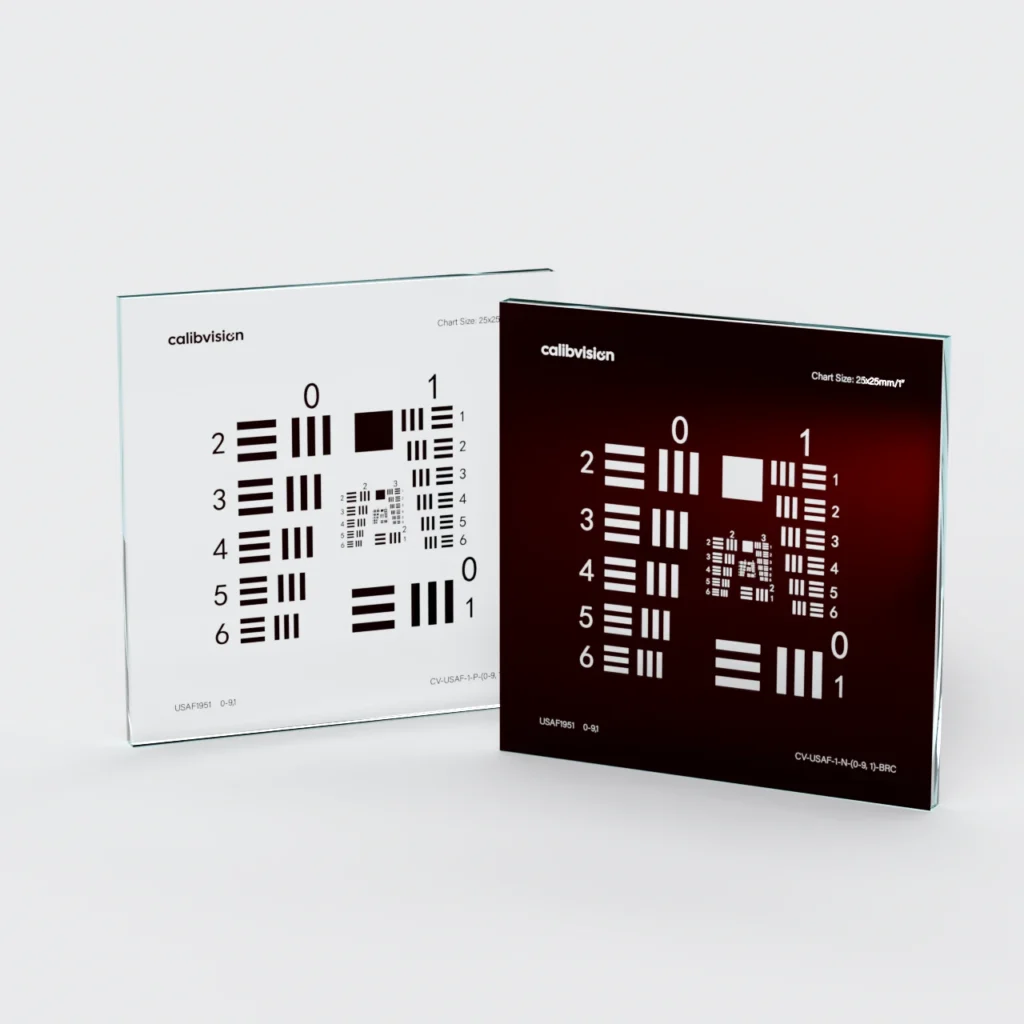
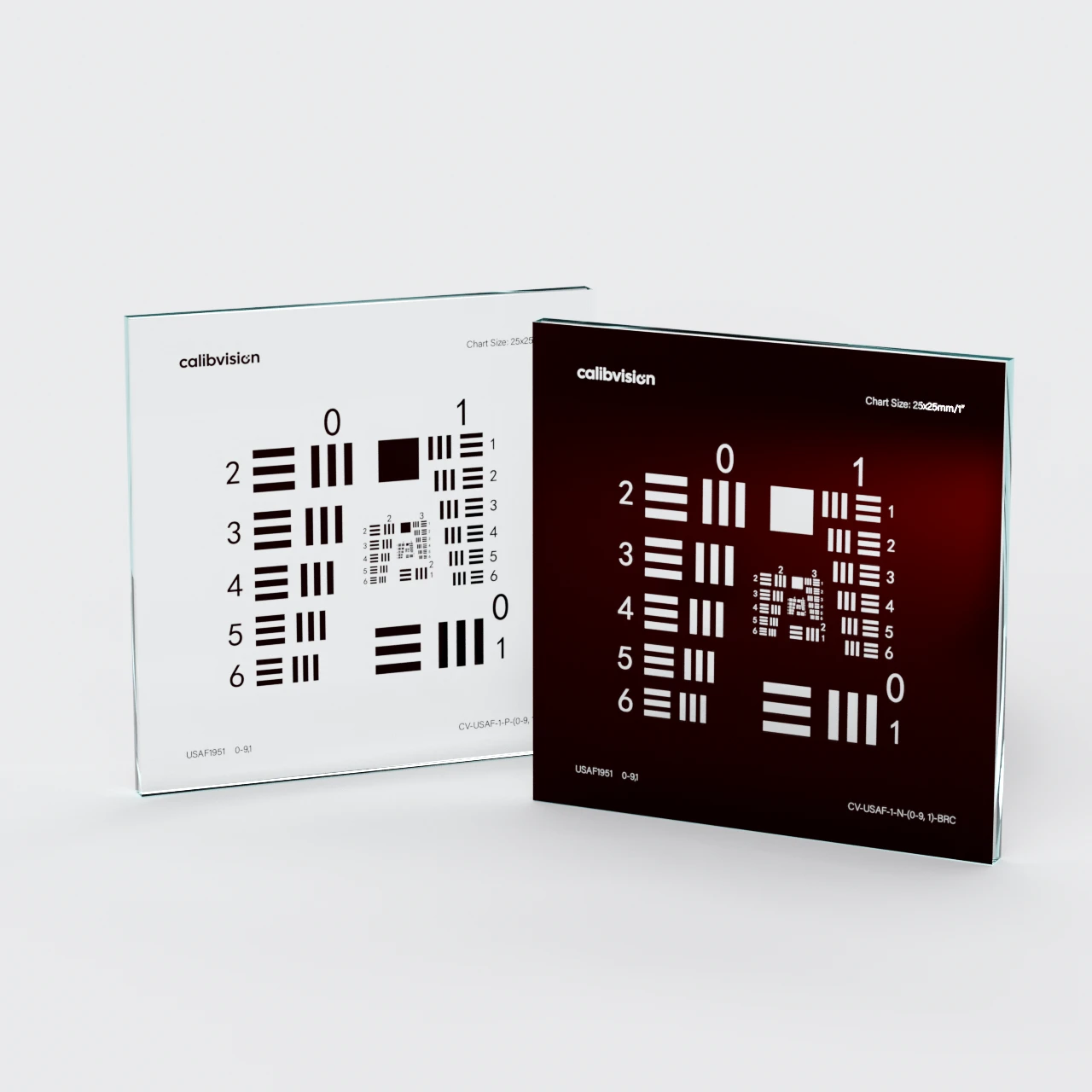
| CV-USAF-1-P-(0-9, 1)-BRC | Quartz Glass | Brown Chrome | 25x25mm/ 1" | Positive | 2.3mm | Group 0 Element 1 to Group 9 Element 1 | 512 |
| CV-USAF-1-N-(0-9, 1)-BRC | Quartz Glass | Brown Chrome | 25x25mm/ 1" | Negative | 2.3mm | Group 0 Element 1 to Group 9 Element 1 | 512 |
| CV-USAF-2-P-(0-9, 1)-BRC | Quartz Glass | Brown Chrome | 50x50mm/ 2" | Positive | 2.3mm | Group 0 Element 1 to Group 9 Element 1 | 512 |
| CV-USAF-2-N-(0-9, 1)-BRC | Quartz Glass | Brown Chrome | 50x50mm/ 2" | Negative | 2.3mm | Group 0 Element 1 to Group 9 Element 1 | 512 |
| CV-USAF-3-P-(0-9, 1)-BRC | Quartz Glass | Brown Chrome | 76x76mm/ 3" | Positive | 2.3mm | Group 0 Element 1 to Group 9 Element 1 | 512 |
| CV-USAF-3-N-(0-9, 1)-BRC | Quartz Glass | Brown Chrome | 76x76mm/ 3" | Negative | 2.3mm | Group 0 Element 1 to Group 9 Element 1 | 512 |
| CV-USAF-1-P-(0-9, 6)-BRC | Quartz Glass | Brown Chrome | 25x25mm/ 1" | Positive | 2.3mm | Group 0 Element 1 to Group 9 Element 6 | 912 |
| CV-USAF-1-N-(0-9, 6)-BRC | Quartz Glass | Brown Chrome | 25x25mm/ 1" | Negative | 2.3mm | Group 0 Element 1 to Group 9 Element 6 | 912 |
| CV-USAF-2-P-(0-9, 6)-BRC | Quartz Glass | Brown Chrome | 50x50mm/ 2" | Positive | 2.3mm | Group 0 Element 1 to Group 9 Element 6 | 912 |
| CV-USAF-2-N-(0-9, 6)-BRC | Quartz Glass | Brown Chrome | 50x50mm/ 2" | Negative | 2.3mm | Group 0 Element 1 to Group 9 Element 6 | 912 |
| CV-USAF-3-P-(0-9, 6)-BRC | Quartz Glass | Brown Chrome | 76x76mm/ 3" | Positive | 2.3mm | Group 0 Element 1 to Group 9 Element 6 | 912 |
| CV-USAF-3-N-(0-9, 6)-BRC | Quartz Glass | Brown Chrome | 76x76mm/ 3" | Negative | 2.3mm | Group 0 Element 1 to Group 9 Element 6 | 912 |
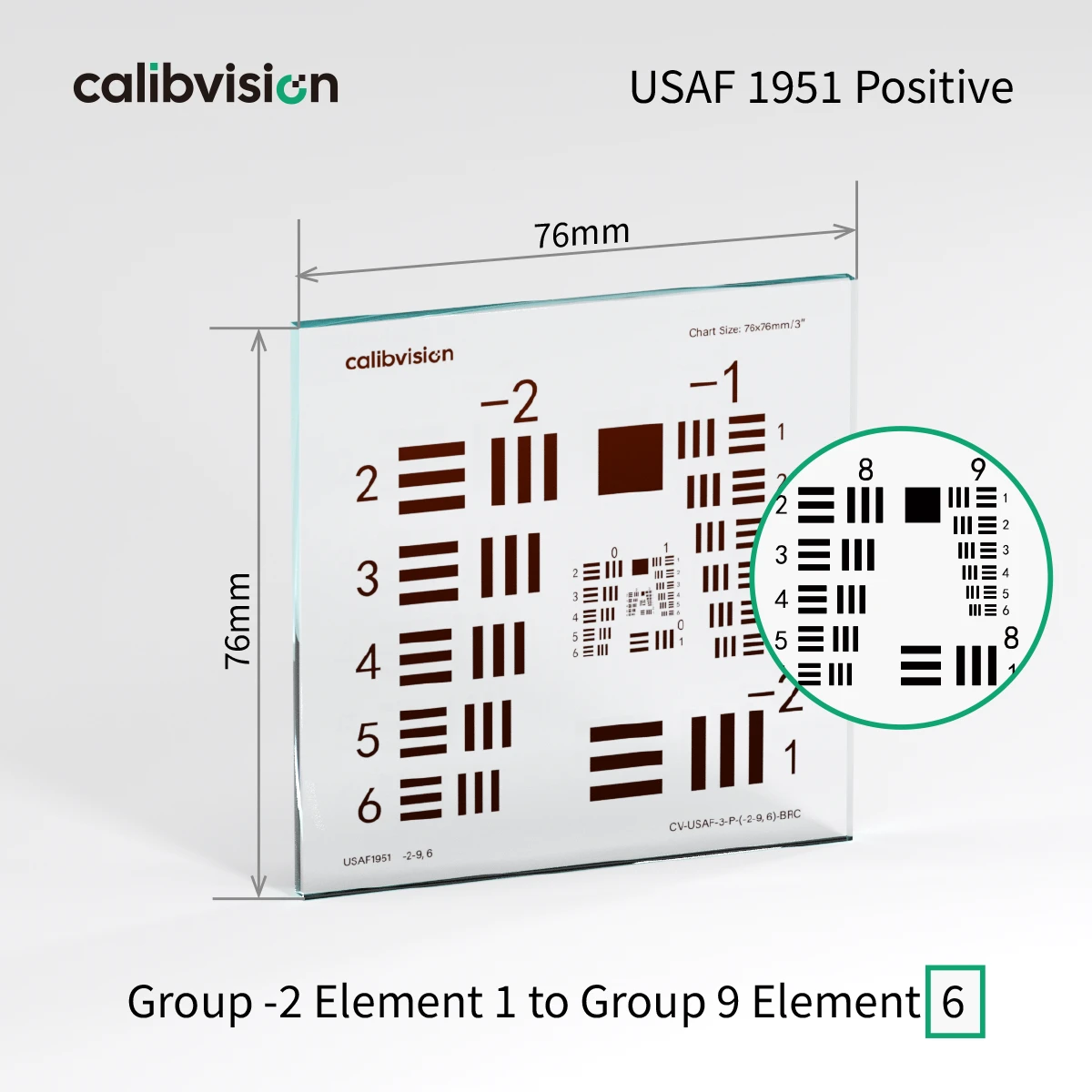
| CV-USAF-3-P-(-2-9, 1)-BRC | Quartz Glass | Brown Chrome | 76x76mm/ 3" | Positive | 2.3mm | Group -2 Element 1 to Group 9 Element 1 | 512 |
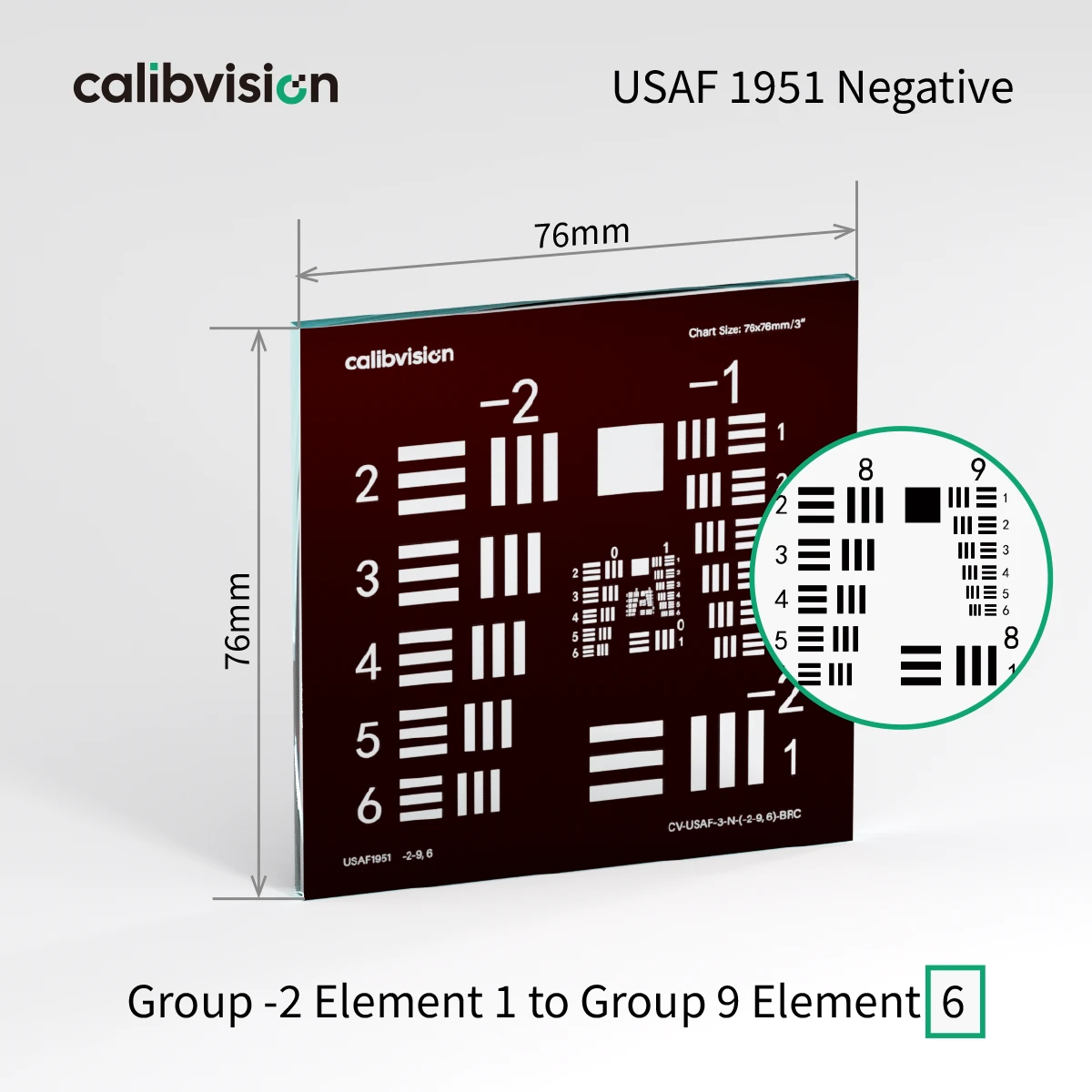
| CV-USAF-3-N-(-2-9, 1)-BRC | Quartz Glass | Brown Chrome | 76x76mm/ 3" | Negative | 2.3mm | Group -2 Element 1 to Group 9 Element 1 | 512 |
| CV-USAF-3-P-(-2-9, 6)-BRC | Quartz Glass | Brown Chrome | 76x76mm/ 3" | Positive | 2.3mm | Group -2 Element 1 to Group 9 Element 6 | 912 |
| CV-USAF-3-N-(-2-9, 6)-BRC | Quartz Glass | Brown Chrome | 76x76mm/ 3" | Negative | 2.3mm | Group -2 Element 1 to Group 9 Element 6 | 912 |
The USAF 1951 resolution test target is a standardized optical chart defined by U.S. Air Force MIL-STD-150A (1951) for measuring the limiting resolution of imaging systems. It contains three-bar patterns arranged in 12 groups (−2 to 9), each with 6 elements. Resolution in line pairs per millimeter (lp/mm) is calculated by 2 (Group + (Element − 1) / 6), ranging from 0.25 lp/mm at Group −2 Element 1 to 912.30 lp/mm at Group 9 Element 6.
| Parameter | Value Line (SG + BRC, Element 1) | Premium Line (QG + BLC, Element 6) |
|---|---|---|
| Resolution Range | up to 512 lp/mm | up to 912.30 lp/mm |
| Substrate Material | Soda Lime Glass | Quartz Glass (Fused Silica) |
| Coating | Brown Chrome | Blue Chrome (Anti-glare) |
| Thickness (1") | 1.6 mm | 1.6 mm |
| Thickness (2"/3") | 2.3 mm | 2.3 mm |
| Thickness Tolerance | ±0.1 mm | ±0.1 mm |
| Dimensional Tolerance | ±0.5 mm | ±0.5 mm |
| Line Width Tolerance | ±50 nm | ±20 nm |
| Surface Flatness | ±3 μm | ±1 μm |
| Coating Optical Density | ≥ OD3 | ≥ OD3 |
| Coating Thickness | 100 nm | 120 nm |
| Surface Finish (Scratch-Dig) | 60/40 | 40/20 |
| Surface Reflectance (Visible) | < 5% | < 2% |
| UV Transmission (200–400 nm) | Limited | Good (>90%) |
| Thermal Expansion (×10⁻⁶/°C) | 9 | 0.55 |
| Working Temperature | −20 to +80°C | −60 to +250°C |
| Standard Compliance | MIL-STD-150A | MIL-STD-150A |
| Calibration Option | NIM-traceable third-party (extra fee) | NIM-traceable third-party (extra fee) |
Industry reference table for converting USAF 1951 (Group, Element) coordinates to resolution in line pairs per millimeter. Calculated by the standard formula: lp/mm = 2^(Group + (Element − 1) / 6).
| Element \ Group | −2 | −1 | 0 | 1 | 2 | 3 | 4 | 5 | 6 | 7 | 8 | 9 |
|---|---|---|---|---|---|---|---|---|---|---|---|---|
| 1 | 0.25 | 0.5 | 1 | 2 | 4 | 8 | 16 | 32 | 64 | 128 | 256 | 512 |
| 2 | 0.281 | 0.561 | 1.12 | 2.24 | 4.49 | 8.98 | 17.96 | 35.9 | 71.8 | 143.7 | 287.4 | 574.7 |
| 3 | 0.315 | 0.63 | 1.26 | 2.52 | 5.04 | 10.08 | 20.16 | 40.3 | 80.6 | 161.3 | 322.5 | 645.1 |
| 4 | 0.354 | 0.707 | 1.41 | 2.83 | 5.66 | 11.31 | 22.63 | 45.3 | 90.5 | 181 | 362 | 724.1 |
| 5 | 0.397 | 0.794 | 1.59 | 3.17 | 6.35 | 12.7 | 25.4 | 50.8 | 101.6 | 203.2 | 406.4 | 812.7 |
| 6 | 0.445 | 0.891 | 1.78 | 3.56 | 7.13 | 14.25 | 28.51 | 57 | 114 | 228.1 | 456.1 | 912.3 |
| Element \ Group | −2 | −1 | 0 | 1 | 2 | 3 | 4 | 5 | 6 | 7 | 8 | 9 |
|---|---|---|---|---|---|---|---|---|---|---|---|---|
| 1 | 2000 | 1000 | 500 | 250 | 125 | 62.5 | 31.25 | 15.63 | 7.81 | 3.91 | 1.95 | 0.98 |
| 2 | 1781.8 | 890.9 | 445.45 | 222.72 | 111.36 | 55.68 | 27.84 | 13.92 | 6.96 | 3.48 | 1.74 | 0.87 |
| 3 | 1587.4 | 793.7 | 396.85 | 198.43 | 99.21 | 49.61 | 24.8 | 12.4 | 6.2 | 3.1 | 1.55 | 0.78 |
| 4 | 1414.21 | 707.11 | 353.55 | 176.78 | 88.39 | 44.19 | 22.1 | 11.05 | 5.52 | 2.76 | 1.38 | 0.69 |
| 5 | 1259.92 | 629.96 | 314.98 | 157.49 | 78.75 | 39.37 | 19.69 | 9.84 | 4.92 | 2.46 | 1.23 | 0.62 |
| 6 | 1122.46 | 561.23 | 280.62 | 140.31 | 70.15 | 35.08 | 17.54 | 8.77 | 4.38 | 2.19 | 1.1 | 0.55 |
| Group | Element 1 (lp/mm) | Element 6 (lp/mm) | Use Case |
|---|---|---|---|
| −2 | 0.25 | 0.45 | Ultra-wide-field optics, telephoto lenses |
| −1 | 0.5 | 0.89 | Low-frequency testing of standard lenses |
| 0 | 1 | 1.78 | Entry-level resolution checks |
| 1 | 2 | 3.56 | General industrial lenses |
| 2 | 4 | 7.13 | Consumer camera lenses |
| 3 | 8 | 14.25 | High-end camera lenses |
| 4 | 16 | 28.51 | Microscope objectives (low magnification) |
| 5 | 32 | 57.02 | Microscope objectives (medium magnification) |
| 6 | 64 | 114.04 | Microscope objectives (high magnification) |
| 7 | 128 | 228.07 | Microscope objectives (oil immersion) |
| 8 | 256 | 456.14 | Semiconductor inspection, ultra-high resolution |
| 9 | 512 | 912.3 | Diffraction-limit resolution, AR/VR micro-lenses |
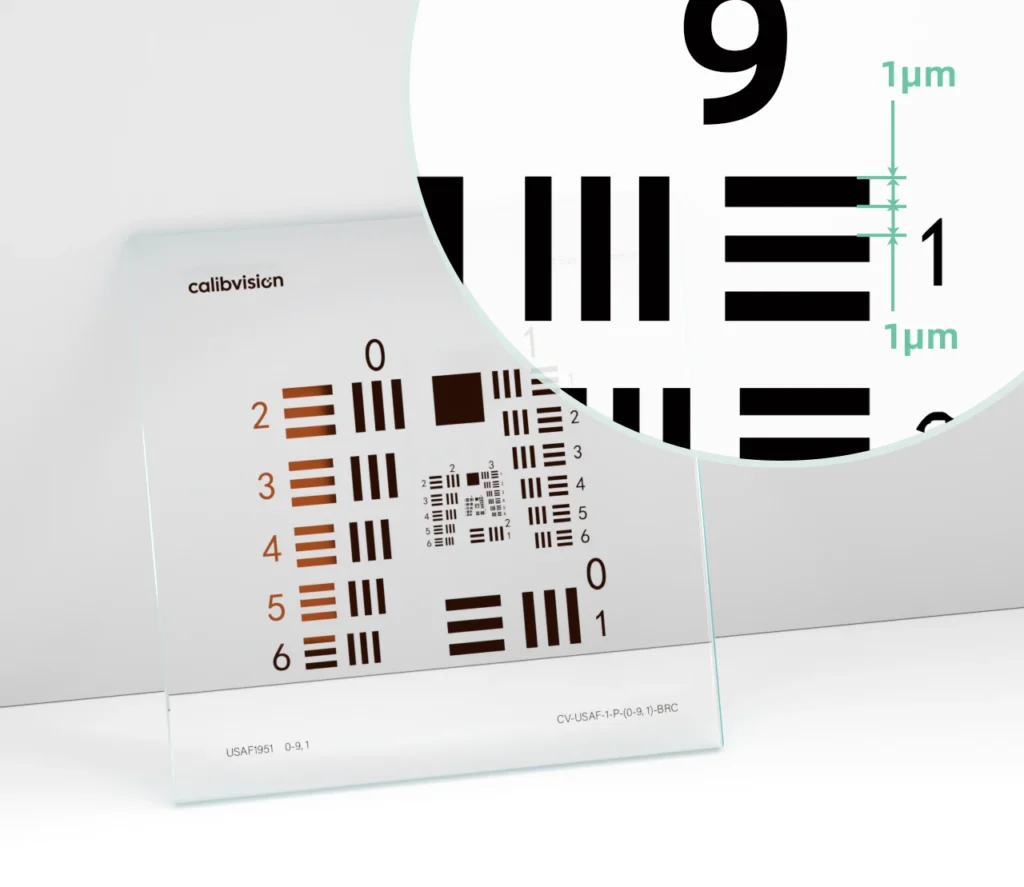
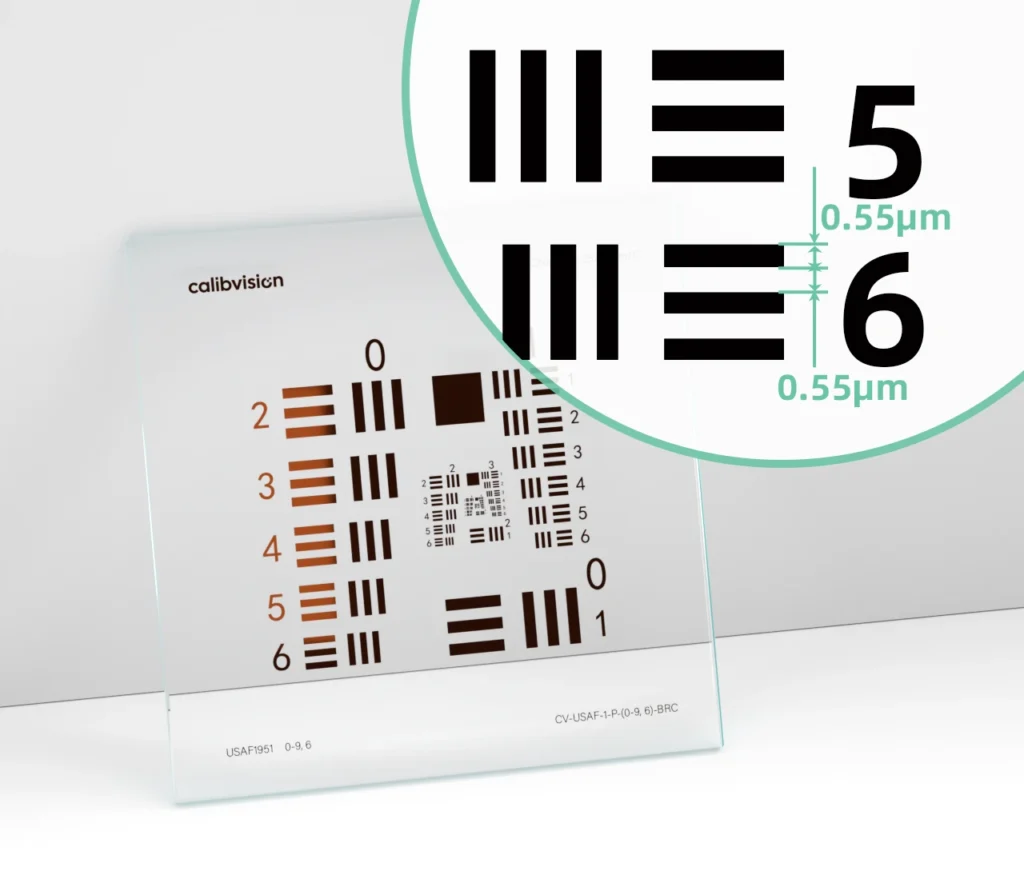
Note: Custom patterns available down to 0.1 µm for semiconductor wafer calibration.
| Property | Positive Pattern | Negative Pattern |
|---|---|---|
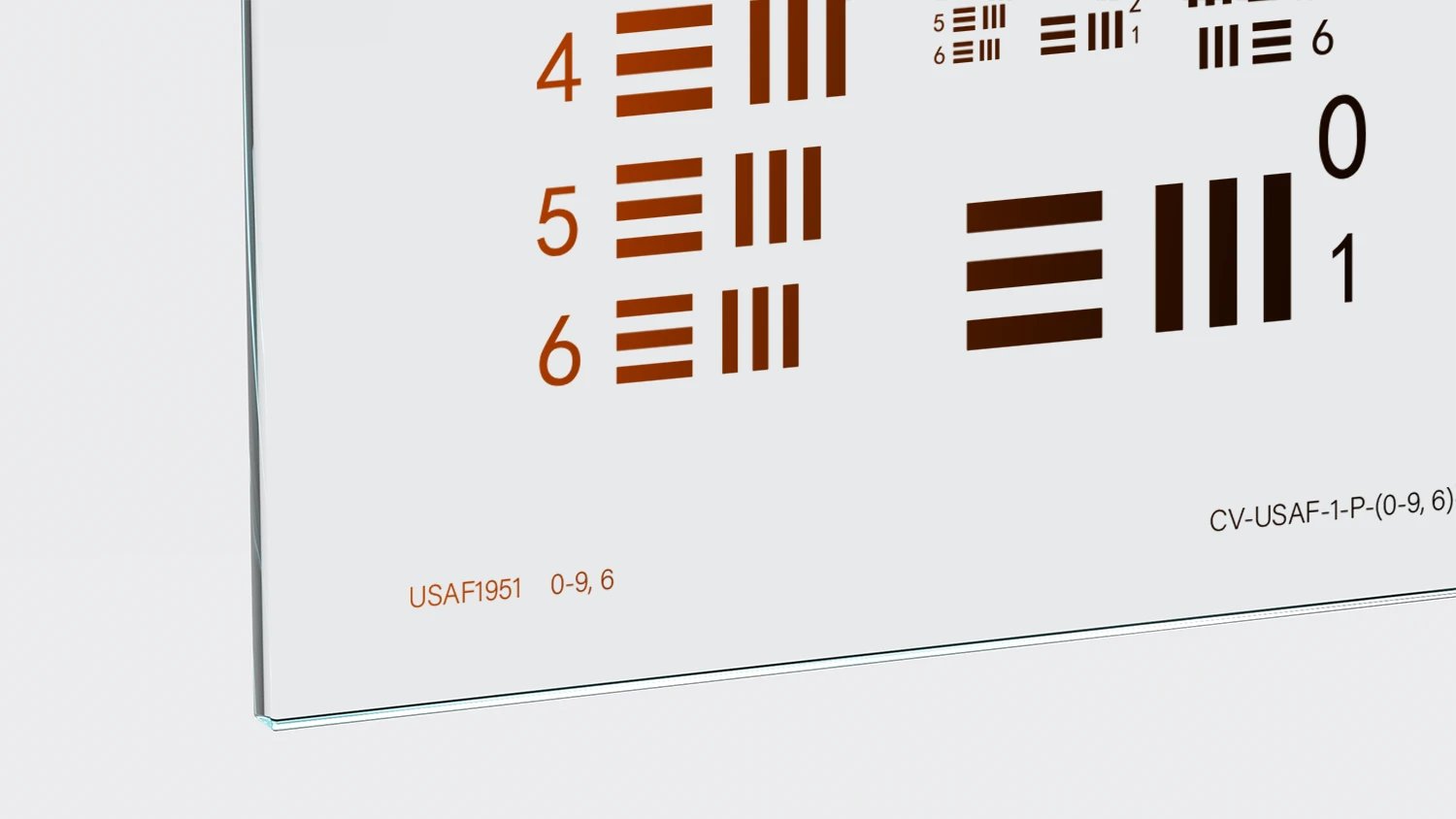
|
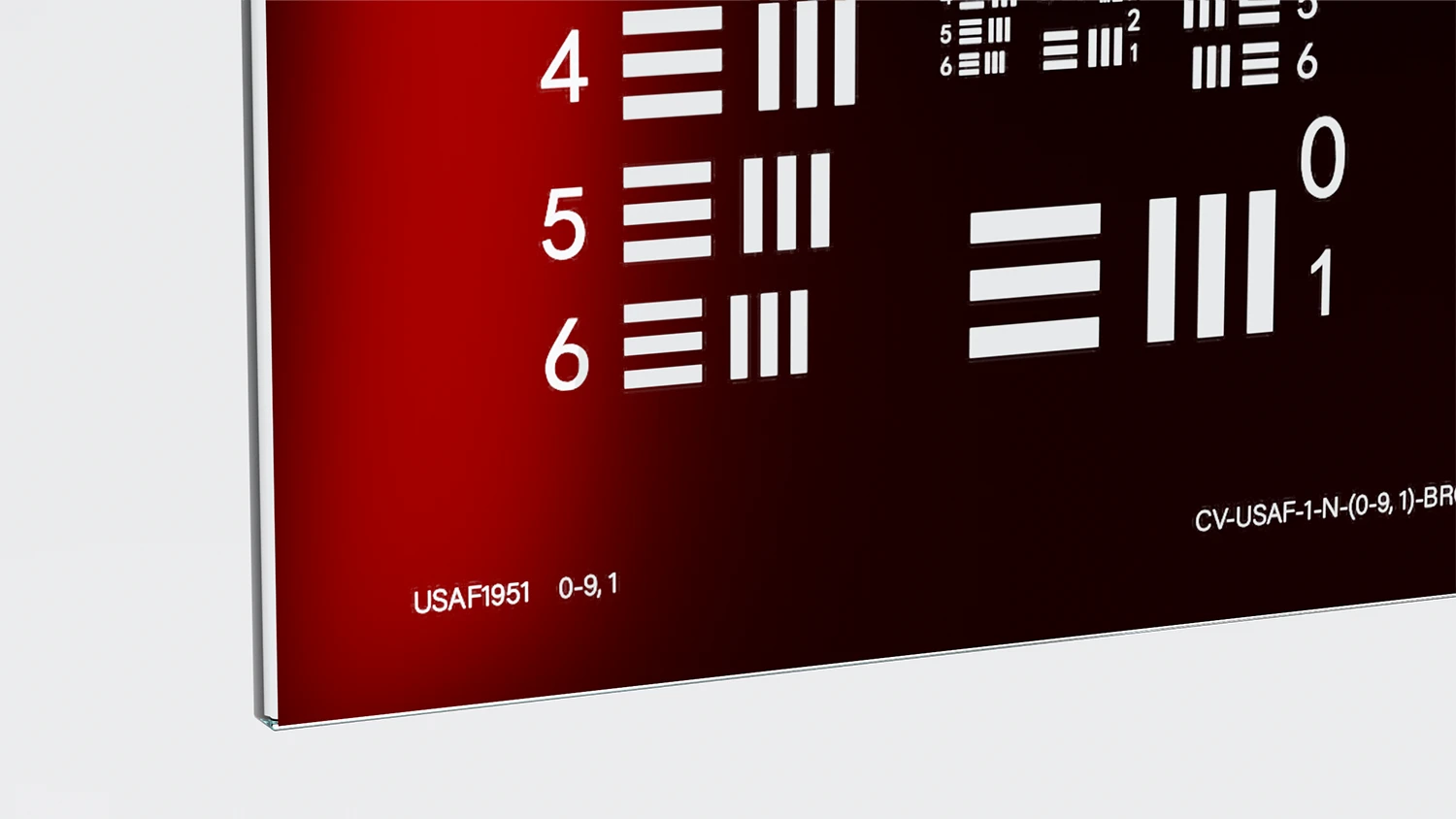
| |
| Pattern (dark) | Chrome (opaque) | Clear (substrate) |
| Background (light) | Clear (substrate) | Chrome (opaque) |
| Best For | Transmission mode with bright field illumination | Transmission mode with dark field illumination |
| Microscope Use | Standard brightfield microscopy | Phase contrast / DIC microscopy |
| Camera Lens MTF | Most common choice | Specialty applications |
| Reflective Setup | Pattern appears dark on bright ceramic | Pattern appears bright on dark chrome |
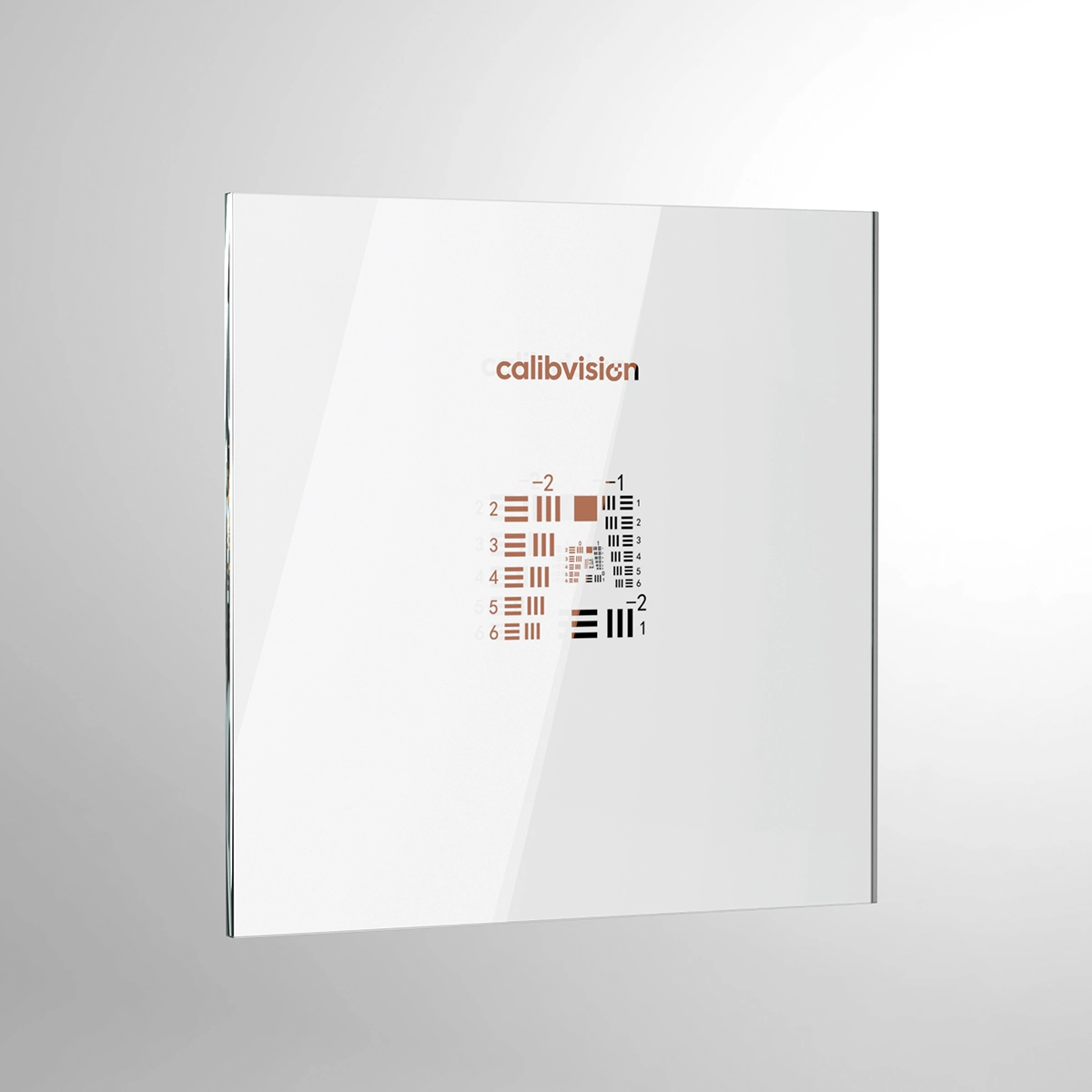
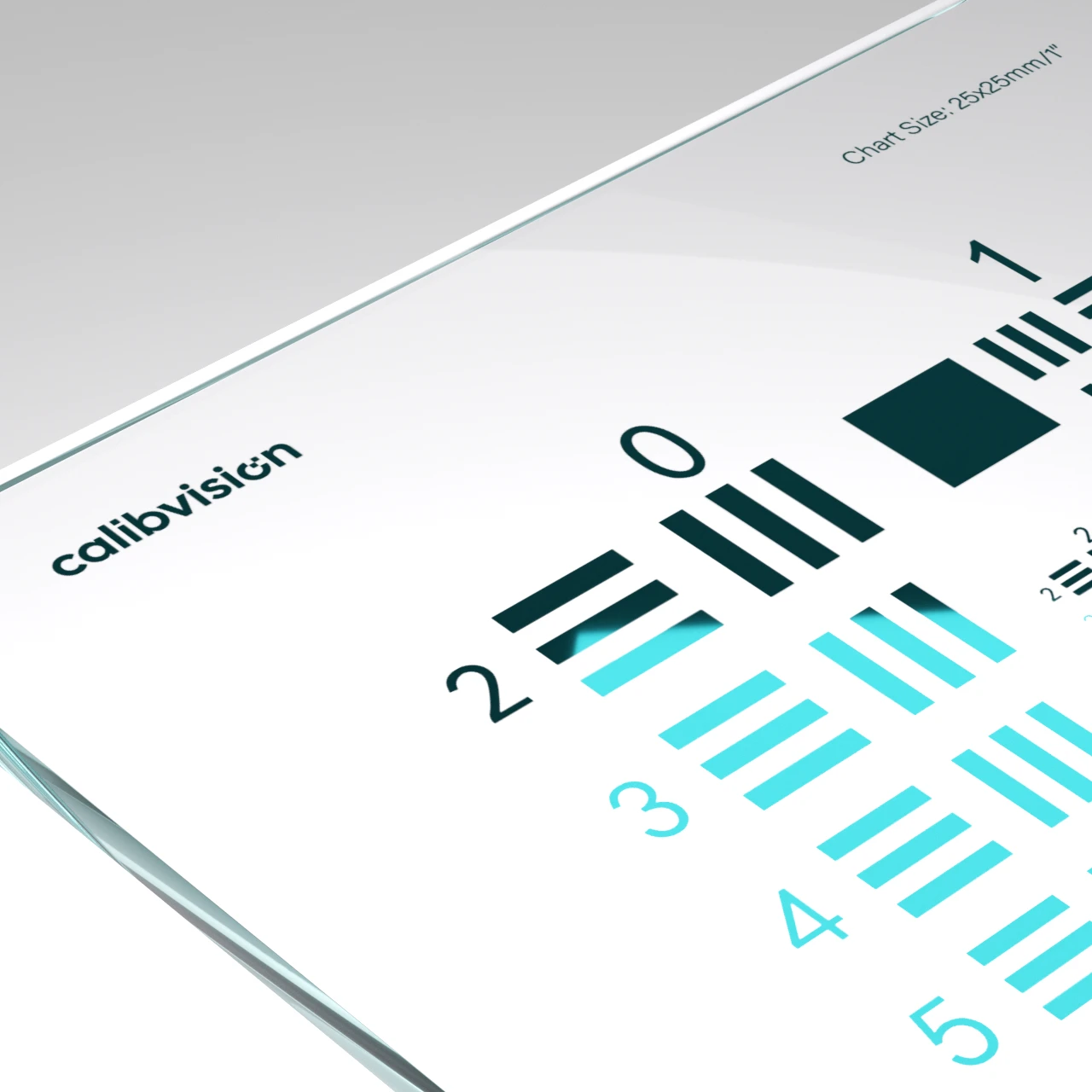
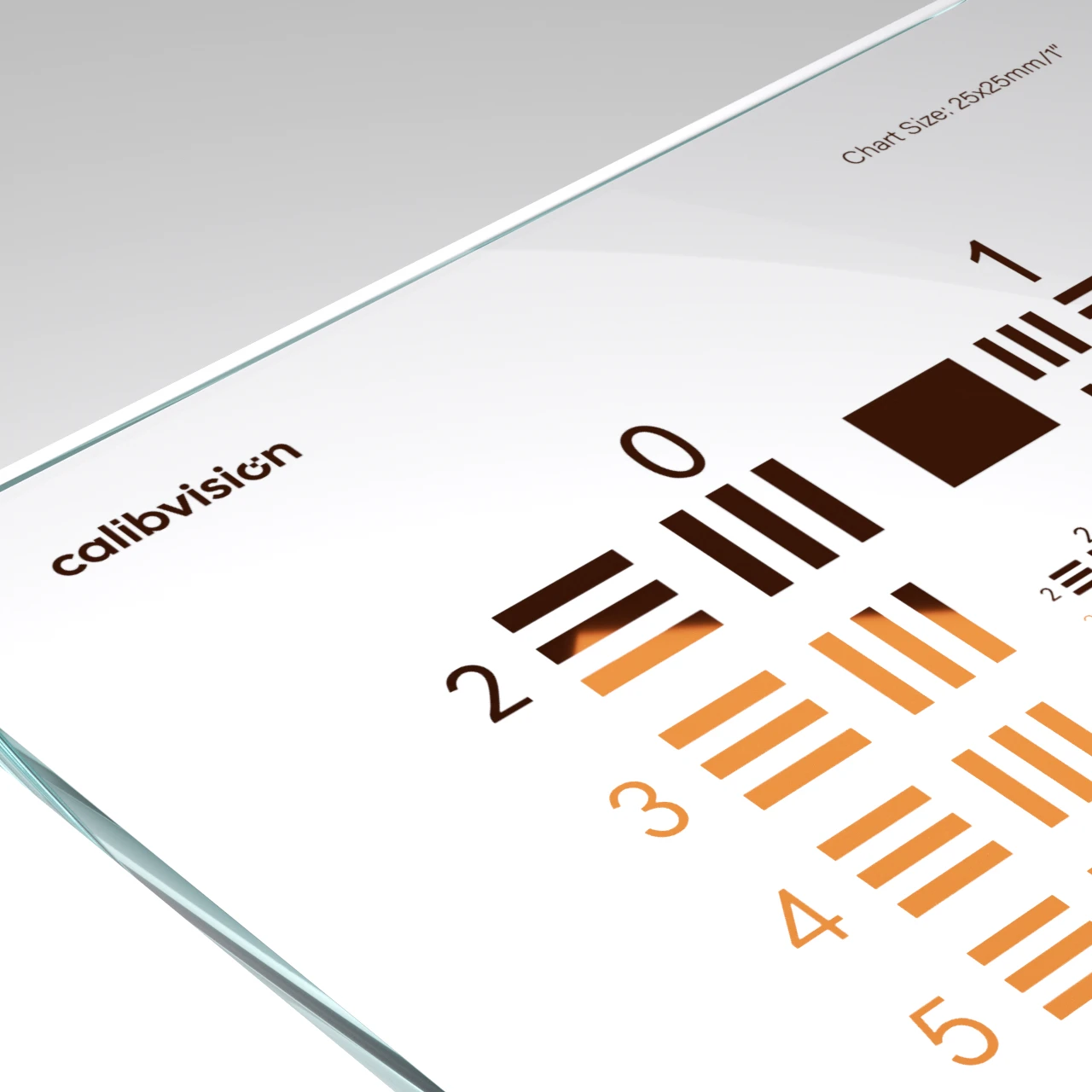
Blue Chrome features a flatter, lower reflectance (anti-glare) across 400–700 nm, making it useful for high-contrast SFR / MTF setups or reflected-light measurements where glare must be minimized.
| Property | Blue Chrome (BLC) | Brown Chrome (BRC) |
|---|---|---|
|
| |
| Coating Color | Dark blue-gray | Dark brown |
| Background (light) | Clear (substrate) | Chrome (opaque) |
| Best For | Transmission mode with bright field illumination | Transmission mode with dark field illumination |
| Microscope Use | Standard brightfield microscopy | Phase contrast / DIC microscopy |
| Camera Lens MTF | Most common choice | Specialty applications |
| Reflective Setup | Pattern appears dark on bright ceramic | Pattern appears bright on dark chrome |
Calibvision USAF 1951 targets ship with Brown Chrome by default. If your application requires Blue Chrome, please contact us — we’ll prepare it to your specification.
Industry-leading standard resolution, with custom down to 0.1 µm
Validation, fluorescence microscope calibration
Line-scan and area-scan resolution qualification
Waveguide and microdisplay resolution measurement
Undergraduate optics teaching (Value), photonics research
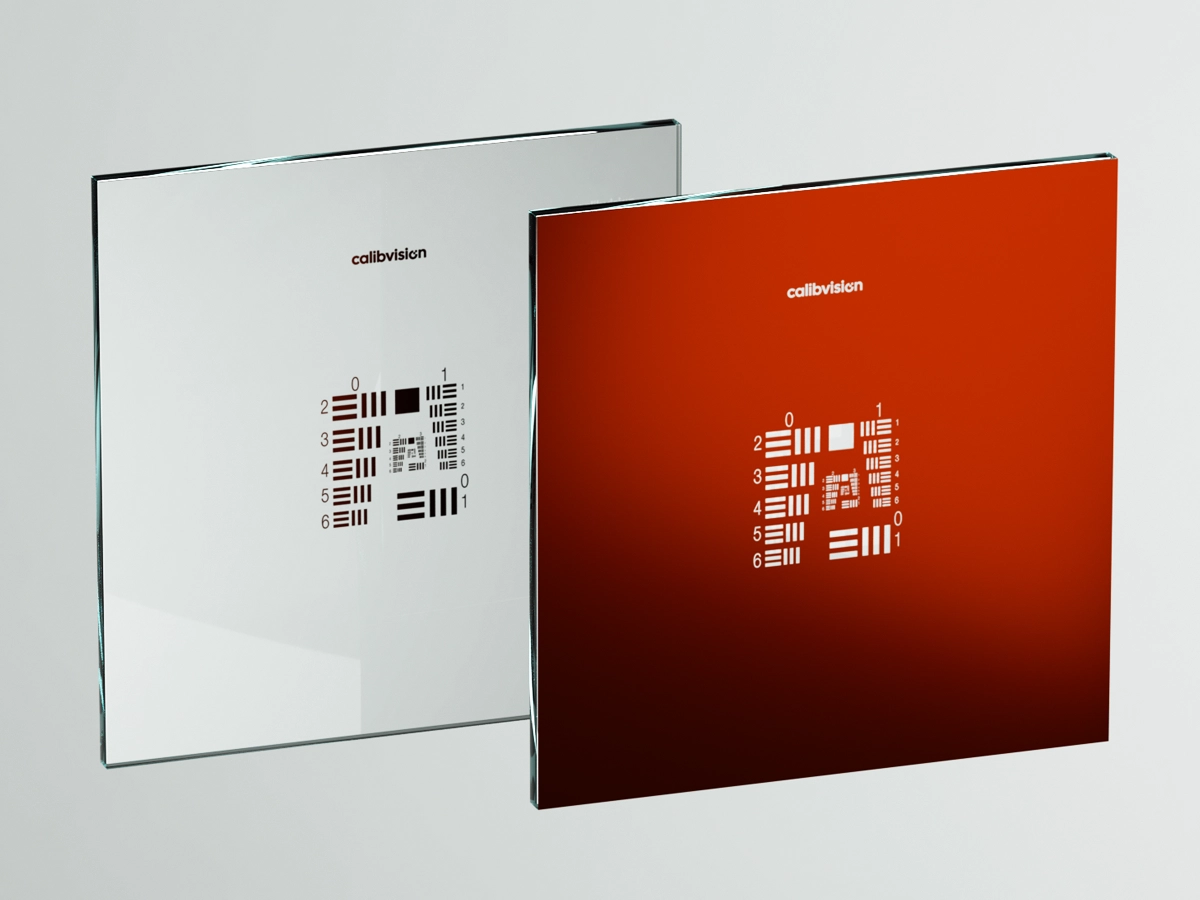
A Positive target has chrome (opaque) patterns on a clear (transmissive) substrate — bars appear dark against bright background in transmission. A Negative target has clear patterns cut into a chrome background — bars appear bright against a dark background. Choose Positive for standard brightfield microscopy and lens MTF testing; choose Negative for darkfield, phase contrast, DIC microscopy, or collimator alignment.
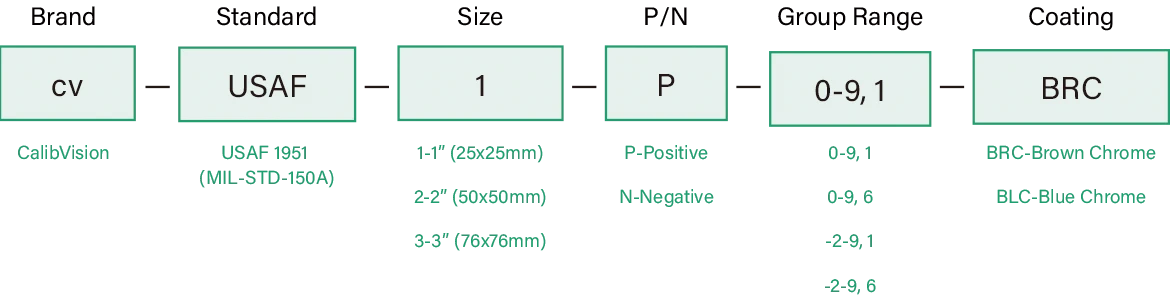
The first number is the Group range — the chart covers Groups 0 through 9. The second number is the maximum Element included at the highest group: 1 means the chart stops at Group 9 Element 1 (~512 lp/mm), while 6 extends to Group 9 Element 6 (~912.30 lp/mm). Choose the “6” variant for high-resolution optics (microscope objectives ≥40×, semiconductor inspection, AR/VR).
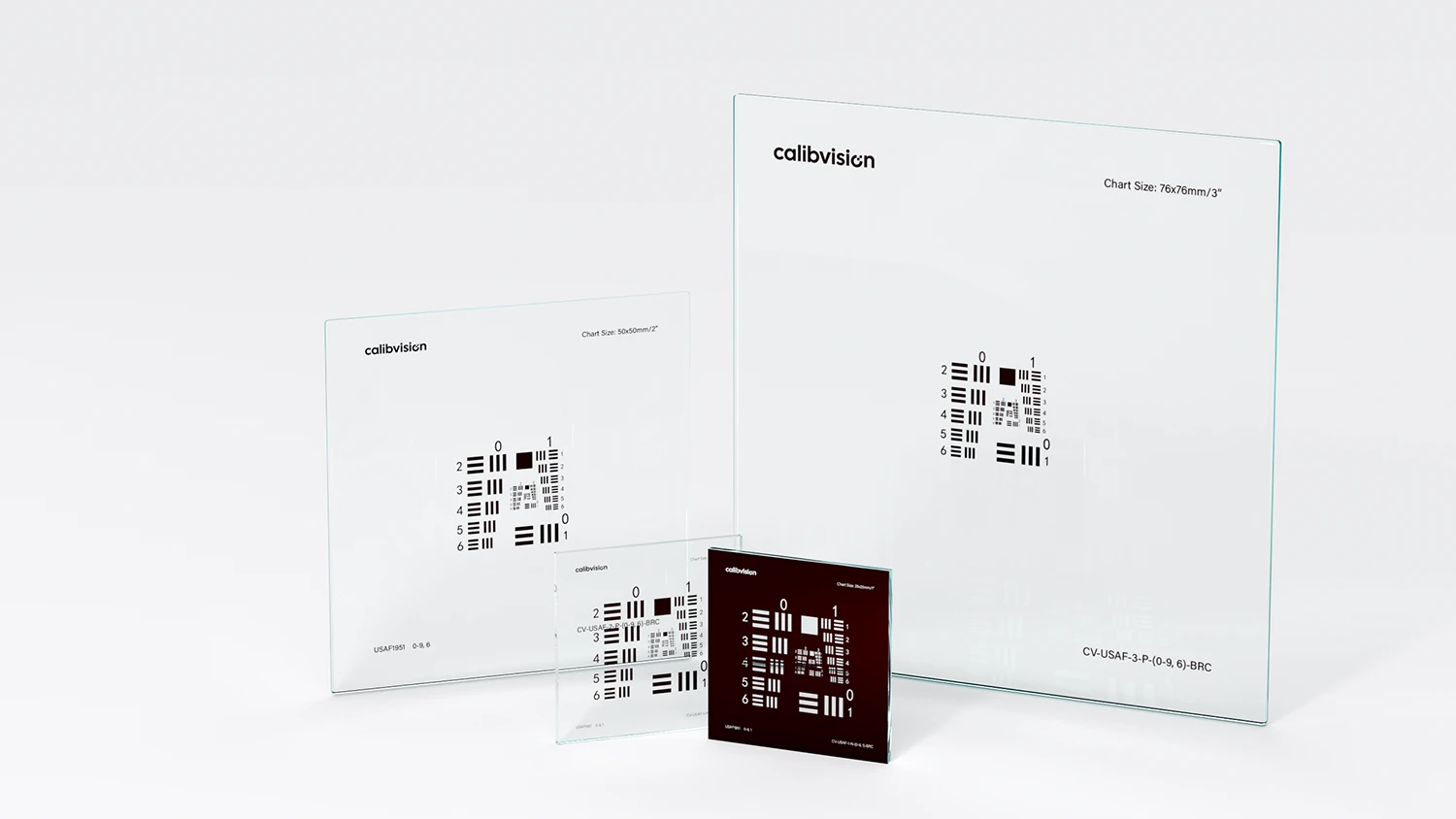
The 3″ (76×76 mm) targets have physical room to include Groups −2 and −1 (0.25 to 0.89 lp/mm) in addition to standard Group 0–9. This is essential for wide-field optical systems, large-format lenses, telescope objectives, and short working distances. A single 3″ chart covers 0.25 to 912.30 lp/mm — a 3,650× resolution range.
Stored flat in the supplied optical case, away from UV (for Soda Lime variants), at 20–25°C and 30–50% RH, Quartz Glass targets remain accurate for 10+ years with no measurable drift. Soda Lime Glass targets last 5–10 years. Recalibration is recommended every 3 years for ISO 17025 accredited labs; for general production, every 5 years or when chrome shows visible scratches.
Please fill out the form below or email us directly to sales@calibvision.com, our sales engineers will review your request and get back to you within 3 working days(typically faster).