
LiDAR Calibration Guide: How to Use Diffuse Reflectance Standards for Automotive Testing
Last Updated: January 2025 | Reading Time: 15 minutes Introduction A Tesla Model S traveling at 120 km/h on the highway relies on its LiDAR sensor to detect a stopped vehicle 200 meters ahead. The sensor must accurately measure both distance (is the obstacle 200m or 205m away?) and reflectance (is it a dark-painted car […]
Understanding Lambertian Reflectance: The Science Behind Diffuse Reflectance Standards
Last Updated: January 2025 | Reading Time: 12 minutes Introduction When you shine a flashlight at a mirror, the reflected beam bounces back at a precise angle—miss that angle by a degree, and you see nothing. Point the same flashlight at a white wall, and it illuminates the entire room regardless of where you stand. […]
Diffuse Reflectance Standards: The Complete Guide to LiDAR Calibration Targets (2026)

Last Updated: January 2025 | Reading Time: 18 minutes 1. Introduction Autonomous vehicles navigate highways at 120 km/h, relying on LiDAR sensors to detect objects 200 meters ahead. Industrial robots manipulate components with sub-millimeter precision using optical ranging systems. What makes these technologies reliable? The answer lies in a critical but often overlooked calibration tool: […]
How to Choose and Customize a ChArUco Calibration Board for Professional Camera Calibration
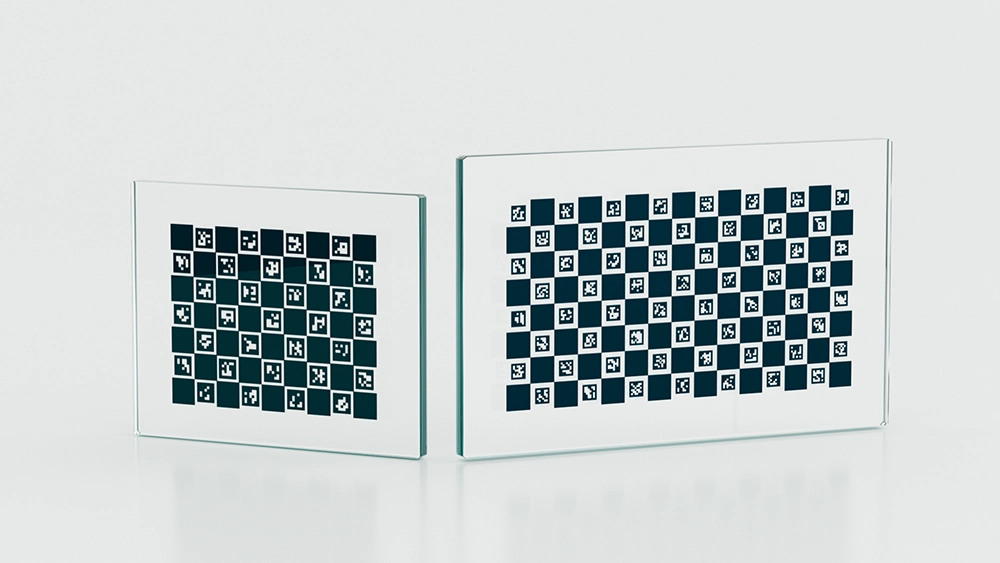
Discover ChArUco calibration boards for professional camera calibration. Custom-made glass, ceramic, and film targets with ±0.3 µm precision.
ChArUco Camera Calibration Boards: Complete Guide & Best Practices for 2025
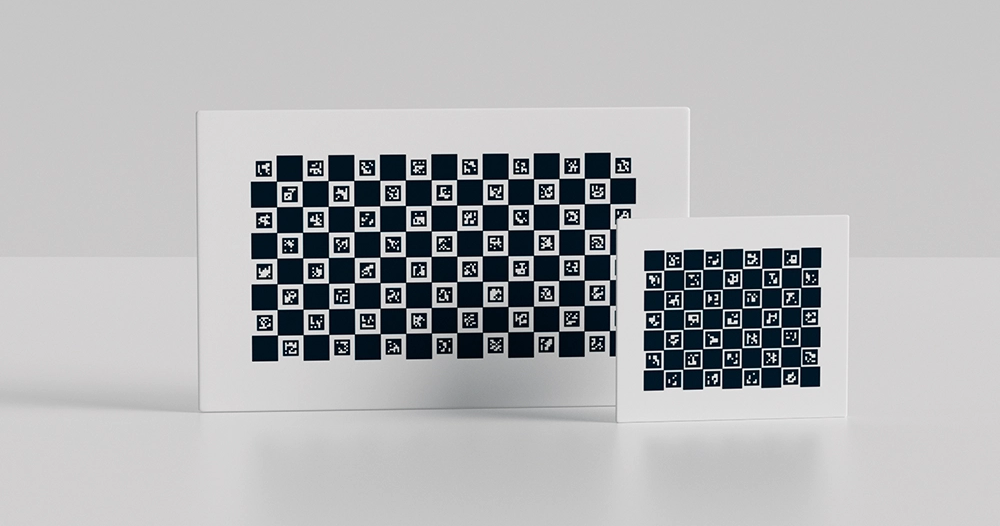
hArUco calibration boards combine checkerboard precision with ArUco marker identification to revolutionize camera calibration workflows. This comprehensive guide demonstrates how ChArUco technology achieves 100% detection success rates versus 92% for traditional checkerboards, reduces calibration time by 48%, and requires 50% fewer images while delivering superior accuracy. Learn optimal configurations for robotics, industrial inspection, AR/VR, and medical imaging applications. Includes detailed specifications, step-by-step calibration tutorials for OpenCV and MATLAB, performance comparisons, common mistake prevention, and ROI calculations proving 30× return on investment. Whether calibrating fisheye lenses, multi-camera arrays, or precision metrology systems, discover why ChArUco has become the industry standard for professional camera calibration in 2025.
Chapter 3: Calibration Patterns|Understanding Calibration Patterns: The Foundation of Accurate Camera Calibration
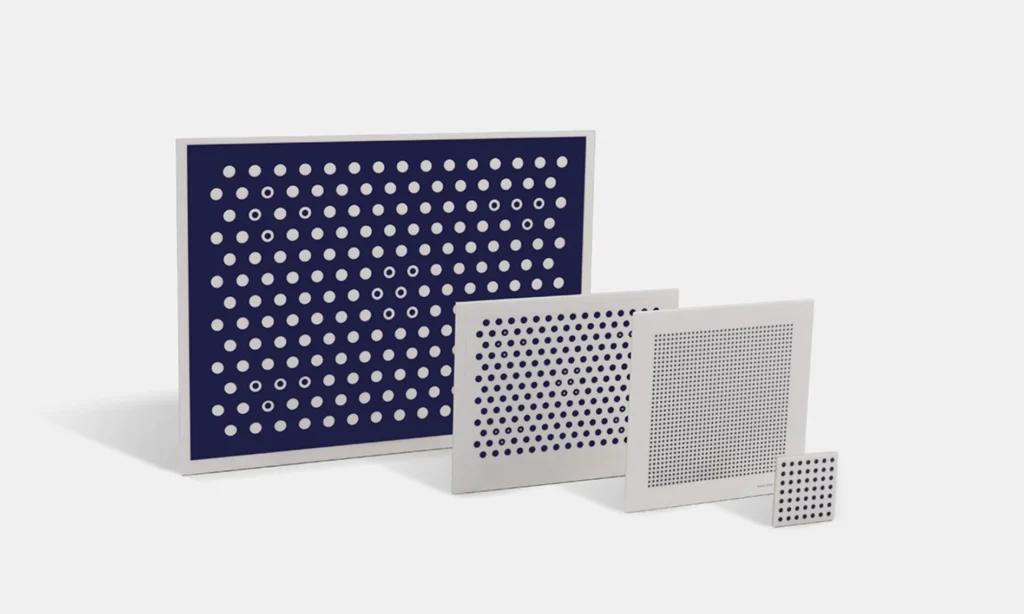
What is Calibration Pattern? Calibration patterns serve as the bridge between the physical world and digital camera measurements. These precisely manufactured targets provide known reference points that enable calibration algorithms to calculate camera parameters with high accuracy. Selecting the right pattern directly impacts calibration quality, affecting everything from distortion correction to 3D reconstruction precision. Types […]
Camera Calibration Targets: The Complete Guide to Precision Calibration Boards (2026)
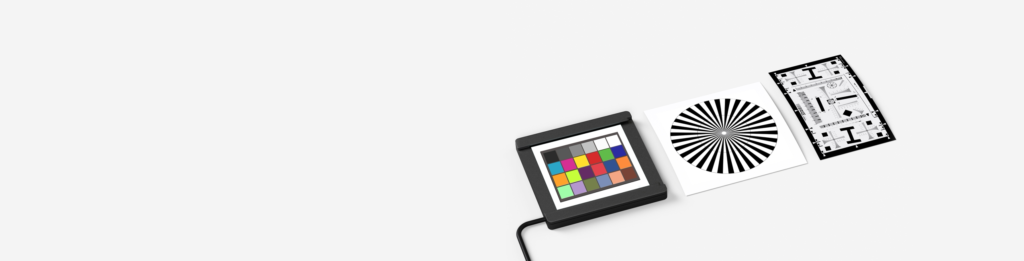
Last Updated: October 2025 | Reading Time: 22 minutes | Expert Guide by CalibVision What is a Camera Calibration Target? Quick Definition Camera Calibration Target: A precision-manufactured plate featuring accurately positioned patterns (checkerboard, dots, circles, or coded markers) printed on rigid substrates like glass or ceramic. These targets enable machine vision cameras to correct lens […]
What is a Halcon Calibration Target?
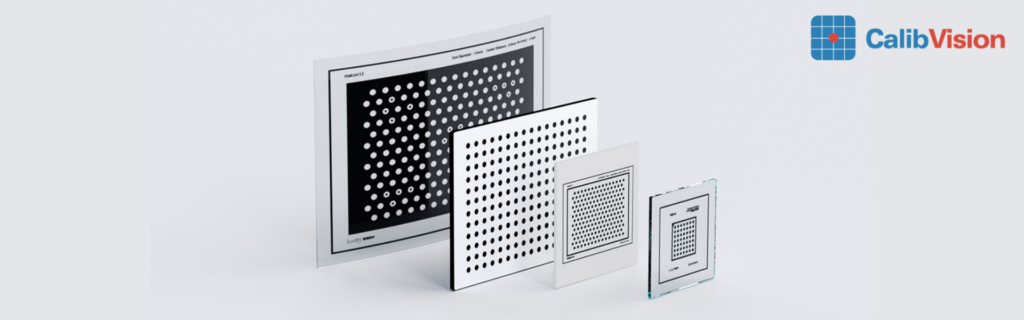
Halcon calibration targets are precisely manufactured physical objects with known geometric properties that serve as reference patterns for camera and machine vision system calibration. These specialized targets enable Halcon software to determine critical camera parameters including focal length, lens distortion, and spatial positioning, transforming standard cameras into accurate measurement instruments.
The calibration process involves capturing multiple images of the target from various angles and positions, allowing Halcon’s algorithms to analyze the known patterns and calculate precise camera parameters. Common target types include circular dot arrays, checkerboard patterns, and hexagonal arrangements, with customization options available through Halcon’s create_caltab operator.
These targets are essential for applications requiring high-precision measurements, including quality control inspection, robot guidance, 3D scanning, and dimensional analysis. By providing sub-pixel accuracy and correcting lens distortion effects, Halcon calibration targets enable reliable and consistent results across different operational conditions.
The proper selection and implementation of calibration targets significantly impact system performance, with factors such as working distance, accuracy requirements, environmental conditions, and target material playing crucial roles in achieving optimal calibration results. Professional implementation typically involves capturing 10-20 calibration images with the target filling approximately one-third to two-thirds of the camera’s field of view for maximum effectiveness.