
The Best Calibration Targets and Test Charts: A Complete Comparison by Use
A comparison of the most widely used calibration targets and test charts, organised by what they measure rather than lumped together. Geometric targets — checkerboard, ChArUco, dot grid, AprilGrid — solve camera geometry and distortion; resolution and image-quality charts — USAF 1951, ISO 12233, ISO 15739 — measure sharpness, resolution and noise. Definitions, applications, the software each pairs with, and where to buy.
Symmetric vs Asymmetric Circle Grids for Camera Calibration
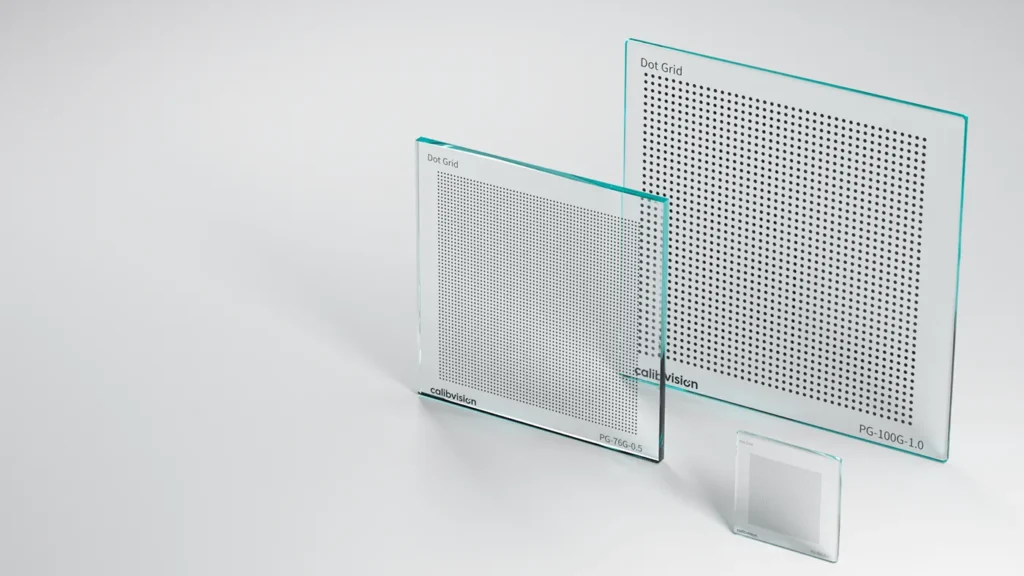
Circle grids are the third common OpenCV calibration pattern, in two layouts. The asymmetric (staggered) grid removes the 180° orientation ambiguity of the symmetric grid and packs more points, which is why it is the recommended layout. How findCirclesGrid counts patternSize for each (the (4,11) gotcha), why circle centroids carry a perspective bias, blob-detector tuning, and how substrate sets the accuracy ceiling.
HALCON Calibration Plate: CALTAB Dot-Mark Targets, Geometry, and Description Files
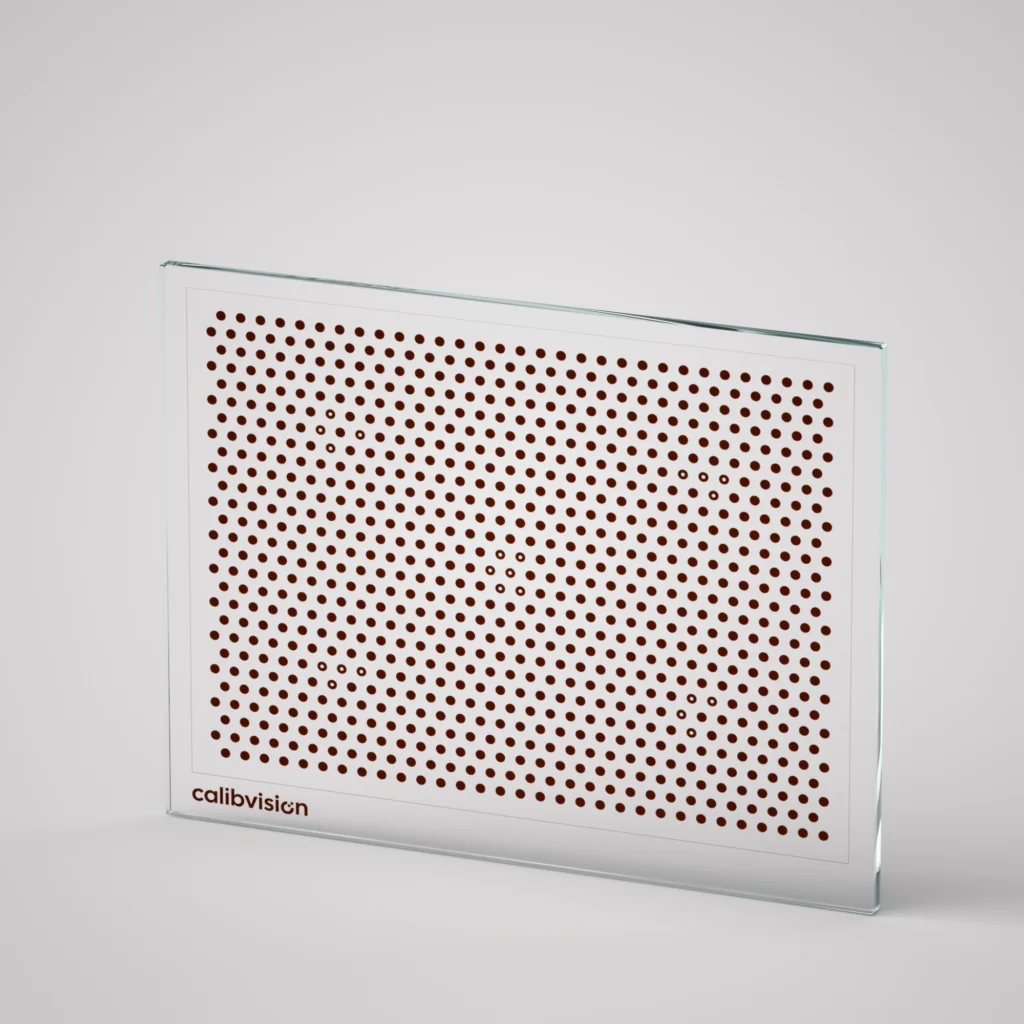
HALCON calibrates from a plate of circular marks, not a checkerboard. The plate geometry is defined by a description file, the marks are fit as ellipses with perspective-bias correction, and a finder pattern fixes the origin. How the CALTAB workflow works, classic fully-visible versus newer partial-view plates, why a third-party plate needs a matching description file, substrate and accuracy from ±0.5 µm, and the VME-series models.
Camera Calibration Pattern Types: Checkerboard, ChArUco, Dot Grid, and AprilGrid Compared
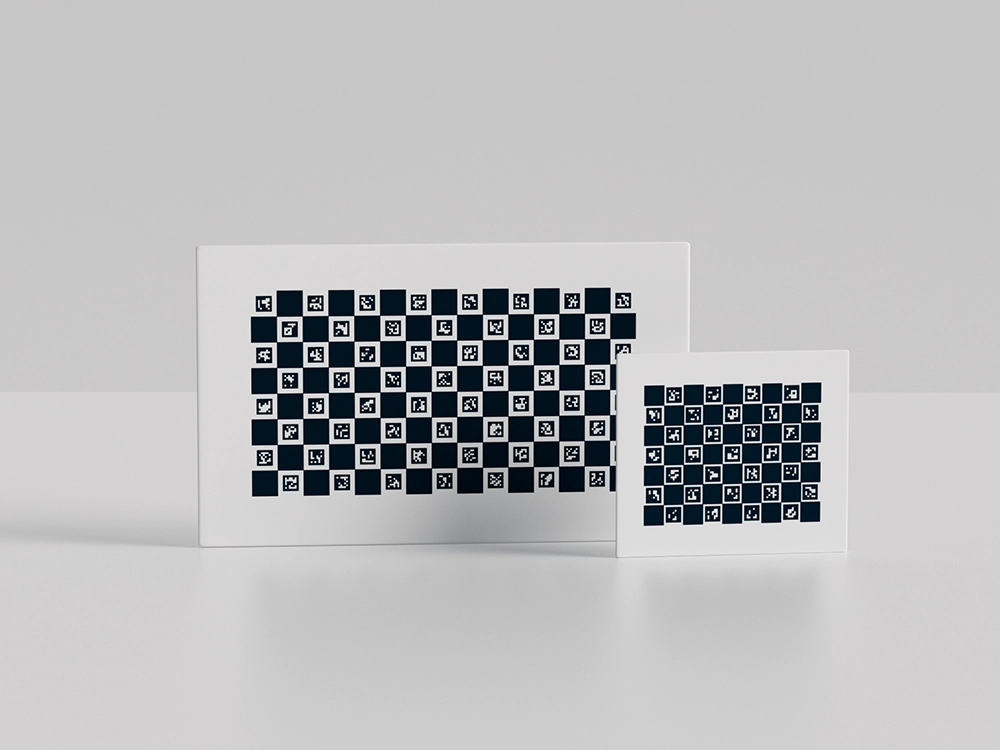
A calibration pattern gives a camera a field of reference points with known geometry. The families differ in feature type (corner, centroid, coded marker), whether points are individually identified, and which software expects them. Overview of checkerboard, ChArUco, dot/circle grid and AprilGrid, how to choose by toolchain and application, and why the substrate sets the accuracy ceiling.
Checkerboard vs Dot Grid Calibration Targets: Corner Detection, Centroid Bias, and How to Choose
A checkerboard is detected by its corners (saddle points); a dot grid by the centroids of its dots. Corners are projectively invariant — no systematic offset under perspective; dot centroids are lower-noise and denser but carry a perspective/eccentricity bias unless the detector models the ellipse. What that means for accuracy, which software expects which pattern, substrate accuracy from ±0.5 µm, and how to choose.
Camera Calibration Targets: How to Choose the Right Pattern, Substrate, and Accuracy
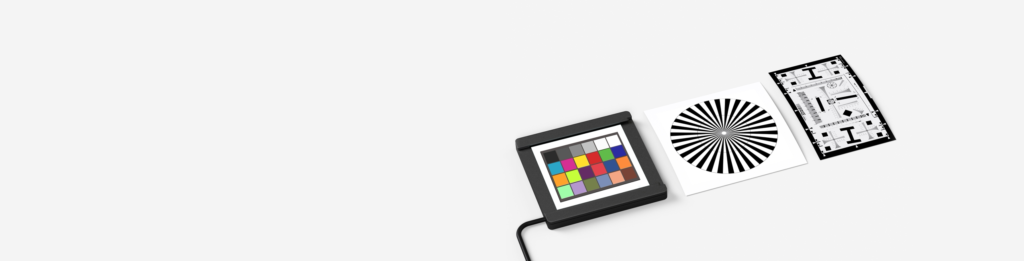
A camera calibration target is a precisely patterned plate that gives a camera a field of known reference points. Choosing one comes down to pattern type, substrate and accuracy, physical size, and toolchain fit — and the target, not the algorithm, sets your accuracy ceiling. A navigational overview that links to each in-depth guide.