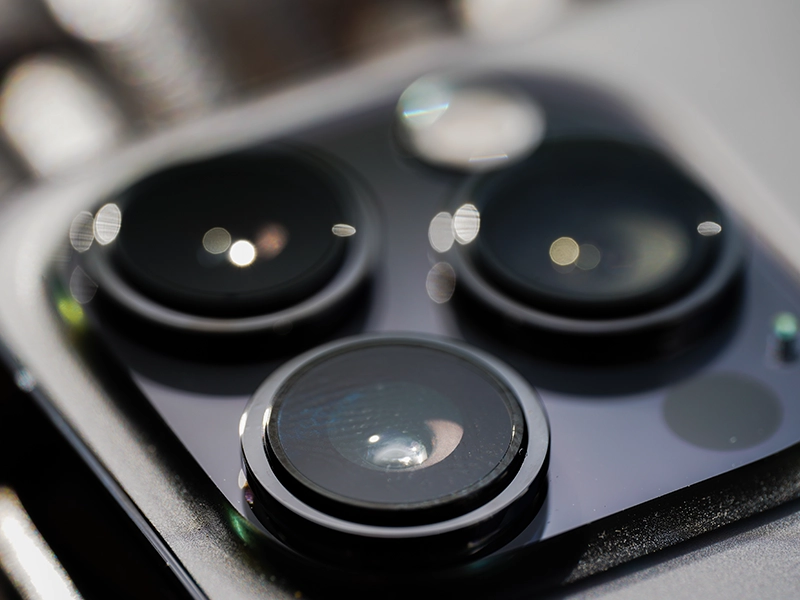
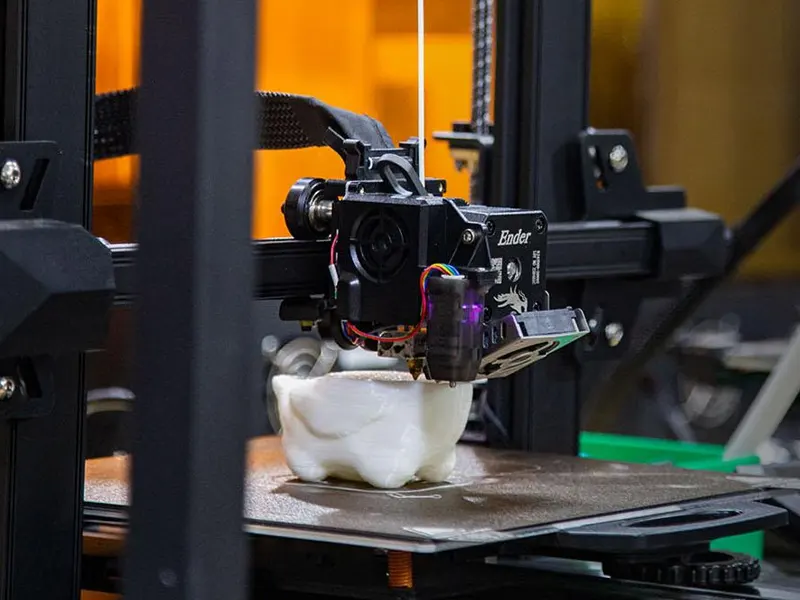
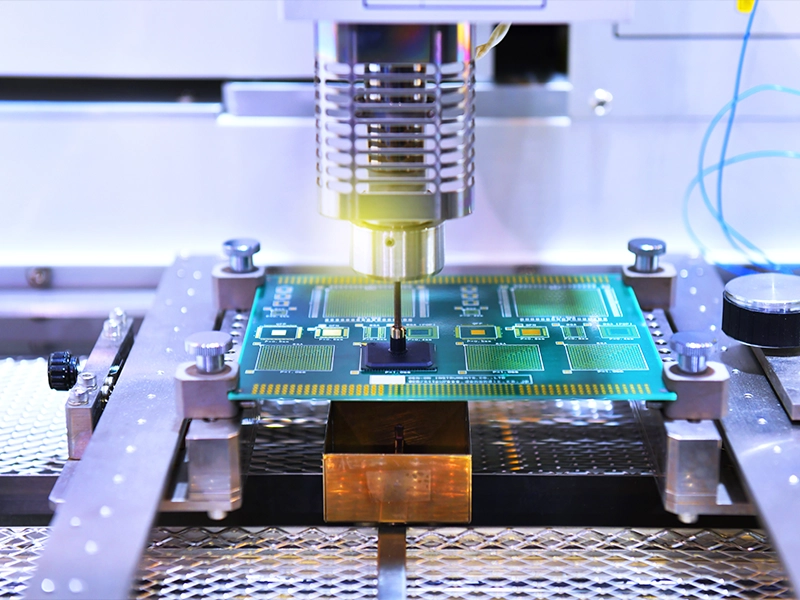
A backlit glass chart used on the assembly fixture to focus and align wide-angle camera modules, with the pattern contrast and surface reflection matched to the optics under test.
Application
| Parameter | Value |
|---|---|
| Device | Compact camera module for a medical imaging device |
| Optics | Wide-angle / fisheye lens, field of view above 120° |
| Process | Focus and active alignment on an assembly fixture, before the lens is bonded |
| Chart position | Close range, backlit, imaged through the lens under test |
| Volume | Prototype builds, with pattern revisions between builds |
Technical challenges
1. Contrast without saturating the sensor. A fully opaque pattern on a bright backlight gives maximum contrast, but it can drive the sensor into saturation near the centre of a wide-angle lens. Focus and MTF algorithms then lose the grey-level gradient they rely on. A partial optical density keeps the dark areas within the sensor’s dynamic range.
2. Stray reflections at close range. At short working distances, light reflected from the chart surface can bounce off the front lens element and return as ghosting or veiling glare. On a wide-angle module this affects the whole field.
3. Fast pattern iterations. During development the alignment pattern changes from build to build. Each revision needs a new chart quickly, so the process has to fit both a short lead time and a tightly specified final version.
Solution
| Item | Option A: standard | Option B: optical-grade |
|---|---|---|
| Substrate | Soda-lime glass, 2.3 mm | Soda-lime glass, 2.3 mm |
| Size | 50 × 50 to 100 × 100 mm, custom | 50 × 50 to 100 × 100 mm, custom |
| Pattern | Photolithographically patterned opaque coating, matte black | Double-sided blue chrome |
| Pattern density | Fully opaque | Custom OD, e.g. OD 0.8 |
| Surface reflection | Matte, low glare | AR coated, 400–700 nm, < 1% reflection |
| Feature accuracy | ±10 µm | ±1 µm |
| Lighting | Backlit (transmissive) | Backlit (transmissive) |
| Lead time | About 6 days | About 25 days |
Why two options
- Option A for iteration: a fully opaque matte pattern ships in about 6 days, so each pattern revision can be tested on the fixture within a week.
- Option B for the final chart: a partial OD keeps the pattern within the sensor’s dynamic range. The AR coating suppresses reflections back into the lens, and double-sided chrome keeps the pattern dark from both viewing directions.
- Glass rather than film: glass keeps the pattern flat and dimensionally stable on the fixture. Film can curl or shift at close working distances.
Verification and deliverables
- Feature dimensions measured on a CNC vision measuring system; inspection report per chart.
- Optical density measured on the coated surface with a calibrated OD meter, recorded per lot.
- Serial number per chart, matched to its inspection report.
- Pattern made 1:1 from the customer’s design file, with drawing confirmation before production.
Related products
- Chrome-on-glass and chrome-on-quartz backlit targets
- Resolution and distortion test charts
- Custom OD and AR-coated optical targets
Aligning a wide-angle or fisheye module? Send us your pattern file and working distance, and we’ll recommend the OD and surface finish.