If you’ve been measuring camera noise the same way since 2017, you might be using a procedure that’s no longer compliant with the latest international standard.
ISO 15739:2023 — the 4th edition of the international standard for digital camera noise measurement — was published on April 21, 2023. It cancels and replaces ISO 15739:2017 with three substantial technical changes that affect every camera test lab, image quality engineer, and ISP tuning workflow that depends on this standard. Most engineers we talk to are aware that “there’s a new version,” but few know precisely what changed, whether their existing test charts still work, or whether their reports are still compliant.
This guide answers those questions completely. By the end, you’ll know exactly which parts of the standard changed, which parts stayed the same, whether you need to buy new equipment, when Imatest and other analysis software will fully support the 2023 methods, and how to migrate your existing test workflow with minimum disruption.
Let’s start with the executive summary.
The Three Changes in 60 Seconds
ISO 15739:2023 introduces exactly three technical changes from the 2017 (3rd edition):
| # | What Changed | Annex | Status Before | Status After |
| 1 | Low-frequency variation removal method | Annex C | Informative (optional) | Normative (required), revised |
| 2 | Signal-to-noise ratio determination procedure | Annex D | Informative | Informative, but revised method |
| 3 | Perceptually uniform noise mapping | Annex F | Did not exist | NEW — Noisiness JND mapping |
Everything else — the chart geometry, the patch density specifications, Annex A (noise component analysis), Annex B (visual noise measurement), and the test setup procedures — stayed identical to the 2017 edition.
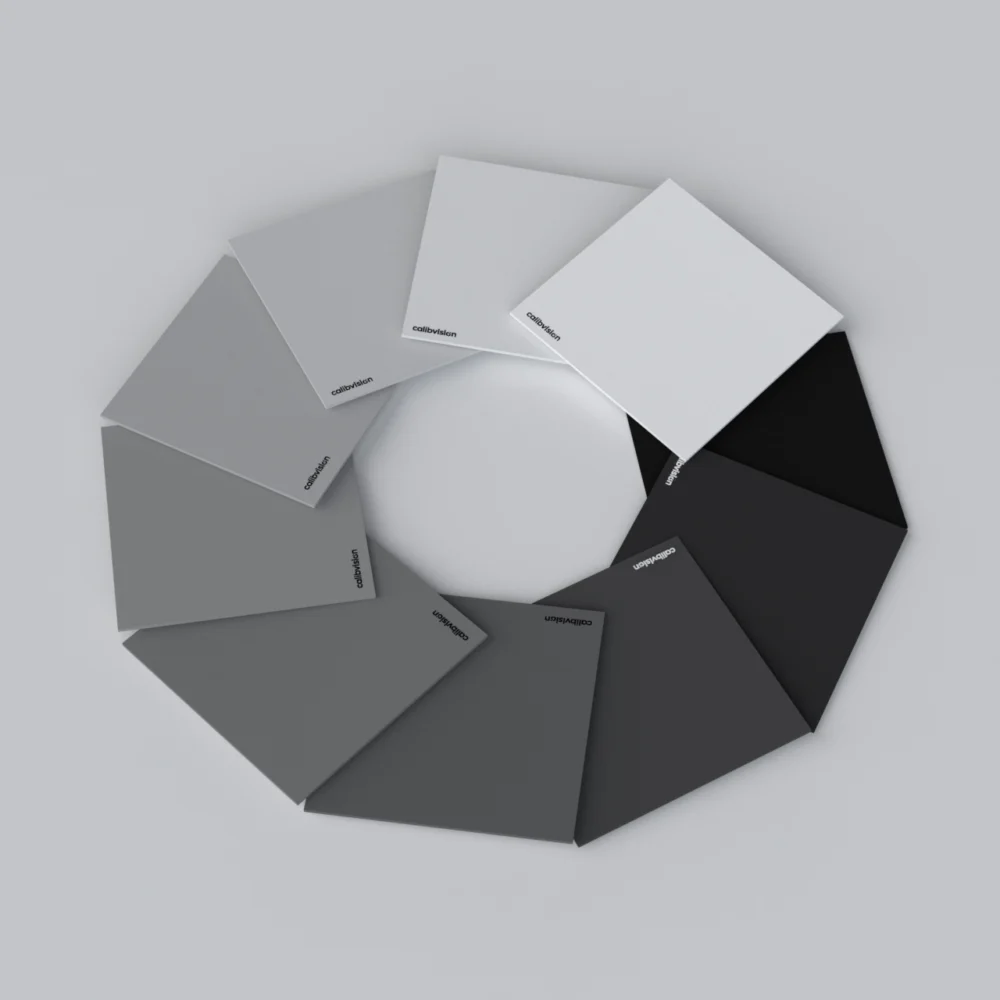
The bottom line for most labs: if you already own a compliant ISO 14524 / ISO 15739 chart (20-patch or 15-patch, transmissive or reflective), it still works perfectly with the 2023 edition. The change is almost entirely on the software side — analysis procedures, not chart hardware.
But the implications are bigger than they first appear. Let’s go through each change in detail.
A Quick History: How ISO 15739 Got Here
Before diving into the 2023 changes, it helps to understand where ISO 15739 came from. The standard has gone through four editions over twenty years:
| Edition | Year | Title | Key Addition |
| 1st | 2003 | Photography — Electronic still-picture cameras — Noise measurements | Original SNR + dynamic range methods |
| 2nd | 2013 | (same) | Visual noise (Annex B) became normative |
| 3rd | 2017 | (same) | Added IEC 61966-2-1 reference, refined dynamic range definition |
| 4th | 2023 | Photography — Electronic still-picture imaging — Noise measurements | LF removal normative, SNR revised, Noisiness JND added |
A few patterns to notice:
- The standard’s scope broadened from “cameras” to “imaging” between 2017 and 2023 — reflecting the reality that ISO 15739 is now applied to sensor modules, mobile devices, and embedded cameras, not just standalone DSCs.
- Each major revision has tightened what was previously optional. Annex B (visual noise) became normative in 2013; Annex C (LF removal) became normative in 2023. The pattern is clear: as the algorithms get validated through years of industry use, ISO promotes them from “recommended” to “required.”
- The standard is maintained by ISO/TC 42 (Photography), specifically Working Group 18 (Image Quality), which also maintains ISO 12233 (SFR) and ISO 14524 (OECF).
This historical trajectory matters because the next revision is already being discussed. If you’re building long-term test infrastructure today, knowing the direction of travel is as important as knowing the current state. We’ll come back to this at the end.
Now, the three changes.
Change 1: Annex C — Low-Frequency Variation Removal Becomes Normative
This is the most consequential change in the 2023 edition. It changes what you’re required to do, not just what you’re recommended to do.
What is “Low-Frequency Variation”?
When you photograph a uniform gray patch under uniform lighting, you’d expect the captured image to also be uniform — every pixel within the patch should have approximately the same brightness. In reality, two effects produce slow spatial variations across the patch:
- Lens vignetting — the corners of the lens transmit less light than the center, even on a uniformly illuminated subject. A 100×100 pixel patch in the corner of the image will be measurably darker than the same patch in the center.
- Illumination shading — even with carefully designed lightboxes, you can rarely achieve perfect uniformity. Real-world test setups have ±2% to ±5% intensity gradients across the patch area.
These slow variations look like “structural noise” if you naively compute the standard deviation of all pixel values in the patch. But they’re not really noise in the noise-measurement sense — they’re a deterministic optical artifact that should be subtracted out before noise statistics are calculated.
Without LF removal, a perfectly clean sensor will appear noisier than it actually is, simply because the patch is unevenly illuminated. This is a well-known systematic error that has been quietly distorting camera noise reports for years.
What Annex C Does
Annex C specifies a mathematical procedure for removing these low-frequency variations from the patch data before computing RMS noise. The algorithm fits a smooth surface (typically a 2D polynomial of order 2-4) to the pixel values within the patch, subtracts that surface from the raw data, and then computes noise statistics on the residual.
The math looks like this conceptually:
1. Capture patch data → I(x, y) for all pixels in the ROI
2. Fit smooth surface → S(x, y) = polynomial fit to I
3. Compute residual → R(x, y) = I(x, y) − S(x, y)
4. Compute noise → σ_total = standard_deviation(R)
The result is a noise value that more accurately reflects the camera’s true random + fixed-pattern noise, with the deterministic shading component removed.
Why “Normative” Matters
In ISO standards language:
- Normative = required for compliance. If you say “measured per ISO 15739:2023,” you must do this step.
- Informative = recommended, but optional. You can skip it and still claim compliance.
In 2017, Annex C was informative. Many test labs simply skipped this step — partly because their existing analysis software didn’t fully implement it, and partly because the resulting noise numbers looked “worse” if they were comparing to historical reports that hadn’t applied LF removal.
In 2023, Annex C is normative. If your test report claims ISO 15739:2023 compliance, you must apply LF removal as part of the noise calculation. There is no longer an opt-out.
Practical Impact
For most labs, three things change:
- Reported noise values may shift slightly when you switch from 2017-style measurements (without LF removal) to 2023-style measurements (with LF removal). The direction depends on your specific lens and lighting setup — labs with strong vignetting or shading will see noise numbers decrease, because the spurious “noise” was actually deterministic shading.
- Comparison across labs becomes more reliable. One of the persistent frustrations with ISO 15739 has been that two labs measuring the “same” camera could report different noise values, partly because they handled LF variation differently. With normative LF removal, this source of disagreement disappears.
- Your existing test charts work without change. The chart geometry, patch sizes, and densities are identical. Only the analysis software needs updating.
What About Annex C Revisions?
The 2023 edition didn’t just promote Annex C from informative to normative — it also revised the algorithm itself. The ISO preview text specifies: “method for removing low frequency variations from the image signals has been revised and changed from informative to normative processing.”
The revision tightens the polynomial fitting procedure and clarifies edge cases that were ambiguous in 2017. If you implemented your own LF removal code based on the 2017 informative Annex C, you’ll want to verify it against the 2023 specification — there are subtle differences that affect the final noise values, particularly for patches near the image edges.
Change 2: Annex D — Revised SNR Determination Procedure
Annex D specifies how to compute the camera’s signal-to-noise ratio at a specific reference luminance. This is the single most important number that most labs report from ISO 15739 testing.
A Quick Refresher on the ISO 15739 SNR Method
The procedure works like this:
- Capture the OECF test chart (ISO 14524-defined patches) under controlled D65 lighting.
- For each patch, measure the mean pixel value (signal) and the standard deviation (noise).
- Plot SNR vs. luminance to get the SNR curve.
- Interpolate the SNR at a reference luminance corresponding to 18% gray with 140% highlight headroom — i.e., approximately 13% of the saturation luminance.
The 18% gray + 140% headroom assumption comes from the way real cameras handle scene-referred exposure. Cameras don’t expose 18% gray to 18% of the maximum digital value; they leave headroom for highlights, which means an 18% gray scene patch ends up at roughly 13% of the maximum digital value (245/1880 ≈ 13% for 8-bit sRGB). So the “reference luminance” L_ref is defined as the lowest scene luminance that produces a digital value of 245 in one of the three color channels (for 8-bit images), and L_SNR — the luminance where SNR is reported — is 13% of L_ref.
This reference point produces a single SNR number that summarizes the camera’s noise performance at typical midtone exposures.
What Changed in 2023
The 2023 revision modifies Annex D in several places. The ISO preview text is brief: “description of procedure for determining signal-to-noise ratio has been revised.” The complete ISO 15739:2023 document specifies the revisions in detail; here are the main practical impacts:
- Clarified handling of saturation and clipping. The 2017 procedure left some ambiguity about what to do when one or more color channels saturate at high signal levels. The 2023 edition specifies a clearer truncation rule.
- Improved accuracy on low-noise sensors. Modern sensors (back-illuminated, large-pixel, full-frame CMOS) have such low noise that the 2017 SNR calculation could produce unstable results because the noise floor was approaching the calculation’s numerical precision. The 2023 procedure adds stabilization steps that improve repeatability for low-noise sensors.
- Better integration with Annex C. Because Annex C is now normative, Annex D explicitly references it as a required preprocessing step. The two annexes are now tightly coupled — you apply LF removal first (per Annex C), then compute SNR (per Annex D).
- Refined dark current handling. The procedure for separating temporal noise from fixed-pattern noise (which requires multi-frame averaging) was clarified, with explicit minimum frame counts (8 or more) for reliable separation.
What This Means for Your Reports
If you’ve been computing SNR per ISO 15739:2017, the 2023 procedure will produce numerically similar but not identical results. For most cameras, the difference is small — well within the natural shot-to-shot variation. But for two specific cases, the difference can be larger:
- Very low-noise sensors (high-end full-frame, medium format): the 2023 SNR may be higher (better) than the 2017 SNR because of the stabilization improvements.
- Sensors with strong shading: the 2023 SNR may be higher (better) than the 2017 SNR because the LF removal step (now required) removes deterministic shading from the noise calculation.
If you maintain a historical database of SNR measurements, plan for a one-time recalibration when you switch to the 2023 procedure. You’ll want to recompute a representative subset of past measurements with the new procedure to establish the offset between 2017-style and 2023-style numbers.
Change 3: Annex F — Noisiness JND Mapping (Brand New)
This is the most exciting addition in the 2023 edition. Annex F is entirely new — it didn’t exist in 2017.
The Problem Annex F Solves
For two decades, ISO 15739 has reported noise as either:
- SNR (in dB) — a ratio of signal to noise
- Total noise (in RMS digital values) — the raw standard deviation of pixel values
- Visual noise (a dimensionless number, per Annex B) — RMS noise weighted by the human visual system’s contrast sensitivity functions
All three of these are useful, but none of them are perceptually uniform. What does that mean? Consider two cameras:
- Camera A: visual noise = 1.0
- Camera B: visual noise = 2.0
Is Camera B “twice as noisy” as Camera A to a human observer? It turns out the answer is no. The relationship between measured visual noise and the perceived amount of noise is non-linear. A doubling of visual noise might correspond to a 1.5× perception increase at low levels, but a 3× perception increase at high levels.
This non-linearity makes it hard to:
- Communicate noise quality in marketing materials (“Camera X has 30% less noise than Camera Y” — but what does 30% feel like?)
- Set internal quality thresholds (“any phone with visual noise above 5.0 fails QC” — but is 5.0 the right number?)
- Compare cameras across very different price tiers without surprises in user perception.
What Noisiness JND Does
A JND — Just Noticeable Difference — is the standard unit of human perception research. One JND is, by definition, the smallest change in a stimulus that a typical human observer can reliably detect (with about 75% accuracy). It’s the natural psychophysical unit for talking about perceived differences.
Annex F provides a mathematical mapping from measured visual noise (Annex B) to Noisiness JND values. The mapping is designed so that:
- 1 JND = the smallest noise change a typical viewer can detect.
- 3 JND = a clearly visible noise difference.
- 10 JND = a dramatic, marketing-relevant noise difference.
In other words, Noisiness JND gives you a perceptually linear scale. If Camera A is 2 JND and Camera B is 4 JND, then Camera A is exactly as different from Camera B as Camera B is from a 6 JND camera. This linear scaling makes Noisiness JND ideal for:
- Quality benchmarking: “Our phone is 1.5 JND better than the competitor” is a meaningful statement.
- ISPtuning: aim for a target JND value rather than a target SNR.
- Marketing claims: “Half the perceived noise” maps to a 1 JND improvement (which is real and meaningful), not to a “50% lower SNR” (which is real but not perceptually 50% better).
How Annex F Was Developed
The Annex F mapping wasn’t pulled out of thin air. It’s based on a multi-year research program involving:
- Psychophysical experiments: real human observers viewing noisy images under controlled conditions, reporting the smallest noise change they could perceive.
- CSF (contrast sensitivity function) modeling: incorporating the established science of how human vision responds to spatial frequencies and color channels.
- Industry validation: results published in IS&T (Society for Imaging Science and Technology) and SPIE journals between 2013 and 2022, including key papers by Wueller, Matsui, Katoh, and others.
The result is a mapping that’s been validated against subjective image quality ratings from Aptina, Sony, Apple, and other camera-system companies.
Why Annex F Is Informative (Not Normative)
Annex F is currently informative — recommended, but optional. There are three reasons for this:
- Industry adoption is still building. Mapping visual noise to Noisiness JND requires precise calibration data that not all camera test labs have. Making the mapping normative immediately would have orphaned labs without the necessary infrastructure.
- The reference software is still maturing. ISO/TC 42 has released MATLAB reference implementations of the Annex F algorithm, but commercial analysis software (Imatest, others) is still in the process of integrating the new mapping.
- The mapping itself may be refined. Like Annex C in earlier editions, Annex F is being battle-tested before it becomes mandatory. If experience reveals issues, the next edition (likely 2028-2030) can refine the algorithm before promoting it to normative.
In practice, expect Noisiness JND to become normative in the next edition of ISO 15739. If you’re building new test infrastructure today, start collecting Noisiness JND data alongside your traditional SNR and visual noise metrics. By the time the next edition is published, you’ll have years of JND history to work with.
What Stayed the Same
It’s just as important to know what didn’t change in 2023:
Annex A — Noise Component Analysis (Normative, Unchanged)
The procedure for separating noise into temporal noise (random shot-to-shot variation) and fixed-pattern noise (deterministic spatial structure that doesn’t change between exposures) is identical to 2017. You still need at least 8 identical captures (typically 16 or 32 for better stability), and the calculation formulas are unchanged.
Annex B — Visual Noise Measurement (Normative, Unchanged)
The visual noise calculation — RMS noise weighted by the human visual system’s contrast sensitivity functions in the CIELUV color space — is the same as in 2017. The weighting formula is still:
V = σL* + 0.852·σu* + 0.323·σv*
Where σL*, σu*, and σv* are the RMS noise values in the L*, u*, and v* channels respectively, and the 0.852 and 0.323 weights account for the human eye’s reduced sensitivity to chromatic noise.
Note: there’s been ongoing technical debate about whether visual noise should use CIELAB instead of CIELUV, and whether the CSF weightings should be revised. Several papers from IS&T 2019-2022 have explored these revisions. As of the 2023 edition, Annex B was not modified — but expect changes in the next edition.
Annex E — Practical Viewing Conditions (Informative, Unchanged)
The recommended viewing distances, display sizes, and luminance levels for evaluating noise visibility are the same as 2017.
Chart Specifications
The OECF chart specifications referenced by ISO 15739 (defined in ISO 14524) are unchanged. If you have a 20-patch transmissive chart or a 15-patch reflective chart that worked for ISO 15739:2017, it works identically for ISO 15739:2023.
Test Setup Requirements
D65 illumination, baffled lighting for reflective charts, backlit boxes for transmissive charts, minimum 64×64 pixel measurement region per patch, multi-frame averaging — all unchanged.
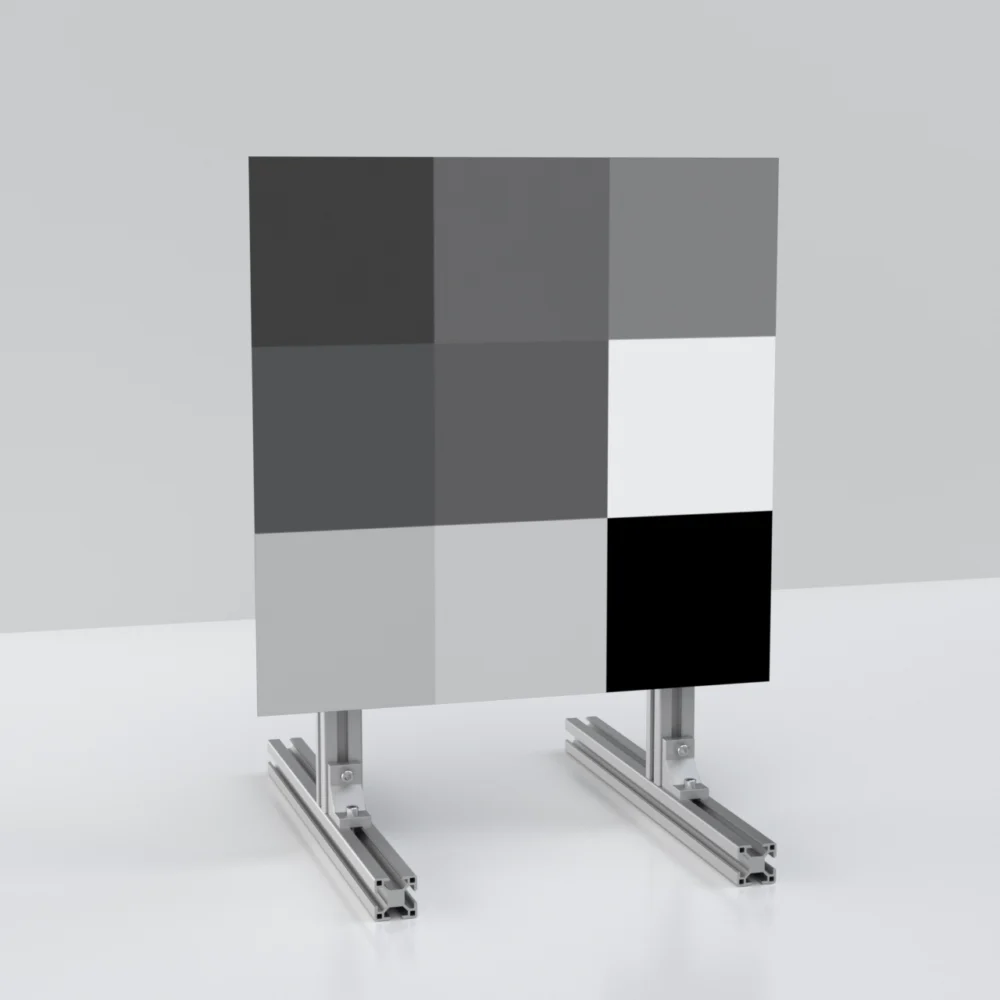
This is the critical point: the standard’s hardware requirements are stable. The 2023 edition is a pure software/procedure update. Your physical test bench, charts, lightboxes, and capture equipment don’t need replacement. (See our complete ISO 15739:2023 noise test chart product line for 20-patch and 15-patch variants in both transmissive film and photographic paper substrates.)
Do You Need New Test Charts for ISO 15739:2023?
No, in almost all cases. Here’s the decision tree:
Q: Does your existing chart conform to ISO 14524 OECF specifications?
├── YES → Your chart is compatible with both ISO 15739:2017 and ISO 15739:2023.
│        No new chart purchase needed. Update your analysis software only.
│
└── NO → Get a compliant chart. Choose between:
         - 20-patch transmissive (10,000:1 contrast) — full dynamic range, lab-grade
         - 20-patch reflective (80:1 contrast) — production QC, mid-range sensors
         - 15-patch transmissive — Imatest Stepchart workflows, premium
         - 15-patch reflective — daily QC, Imatest-compatible, budget-friendly
The reason your old chart still works: the chart’s job is to present known density patches under known illumination. ISO 15739:2023 didn’t change the patch densities, the patch geometry, or the illumination requirements. It only changed how the captured images are analyzed after the shutter fires.
There’s one edge case worth mentioning: if your existing chart is a low-contrast reflective chart (60:1 or below), you may struggle to fully exercise the dynamic range of premium sensors regardless of which edition of ISO 15739 you cite. The 2023 edition didn’t change the recommended 10,000:1 transmissive contrast in §5.4, but it also didn’t make it more strict than before. Reflective charts remain acceptable for most production QC use cases.
Do You Need New Analysis Software?
Yes, eventually — but maybe not immediately. Here’s the status as of 2026:
Imatest
Imatest’s Stepchart, Multicharts, and Multitest modules implement the ISO 15739 noise measurement procedures, but the implementation is currently based on the 2017 edition. Specifically:
- Annex B (visual noise): Imatest 4.0+ implements the 2017 visual noise calculation. This is unchanged in 2023 and continues to work.
- Annex C (LF removal): Imatest has its own LF removal implementation, which is functionally similar to the 2023 normative Annex C but not identical in every detail.
- Annex D (SNR): Imatest’s ISO 15739 SNR calculation follows the 2017 procedure. Imatest has indicated that 2023 updates are “ongoing” but no specific timeline has been published.
- Annex F (Noisiness JND): Not yet implemented in any released Imatest version. ISO/TC 42 has published reference MATLAB code for Annex F that you can use independently.
If you need ISO 15739:2023 compliant reports today, the most reliable path is:
- Use Imatest for capture, OECF analysis, and traditional SNR/visual noise reporting.
- Run the ISO/TC 42 reference MATLAB code on your image data to add Noisiness JND values.
- Document both the Imatest version and the reference code version in your test reports.
Image Engineering iQ-Analyzer
iQ-Analyzer from Image Engineering is closer to ISO 15739:2023 compliance than Imatest, as Image Engineering’s chief scientist Dietmar Wueller is one of the principal authors of the Annex F Noisiness JND research. Their software roadmap explicitly tracks ISO/TC 42/WG 18 specifications. If 2023 compliance is critical to your business, iQ-Analyzer is currently the most direct route.
ISO/TC 42/WG 18 Reference Implementations
The ISO/TC 42 working group has released MATLAB reference implementations of both Annex B (visual noise) and Annex F (Noisiness JND mapping). These are not production-grade software — they’re intended as reference implementations that commercial software developers can validate against. But for advanced labs with MATLAB licenses, they’re a free way to get 2023-compliant numbers today.
Download links are available from the IS&T (Society for Imaging Science and Technology) website under the “Digital Camera Noise Tools” section.
In-House Implementation
Several large camera-system companies (we’re aware of teams at Apple, Sony, and major Chinese smartphone manufacturers) have implemented the ISO 15739:2023 algorithms in-house, in Python or C++. If you have engineering capacity, the 2023 standard is implementable in a few weeks of focused work, and the algorithms are well-documented in the public ISO preview and the supporting IS&T papers.
Migration Guide: How to Upgrade Your Test Workflow
If you’re maintaining a production camera test lab, here’s a practical migration plan from ISO 15739:2017 to ISO 15739:2023.
Phase 1 — Audit (1 week)
- Inventory your current charts. Confirm they conform to ISO 14524 OECF specifications. If they do, they’re compatible with 2023.
- Document your current SNR / visual noise values for a representative set of cameras (say, 20-30 reference units). These become your “before” baseline.
- Check your analysis software version. Note which Imatest version you’re running (or which other software). Document which Annex versions it implements.
Phase 2 — Pilot (2-4 weeks)
- Run the ISO/TC 42 reference MATLAB code on the same image data you analyzed in Phase 1. Generate the 2023-compliant numbers (with normative Annex C LF removal and Annex F Noisiness JND).
- Compare the before/after values. Compute the offset between 2017-style and 2023-style SNR for each reference camera. Build a calibration table.
- Validate the Noisiness JND values against subjective ratings if you have any. A 1 JND difference should correspond to “just noticeable” in your QC team’s blind comparisons.
Phase 3 — Cutover (1 month)
- Update your test reports to specify “measured per ISO 15739:2023” instead of “ISO 15739:2017.”
- Recalibrate your QC thresholds using the 2023 numbers. If your previous threshold was “SNR > 32 dB at 13% reference,” verify whether 32 dB has the same meaning under the new procedure (it usually does, but verify per the Phase 2 calibration table).
- Add Noisiness JND to your reports as a complementary metric. Even if your QC thresholds remain SNR-based, having JND values builds a historical dataset for the next ISO 15739 edition.
Phase 4 — Communicate (ongoing)
- Notify customers that your reports now reference the 2023 edition. Most customers won’t notice, but a few sophisticated ones (especially those buying camera modules for safety-critical applications like ADAS) will appreciate the proactive communication.
- Update your ISO 17025 scope if you’re accredited. Your accreditation body will need to know which edition of ISO 15739 your laboratory now references.
- Train your test engineers on the new metrics. Noisiness JND in particular is a new concept that engineers used to “SNR in dB” need to understand.
For most labs, the entire migration takes 6-8 weeks of part-time engineering effort. If you’re operating a production line that needs continuous test coverage, plan for a parallel-run period where both 2017 and 2023 numbers are computed for the same cameras, so you can validate the cutover before retiring the old reports.
What’s Coming in the Next Edition (5th Edition, Estimated 2028-2030)
ISO standards typically review on a 5-year cycle. ISO 15739:2023 entered “International Standard under systematic review” status shortly after publication. The next edition isn’t expected before 2028 at the earliest, but the technical work is already underway.
Based on public ISO/TC 42 meeting notes, IS&T papers from 2023-2025, and the trajectory of past revisions, the most likely changes for the 5th edition include:
- Annex F (Noisiness JND) will likely become normative. The pattern is clear from earlier editions: features get added as informative, validated by industry use, then promoted to normative. The 2023 edition added Annex F as informative; the 5th edition will probably make it required.
- Annex B (visual noise) may shift from CIELUV to CIELAB. Multiple papers have explored whether CIELAB produces better correlation with subjective ratings, particularly for chromatic noise. The transition has been discussed since 2019 but hasn’t yet been adopted.
- CSF weighting coefficients may be refined. The current 0.852 and 0.323 weights in the visual noise formula date to early 2000s research. Modern psychophysical experiments suggest slight refinements would improve accuracy.
- Mobile and embedded camera considerations may be formalized. ISO 15739 has historically targeted standalone DSCs. As the standard is increasingly used for smartphone cameras, embedded automotive cameras, and security cameras, the next edition may add specific guidance for these use cases.
- HDR scene-referred noise reporting may be added. The current dynamic range definition assumes a single capture. Modern computational photography pipelines that combine multiple exposures may require new noise metrics, possibly drawing on the work in IEEE P2020 (ADAS image quality) and CPIQ.
None of these are certain. But if you’re building test infrastructure with a 5-7 year horizon, designing for future flexibility — separating your capture pipeline from your analysis pipeline, using reference MATLAB code as ground truth, maintaining raw image archives — will pay dividends when the next revision lands.
FAQs
Do my ISO 15739:2017 reports become invalid when 2023 publishes?
No. Reports issued before April 2023 referencing ISO 15739:2017 remain valid. They simply reflect the standard in effect at the time of measurement. For new reports going forward, most labs will want to migrate to the 2023 edition over a 6-12 month transition period.
Can I claim “ISO 15739 compliant” without specifying the edition?
Technically yes, but it’s not best practice. Sophisticated customers, accreditation bodies (especially for ISO 17025 labs), and other downstream users will want to know exactly which edition you followed. Always specify “ISO 15739:2023” or “ISO 15739:2017” in your reports.
How big is the practical difference in SNR values between 2017 and 2023?
For most cameras, the difference is within ±1 dB — well below the natural variation between two measurements of the same camera. For very low-noise sensors or setups with strong vignetting, the difference can be 2-3 dB, with the 2023 procedure generally producing slightly higher (better) SNR values because the LF removal step removes shading-induced spurious noise.
Is Noisiness JND the same as VN_tentative or VN_ed3 in the research papers?
No. Various papers have explored different visual noise revisions — including “VN_tentative” and “VN_ed3” — but these are intermediate research variants, not the final Annex F mapping. The standardized Annex F Noisiness JND is the result of years of refinement and was approved by ISO/TC 42 as the official mapping for the 2023 edition.
Does ISO 15739:2023 work with reflective (paper) charts?
Yes. Both transmissive (film) and reflective (paper) charts work with ISO 15739:2023. The standard recommends 10,000:1 transmissive contrast for full dynamic range characterization (especially for HDR sensors), but reflective charts at 80:1 contrast remain compliant for production QC and mid-range sensor testing.
What’s the relationship between ISO 15739 and IEEE P2020 / CPIQ?
ISO 15739 specifies the underlying noise measurement methodology. IEEE P2020 (for ADAS / automotive camera image quality) and CPIQ / IEEE 1858 (for mobile phone camera image quality) build on ISO 15739, adding domain-specific test conditions and metrics. If you’re testing automotive or mobile cameras, you’ll typically reference both ISO 15739 and the relevant IEEE standard.
Where can I download the ISO/TC 42 reference MATLAB code?
The IS&T (Society for Imaging Science and Technology) website hosts the official ISO/TC 42/WG 18 reference implementations. Look for “Digital Camera Noise Tools” — there are separate zip files for Annex B (visual noise) and Annex F (Noisiness JND mapping). MATLAB is required to run the code.
What is the difference between ISO 15739 and ISO 14524?
ISO 14524 defines the OECF (Opto-Electronic Conversion Function) test chart — the physical specifications for the gray patch chart. ISO 15739 defines the noise measurement methodology that uses that chart. The two are companion standards: ISO 14524 specifies the test target, ISO 15739 specifies what to do with it.
Will the 2023 changes affect ADAS / automotive camera testing?
Possibly. IEEE P2020 references ISO 15739 for its noise measurement methodology. As IEEE P2020 evolves, it will likely update to reference ISO 15739:2023 specifically. Automotive camera test labs should plan for this transition over the next 2-3 years.
Are there any new chart requirements I should be aware of?
No new chart requirements. The 2023 edition reuses the existing ISO 14524 chart definitions. The only change worth noting is that ISO 14524 itself was last revised in 2009, and there are ongoing discussions about a possible revision aligned with ISO 15739:2023. If ISO 14524 is revised, that would be the trigger for new chart procurement — not the 2023 ISO 15739 update.
The Bottom Line
ISO 15739:2023 is a measured, focused revision of a standard that’s been steadily refined over twenty years. The three changes — normative LF removal, revised SNR procedure, and new Noisiness JND mapping — together represent a meaningful improvement in measurement accuracy, cross-lab comparability, and human-perception relevance. None of the changes require new test charts or test setups.
For most labs, the migration path is:
- Confirm your existing charts are ISO 14524 compliant — they almost certainly are.
- Plan a 6-8 week software migration to ISO 15739:2023 compliant analysis procedures.
- Start collecting Noisiness JND values alongside traditional SNR, anticipating that JND will become normative in the next edition.
For new labs setting up today, design your test infrastructure with the 2023 edition as the baseline. Use chart hardware that meets the 10,000:1 transmissive contrast recommendation for full dynamic range characterization. Plan your analysis pipeline around the ISO/TC 42 reference implementations, with commercial software (Imatest, iQ-Analyzer) as the production layer.
The next ISO 15739 edition isn’t expected before 2028. You have time to migrate carefully — but you also have a competitive advantage if you migrate ahead of your competitors, especially in production environments where ADAS and mobile customers are increasingly asking for “the latest standard” in their incoming spec sheets.
Related Resources
- ISO 15739:2023 Noise Test Chart — CalibVision product line — 20-patch transmissive (10,000:1), 20-patch reflective, 15-patch Imatest-simplified variants
- How to Read a USAF 1951 Chart — companion article on resolution measurement
- How to Test Microscope Objective Quality — practical guide for optical resolution testing
- ISO 15739:2023 official document — available from the ANSI store or your national standards body
- IS&T Digital Camera Noise Tools — free MATLAB reference implementations of Annex B and Annex F
About CalibVision
CalibVision manufactures precision test charts for digital camera and optical system characterization, including ISO 15739:2023, ISO 12233:2017, ISO 12233:2023, eSFR ISO, SFRplus, and USAF 1951 resolution targets. All charts ship with CNAS-accredited (L0579) third-party inspection reports and serial-numbered traceability. Based in China with worldwide shipping. Learn more at calibvision.com.