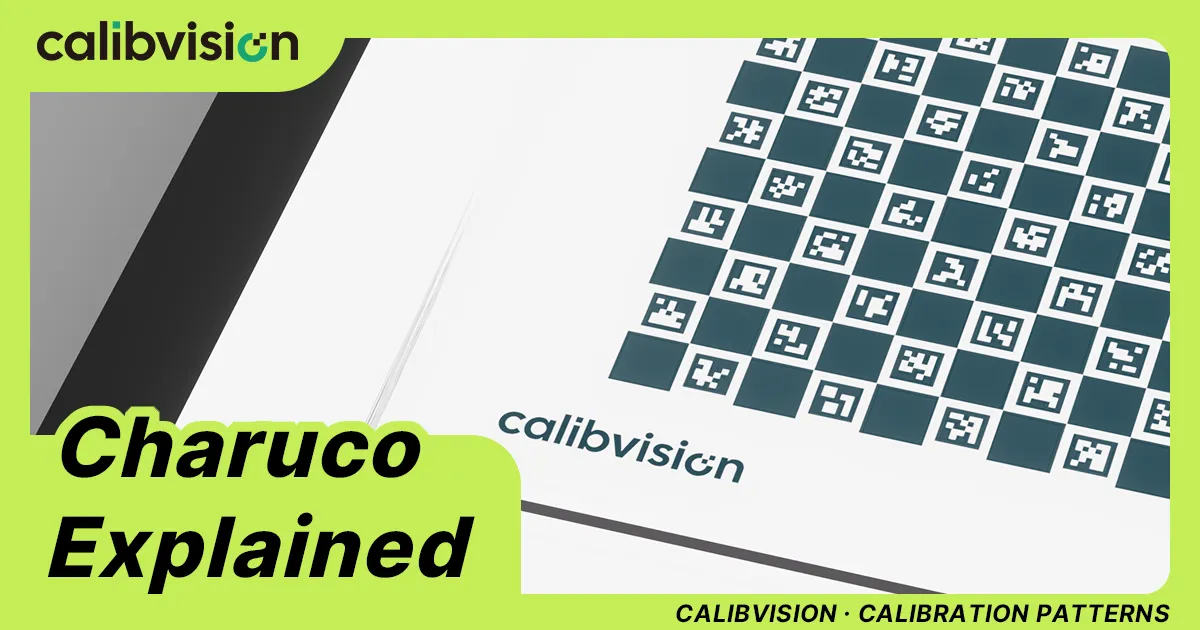
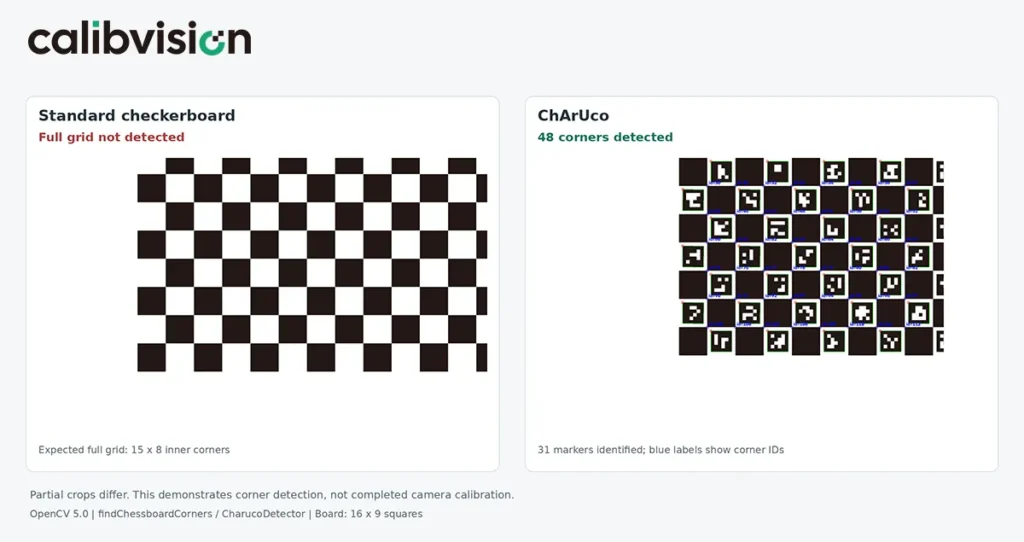
A ChArUco board addresses a specific limitation of the plain checkerboard. Most checkerboard detectors require the entire pattern to be visible, because every corner is geometrically identical and can only be indexed once the complete grid is resolved. A ChArUco board embeds a coded ArUco marker in each white square, giving every corner a unique, independently detectable ID. Calibration can then proceed from partial views, oblique angles, and frames where the board extends past the sensor edge.
That property makes ChArUco the default choice for wide-angle and fisheye lenses, multi-camera and stereo rigs, and any setup where full-board visibility cannot be guaranteed. This article covers the detection principle, the four parameters that define a board, substrate and accuracy selection, how ChArUco differs from a plain checkerboard and from AprilGrid, software support, and the standard models available.
What is a ChArUco board?
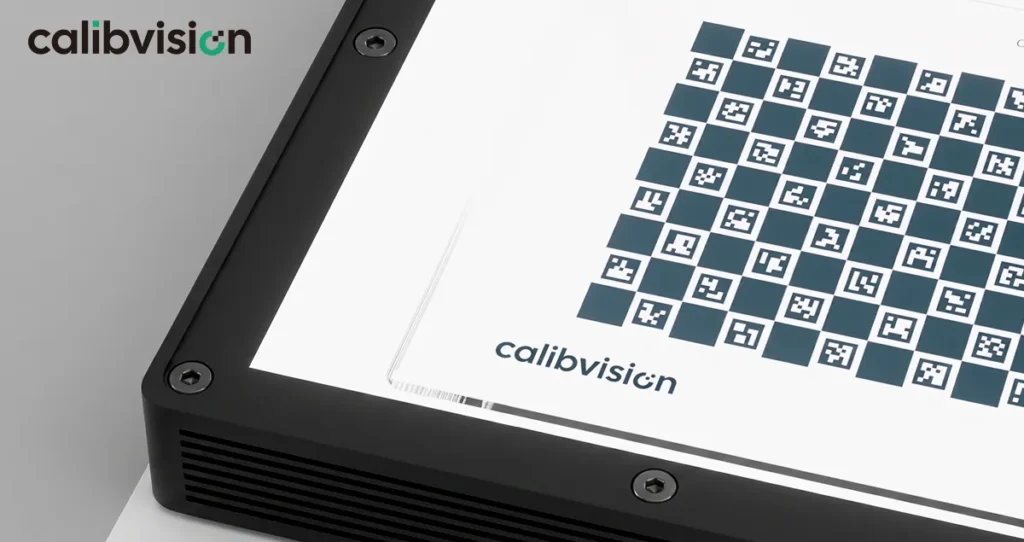
A ChArUco board is a hybrid camera-calibration target that embeds coded ArUco markers inside the white squares of a checkerboard. It gives you the sub-pixel corner accuracy of a checkerboard plus a unique ID at every corner, so calibration still succeeds when the board is tilted, partially occluded, or only partly in frame.
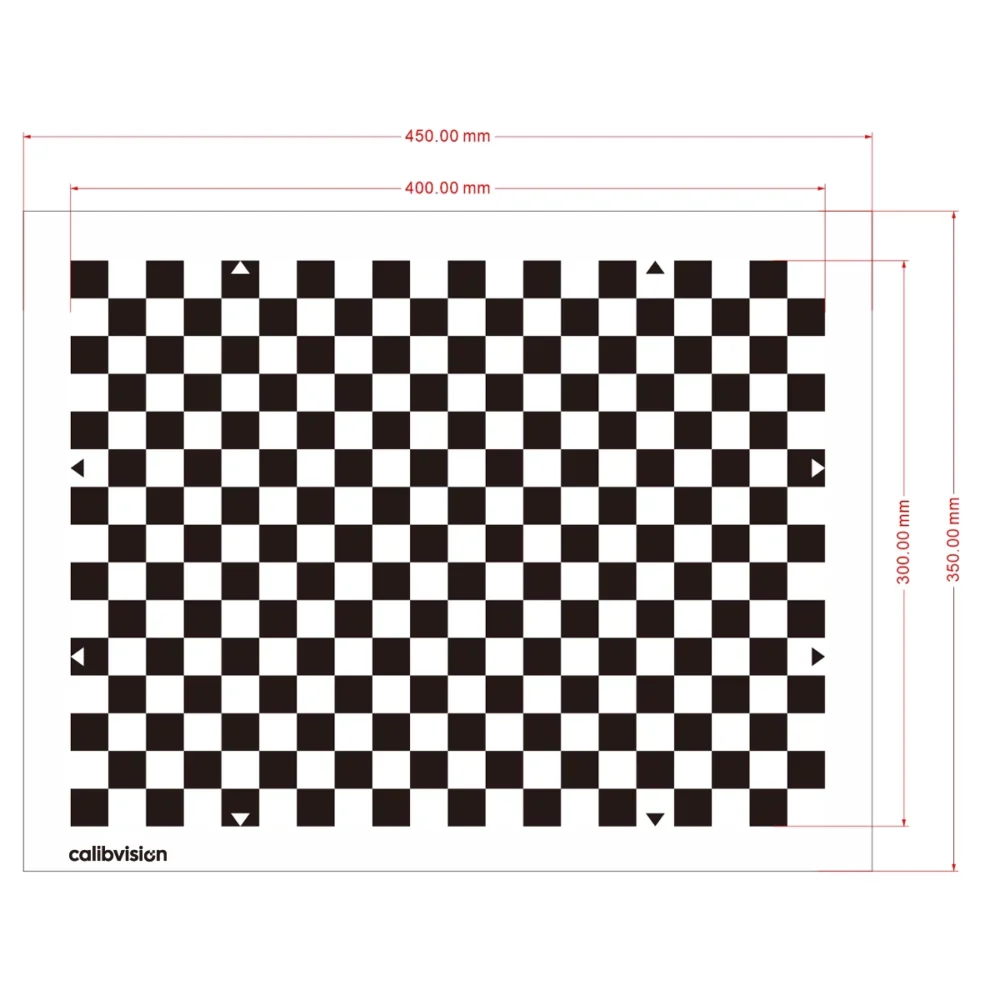
Think of it as a checkerboard that carries its own map. On a plain checkerboard every corner looks identical, so the software has to see the whole pattern to work out which corner is which. ChArUco stamps each region with a coded marker, so any corner can identify itself — no full-board view required. It sits in the same family as the other calibration pattern types, but this is the one that solved the partial-visibility problem.
Why use a ChArUco board instead of a plain checkerboard?
A plain checkerboard is simpler, denser, and perfectly good — right up until part of it leaves the frame. Then most detectors throw the whole image away. ChArUco removes that limit, and that unlocks three things that matter in the real world:
- Partial views count. A subset of visible corners is enough, so you can deliberately push the board into the image corners — exactly where the lens distorts most and where a checkerboard is hardest to keep fully in frame.
- No rotation ambiguity. The IDs make orientation unique, so you avoid the quiet 180° pose flips that degrade checkerboard stereo calibration.
- Multi-camera correspondence is automatic. Cameras seeing different parts of the same board still agree on which physical point is which.
The trade-off is honest: fewer corners per unit area, because the markers take up room, and a slightly heavier detection step. For a single camera at a controlled, close range, a checkerboard is still the right tool. For everything wide, multi-camera, or awkward, ChArUco earns its place.
How does a ChArUco board work?
Detection runs in three steps. First the ArUco markers are found by binary pattern matching. Then the checkerboard corners between them are located to sub-pixel precision. Finally each corner is assigned the ID implied by its neighbouring markers. You end up with corners that are both accurately placed (checkerboard-grade) and individually named (ArUco-grade) — which is exactly what lets a partial view still contribute.
Which ChArUco specs actually matter?
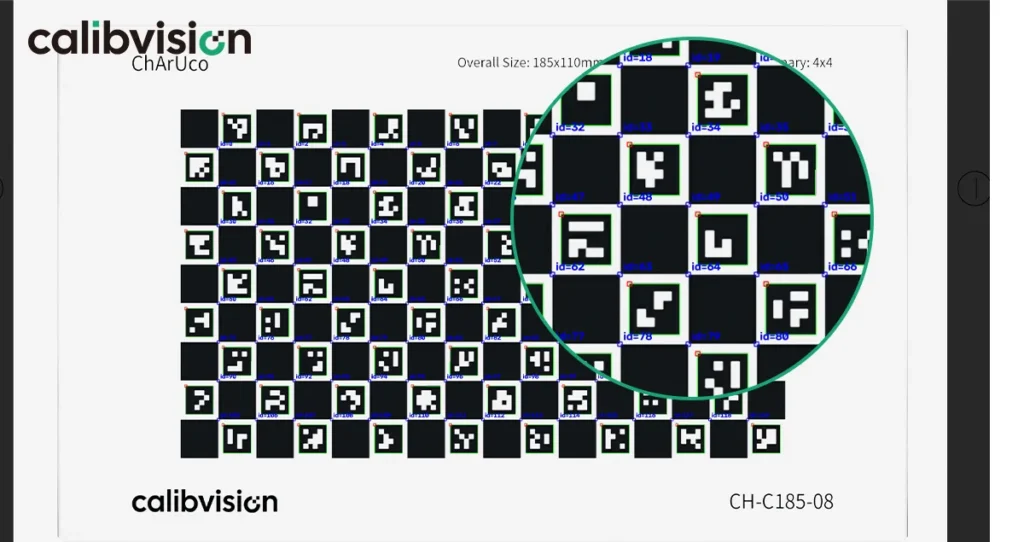
Four parameters define a board. Get these right and detection stays robust across a wide working range:
- Grid (squares × squares). More squares means more corners and better constraints, but a bigger board or smaller squares. 8×6 to 9×7 covers most machine vision; 10×8 and up for wide-angle and multi-camera.
- Square size. Pick it so each square is at least 10–15 px at your working distance and the board fills roughly 30–70% of the frame. Rough guide: 3–10 mm close range, 10–25 mm standard machine vision, 30 mm+ long range.
- Marker-to-square ratio. About 70% balances corner precision against reliable marker reads.
- ArUco dictionary. Use one with at least twice the markers your grid needs —
DICT_5X5_100for medium boards,DICT_6X6_250for large or multi-camera boards.
Which ChArUco configuration should you choose?
| Application | Grid | Square | Dictionary | Substrate |
|---|---|---|---|---|
| Standard machine vision (6–25 mm lens) | 8×6 | 25–30 mm | DICT_6X6_250 | Chrome-on-glass or ceramic |
| Fisheye / wide-angle (≤ 6 mm) | 10×8 | 20–25 mm | DICT_6X6_250 | Matte, low-reflection |
| Multi-camera / stereo | 10×8 – 12×9 | 40–50 mm | DICT_6X6_250 | Rigid, lightweight |
| Microscopy / close range | 6×5 | 3–8 mm | DICT_5X5_100 | Quartz glass (flatness) |
Why the target, not the algorithm, sets your accuracy ceiling
This point is worth stating plainly, because it is where budget is most often misspent. A calibration cannot be more accurate than the board it is derived from. A laser-printed paper ChArUco carries ±50–200 µm of positional error from printer distortion and paper movement, and any bow in the substrate is absorbed into the model as false lens distortion. No amount of solver tuning will push the result below the target’s own positional error.
For sub-pixel work, a photolithographic chrome pattern on a flat, dimensionally stable substrate removes that error source entirely — you start from a known, certified baseline instead of fighting your own reference:
| Substrate | Feature accuracy | Best for |
|---|---|---|
| Quartz glass (blue chrome) | ±0.5 µm | Metrology, thermal/UV, microscopy |
| Soda-lime glass (brown chrome) | ±1 µm | Backlit precision machine vision |
| Matte ceramic | ±2 µm | Front-lit, rugged production floors |
| Film | ±15 µm | Large-format, portable |
Every board we ship carries a serial-numbered inspection report, and NIST/NIM-traceable, CNAS-accredited (ILAC-MRA-recognised) third-party calibration is available on request. If you want to see exactly what a trustworthy inspection report should contain — and the one alignment mistake that quietly inflates supplier numbers — read how we measure and report target accuracy.
ChArUco vs checkerboard vs AprilGrid — what’s the difference?
All three are corner-based or coded, but they differ in feature type and ecosystem, and they get mixed up constantly. The one to keep straight: ChArUco is a checkerboard with embedded ArUco markers and is OpenCV-native; AprilGrid is a grid of AprilTags used mainly by Kalibr for camera-IMU work. Different marker family, different toolchain.
| Checkerboard | ChArUco | AprilGrid | |
|---|---|---|---|
| Feature | Saddle corners | Corners + ArUco IDs | AprilTag corners |
| Partial visibility | No | Yes | Yes |
| Corner density | High | Medium | Lower |
| Native ecosystem | Universal | OpenCV / MATLAB / HALCON | Kalibr / ROS |
| Best for | Single, controlled | MV, multi-cam, fisheye | Cam-IMU, robotics |
Does OpenCV support ChArUco?
Yes — natively, through cv2.aruco, and it’s also supported in MATLAB, MVTec HALCON and ROS. A minimal board definition in OpenCV 4.7+ looks like this:
import cv2
d = cv2.aruco.getPredefinedDictionary(cv2.aruco.DICT_6X6_250)
board = cv2.aruco.CharucoBoard((8, 6), 0.030, 0.021, d)  # 8x6 squares, 30 mm square, 21 mm marker
Order the physical board at the exact square and marker sizes you pass here, then verify with calipers. A scale mismatch between the digital definition and the printed target is the single most common ChArUco setup error — and it looks exactly like a calibration problem when it isn’t one.
Which ChArUco models are in stock?
The standard range covers 110×85 mm up to 460×280 mm across four substrates, and the model number tells you the board at a glance: CH-[substrate + chrome]-[board width mm]-[square size mm]. BRC is brown chrome on soda-lime glass, BLC is blue chrome on quartz or ceramic, and F is film. Every standard board uses a 16×9 array, Start ID 0, and a 5×5 dictionary (film uses 6×6). Dictionary, Start ID, array and size are all customisable.
| Model | Substrate · chrome | Overall size | Square | Feature accuracy |
|---|---|---|---|---|
| CH-SGBRC-110-05 | Soda-lime · brown (backlit) | 110×85 mm | 5 mm | ±1 µm |
| CH-SGBRC-185-08 | Soda-lime · brown (backlit) | 185×110 mm | 8 mm | ±1 µm |
| CH-SGBRC-230-10 | Soda-lime · brown (backlit) | 230×140 mm | 10 mm | ±1 µm |
| CH-SGBRC-270-12 | Soda-lime · brown (backlit) | 270×165 mm | 12 mm | ±1 µm |
| CH-QGBLC-110-05 | Quartz · blue (backlit) | 110×85 mm | 5 mm | ±0.5 µm |
| CH-QGBLC-185-08 | Quartz · blue (backlit) | 185×110 mm | 8 mm | ±0.5 µm |
| CH-QGBLC-230-10 | Quartz · blue (backlit) | 230×140 mm | 10 mm | ±0.5 µm |
| CH-QGBLC-270-12 | Quartz · blue (backlit) | 270×165 mm | 12 mm | ±0.5 µm |
| CH-CBLC-110-05 | Matte ceramic · blue (front-lit) | 110×85 mm | 5 mm | ±2 µm |
| CH-CBLC-185-08 | Matte ceramic · blue (front-lit) | 185×110 mm | 8 mm | ±2 µm |
| CH-F-340-15 | Film (backlit, 6×6 dict) | 340×200 mm | 15 mm | ±15 µm |
| CH-F-460-20 | Film (backlit, 6×6 dict) | 460×280 mm | 20 mm | ±15 µm |
Full specs, pricing and the configurator are on the ChArUco calibration board product page.
How do I order the right ChArUco target?
Send substrate, grid, square and marker size, dictionary, start ID, edge margin and overall size — or skip all that and just send your camera, lens and working distance, and our engineers will spec it for you. Custom boards ship in 5–7 working days with a dimensional inspection report. It’s a cheap part to get right and an expensive one to get wrong, so we’d rather size it with you than watch a mismatch masquerade as a calibration bug.