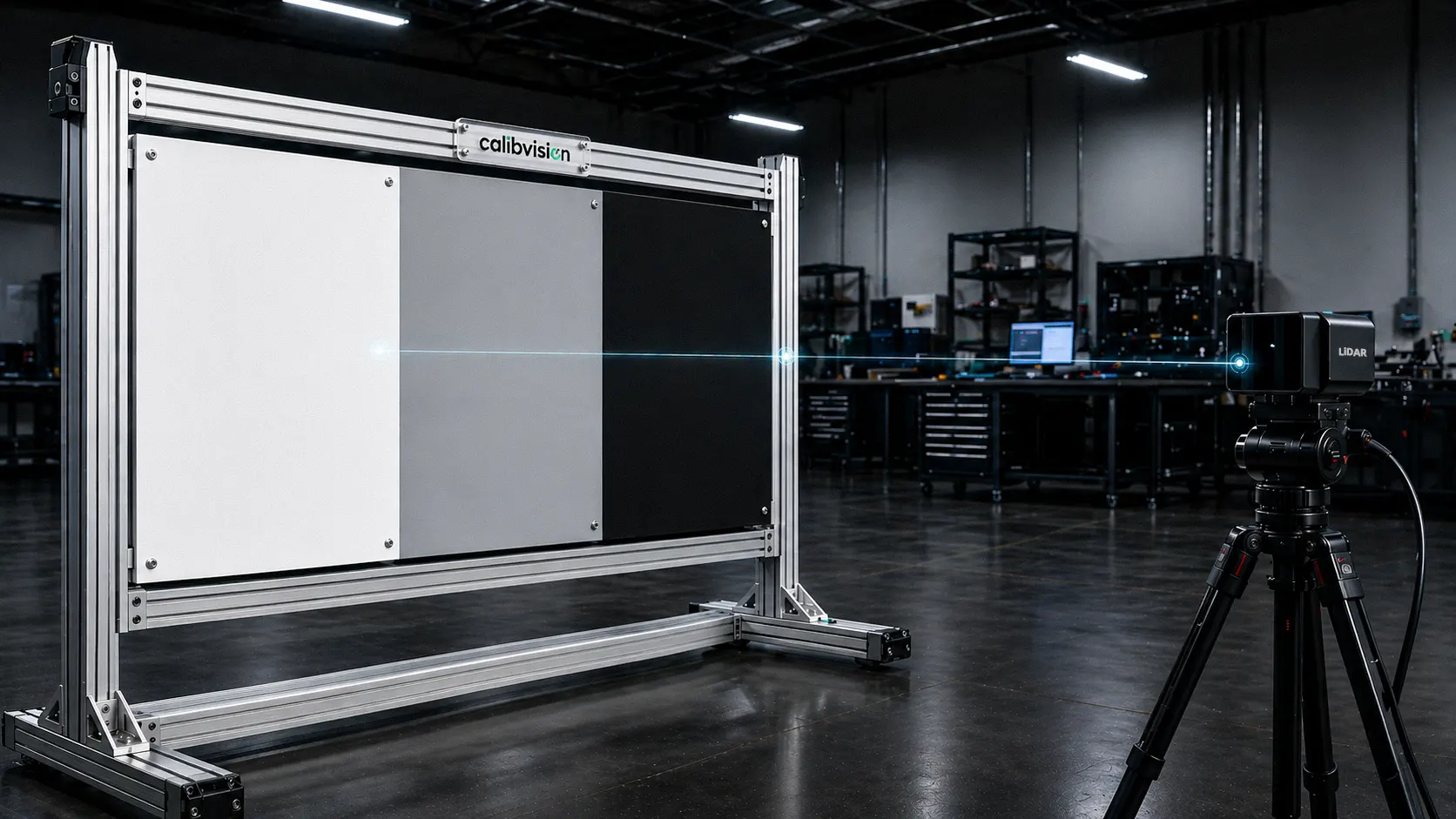
1550nm sits in the shortwave infrared (SWIR) band and is the wavelength of choice for long-range automotive LiDAR systems where detection beyond 250m matters. Luminar, Aeva, Aurora, Innoviz Pro, and Hesai’s long-range AT-series use 1550nm specifically because the eye-safety regulations allow approximately 40× higher laser power at this wavelength compared to 905nm — which translates directly into longer detection range. The trade-off is component cost: 1550nm laser diodes and InGaAs photodetectors cost 5-10× more than equivalent 905nm silicon-based components, which is why 1550nm appears in premium automotive applications but not yet in robotics, AGV, or consumer LiDAR.
For test labs characterizing 1550nm LiDAR, the reflectance target choice matters more than at 905nm. Most coatings and materials behave differently in SWIR than in NIR — a target calibrated at 905nm typically reads 10-30% off when measured at 1550nm. This guide covers why 1550nm dominates long-range LiDAR, which sensors use it, how to size and select the right reflectance target, and the SWIR-specific calibration considerations that separate 1550nm test setups from 905nm.
Why Did Long-Range Automotive LiDAR Move to 1550nm?
The shift to 1550nm was driven by a single physical constraint: eye-safety regulations cap laser power at 905nm at levels that limit detection range to roughly 200m. To detect dark vehicles, pedestrians, and road obstacles at automotive highway speeds — where stopping distances exceed 250m at 80 mph — engineers needed more laser power. The path forward was changing wavelength, not pushing power harder.
Three factors made 1550nm the destination:
1. Higher allowable laser power under Class 1 eye-safety. Wavelengths between 400nm and 1400nm pass through the cornea and lens of the eye and focus directly onto the retina, where photoreceptor damage occurs at low energy thresholds. 1550nm is absorbed by the cornea and lens before reaching the retina — meaning the same laser pulse spreads its energy across a much larger area in the eye’s outer structures, which dissipate heat efficiently. The IEC 60825-1 international standard reflects this physics: maximum permissible exposure at 1550nm is approximately 40× higher than at 905nm.
2. Better atmospheric performance in dust and fog. 1550nm scatters less in atmospheric particulates than near-infrared wavelengths, giving SWIR LiDAR somewhat better performance in dusty environments and certain fog conditions. The advantage is modest — perhaps 20-30% better range in heavy fog — but matters for automotive deployment where weather variability is constant.
3. Tighter beam collimation at long range. 1550nm laser beams collimate more tightly than 905nm at long distances. At 100m, the beam spot from a 1550nm LiDAR is approximately 1/4 the diameter of a comparable 905nm system, which translates to higher angular resolution at long range — useful for distinguishing a pedestrian from a roadside object at 200m+.
The detection-range advantage that follows is approximately 2-3× compared to equivalent 905nm sensors. For automotive perception at highway speeds, this is the difference between a system that meets safety requirements and one that doesn’t.
Which Automotive LiDAR Systems Use 1550nm?
The 1550nm market in 2026 is dominated by long-range automotive LiDAR companies, with smaller niches in defense, aerospace, and specialty research:
Long-range automotive LiDAR:
- Luminar (Iris, Iris+, Halo) — pioneered automotive 1550nm, now in production with Volvo, Polestar, Mercedes-Benz, and others
- Aeva (Aeries II, Atlas) — 1550nm with FMCW (Frequency-Modulated Continuous Wave) technology, used in trucking and commercial fleet applications
- Aurora (FirstLight) — proprietary 1550nm FMCW LiDAR for autonomous trucking
- Innoviz Pro — 1550nm long-range complement to Innoviz Two (which is 905nm)
- Hesai AT512, AT128 long-range variants — Hesai’s premium long-range product line uses 1550nm
- Cepton Vista-X family long-range configurations
- Ibeo Lux variants for premium ADAS
Defense and aerospace:
- Many military LiDAR systems use 1550nm for the same eye-safety + long-range advantages
- Spaceborne LiDAR for satellite altimetry (NASA’s GEDI uses 1064nm, but 1550nm is increasingly common for newer designs)
Specialty industrial:
- Long-range surveying LiDAR (some Trimble and Leica products at 1550nm or near-1550nm wavelengths)
- Wind LiDAR for atmospheric measurement (typically 1550nm because of laser availability)
- Some research and defense remote-sensing platforms
The pattern: if your LiDAR needs to detect low-reflectance targets beyond 250m, it’s likely 1550nm. Below 200m, the 5-10× cost premium of 1550nm components is rarely justified, which is why short-to-medium range applications stay at 905nm.
How Does 1550nm Differ from 905nm for Reflectance Testing?
The four common LiDAR wavelengths sit in different optical regimes, and this matters more for 1550nm than for any other wavelength:
| Specification | 905nm (NIR) | 1550nm (SWIR) |
| Detector Type | Silicon APD/SPAD | InGaAs APD |
| Detector Quantum Efficiency | 70-85% | 70-90% |
| Component Cost (relative) | 1× (baseline) | 5-10× |
| Eye-Safety MPE (Class 1) | Reference | ~40× higher |
| Typical Max Detection Range | 150-200m | 250-400m+ |
| Beam Spot @ 100m (relative) | 4× | 1× |
| Atmospheric Penetration (dust/fog) | Good | Better |
| Rain/Snow Performance | Better | Worse |
| Solar Background Noise | High | Moderate |
[Sources: Leishen LSLiDAR (2022), Inertial Labs (2024), industry datasheet analysis 2025-2026]
For reflectance target work, two practical implications follow:
Cross-wavelength behavior is significant. A target calibrated for 905nm reads systematically wrong at 1550nm. The shift varies by material — typical engineered Lambertian coatings show 10-30% reflectance variation between 905nm and 1550nm. Without recalibration at 1550nm, you cannot use a 905nm-spec target for 1550nm testing.
Detector noise characteristics differ. Silicon detectors at 905nm have well-characterized noise behavior across operating conditions. InGaAs detectors at 1550nm have higher dark current, more thermal noise sensitivity, and tighter cooling requirements. Test setups for 1550nm must account for these characteristics — particularly during long test sessions where InGaAs cooling drift matters.
Solar background noise is lower at 1550nm. This is a real operational advantage for outdoor testing. The atmosphere absorbs significant solar radiation in the SWIR band (water vapor absorption around 1400nm and 1900nm), reducing solar near-IR contamination that plagues 905nm outdoor testing.
Why Is 1550nm “Safer for the Eye” Than 905nm at the Same Power?
The eye-safety advantage of 1550nm comes down to where each wavelength is absorbed in the human eye:
Wavelengths between 400nm and 1400nm pass through the cornea and lens and focus directly onto the retina. The retina contains photoreceptor cells that are damaged when local temperature rises by more than approximately 10°C — and this damage is permanent because retinal cells don’t regenerate.
905nm sits squarely inside this 400-1400nm “retinal danger band.” A 905nm laser pulse passes through the eye optics and concentrates all its energy onto a tiny retinal spot. The focusing geometry of the eye multiplies energy density by a factor of roughly 100,000 between the cornea and the retina — meaning even a low-power 905nm pulse produces significant local heating at the retina.
1550nm is absorbed in the cornea and lens before reaching the retina. The same laser pulse deposits its energy across a much larger area in the eye’s outer structures, which dissipate heat rapidly and have higher damage thresholds.
The IEC 60825-1 international standard codifies this physics as different Maximum Permissible Exposure (MPE) limits for each wavelength:
MPE (1550nm) ≈ 40 × MPE (905nm)
This means a 1550nm LiDAR can emit approximately 40× more laser energy per pulse than a 905nm LiDAR while remaining Class 1 eye-safe. Detection range scales with the square root of laser power for diffuse targets, so 40× higher allowable power translates to roughly 6× theoretical range advantage. In production, detector sensitivity differences and other factors narrow the realized advantage to about 2-3×, but this is still the gap that justifies the cost premium for long-range automotive applications.
What Reflectance Values Do You Need for 1550nm Testing?
For 1550nm long-range automotive LiDAR, the standard 10%, 50%, 90% trio is the right starting point — same as for 905nm — but the reflectance values themselves shift significantly between wavelengths:
A 90% Lambertian target at 905nm typically reads 70-85% at 1550nm. The drop is real and material-dependent. Engineered coatings designed for 905nm may not maintain performance at 1550nm without specific formulation changes.
A 10% Lambertian target at 905nm typically reads 8-12% at 1550nm. Drift is smaller at low reflectance because the absolute reflectance value is small to begin with, but proportional error can still be significant.
A 50% Lambertian target at 905nm typically reads 40-55% at 1550nm. Mid-range values shift by 10-20% in either direction depending on coating composition.
For accurate 1550nm testing, order targets specifically calibrated at 1550nm. The cross-wavelength shift is too large to interpolate from 905nm calibration data.
Two specific situations call for additional reflectance values beyond the standard 10/50/90 at 1550nm:
Sub-5% reflectance for long-range stress testing. When testing detection of dark vehicles at 250m+, the relevant target reflectance is what the dark vehicle actually presents to the sensor. Stress testing at 2-5% reflectance reveals failure modes that pass at 10%.
95%+ reflectance for radiometric calibration. Calibrating 1550nm sensor intensity output against an absolute reference requires high-reflectance Lambertian standards. Sintered PTFE materials maintain 95%+ Lambertian reflectance from 250nm through 2500nm — covering 1550nm with characterized performance.
How Big Should Your 1550nm Test Target Be?
Target size depends on test distance and sensor beam divergence. Because 1550nm LiDAR routinely operates at 250-400m+, target sizes typically run larger than for 905nm testing:
| Test Distance | Recommended Minimum Target Size |
| Up to 100m | 600 × 600mm (or 18″×36″) |
| 100-150m | 1m × 1m (or 24″×48″) |
| 150-200m | 1.5m × 1.5m custom |
| 200-300m | 2m × 2m custom |
| 300-400m | 2m × 3m to 3m × 4m custom |
| 400m+ | 3m × 5m custom outdoor configuration |
Two practical considerations specific to 1550nm long-range work:
Outdoor test track configuration is the norm. Most 1550nm long-range testing happens at distances impossible to achieve in indoor labs. Test targets at 250m+ live at outdoor test tracks, often weatherproof-coated to withstand months of UV exposure, rain, and temperature cycling. Custom target sizes 2m × 3m or larger are standard for these deployments.
Substrateflatness matters at long range. A target with 5mm bow distortion at 100m range produces measurable angular error at 300m. Honeycomb composite substrate maintaining ≤1mm flatness is the standard for 1550nm targets above 1m × 1m.
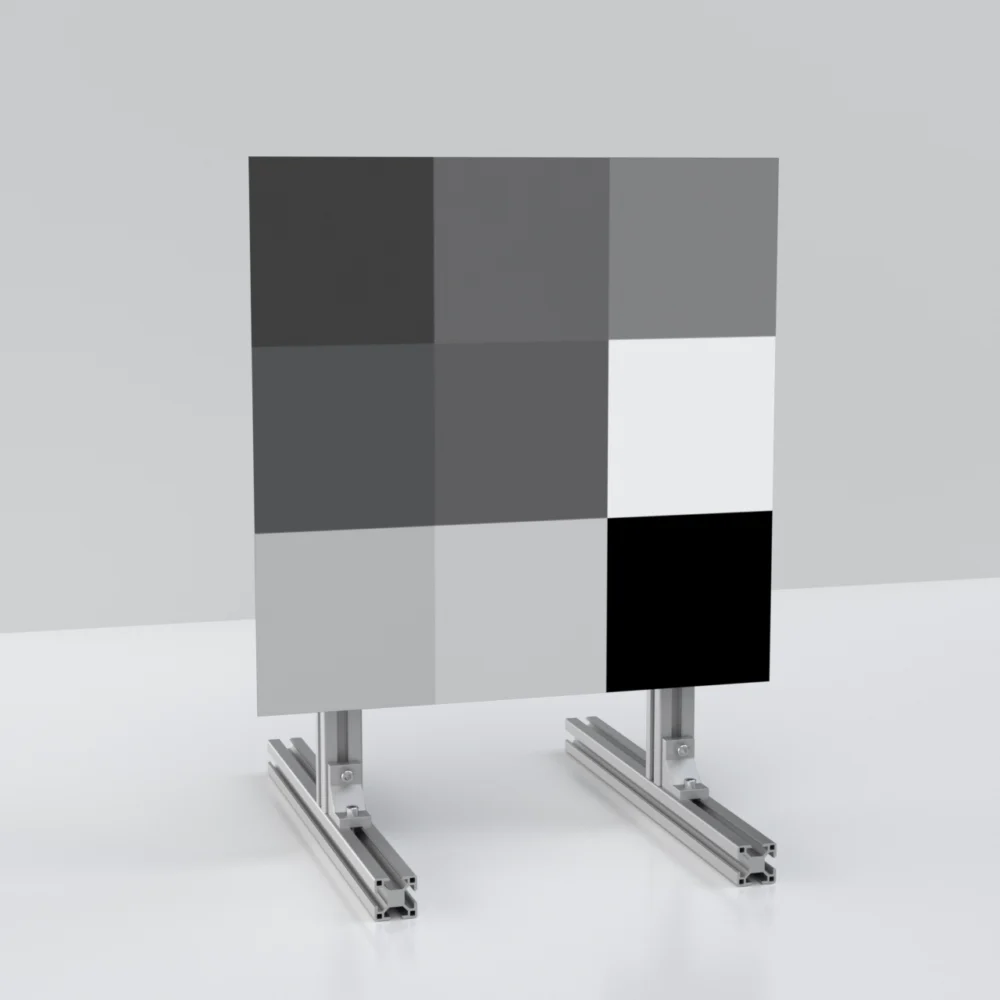
For OEM acceptance testing of 1550nm long-range LiDAR, multi-zone targets at the 24″×48″ to 2m × 2m range covering 10/50/90 reflectance values are typical. Custom configurations with 5-zone (10/30/50/70/90) or sub-5% stress-test zones are common for advanced characterization programs.
How Do You Set Up a 1550nm Test Lab Environment?
Three environmental factors specifically affect 1550nm test results:
Solar background noise is lower at 1550nm than at 905nm. Atmospheric water vapor absorbs significant solar radiation around 1400nm and 1900nm, reducing daytime solar contamination in the 1550nm band. This is a real advantage for outdoor testing — 1550nm long-range LiDAR can operate during daylight without the noise penalties that affect 905nm in the same conditions.
InGaAs detector cooling stability is critical. InGaAs detectors at 1550nm have higher dark current than silicon detectors at 905nm, and their performance is sensitive to temperature. Production 1550nm LiDAR systems include thermoelectric cooling for detector stability, but lab temperature should still be controlled (typically ±2°C) for repeatable test data. Long test sessions should monitor detector temperature alongside ambient temperature.
Atmospheric humidity affects 1550nm propagation. Water vapor absorbs 1550nm energy more than 905nm. For outdoor testing, recording humidity alongside other measurements lets you flag any humidity-driven attenuation in test data. This rarely matters for indoor lab work but is significant for outdoor test tracks.
For the largest 1550nm test installations (250m+ outdoor configurations), environmental monitoring is part of the test protocol — temperature, humidity, ambient lighting, and atmospheric particulate measurement are recorded with each test session for OEM acceptance documentation.
What Test Setup Mistakes Are Common with 1550nm?
Five mistakes that invalidate 1550nm test results:
Using a 905nm-calibrated target for 1550nm testing. This is the single most common 1550nm mistake. The cross-wavelength reflectance shift is too large to ignore — testing a 1550nm sensor against a “90% reflectance” target calibrated at 905nm gives systematically wrong results that look reasonable but are wrong by 10-30%.
Skipping InGaAs detector calibration. 1550nm LiDAR sensors require periodic recalibration of their InGaAs detector response. Test data taken on uncalibrated detectors mischaracterizes both range and intensity. Verify recent detector calibration before treating test results as defensible.
Testing at distances too short to characterize the sensor’s design envelope. A 1550nm LiDAR designed for 350m detection range tested at 50m doesn’t reveal its actual performance characteristics. Test at distances appropriate to the sensor’s design range — meaning outdoor test track work for most production 1550nm sensors.
Not accounting for atmospheric effects at long range. At 300m+ in outdoor conditions, atmospheric humidity, particulates, and temperature gradients all measurably affect 1550nm propagation. Test results at long range without environmental controls produce data that’s correct for the test conditions but doesn’t generalize.
Running tests through windows or partial enclosures. Most architectural glass blocks 50-90% of 1550nm transmission. Testing 1550nm sensors through windows, plastic enclosures, or partial protective housings introduces large attenuation errors that go unrecognized because visible light passes through fine.
These mistakes are particularly costly because 1550nm test programs are expensive — outdoor test track time, large custom targets, traceable metrology documentation. Getting tests right the first time matters more than at any other wavelength.
What’s the Maximum Detection Range of 1550nm LiDAR?
For Class 1 eye-safe production 1550nm automotive LiDAR, maximum useful detection range is typically:
- 10% reflectance target: 250-400m
- 50% reflectance target: 400-600m
- 90% reflectance target: 500-800m+
These ranges are theoretical maximums under ideal lab and outdoor conditions. Real-world detection range in adverse weather, with atmospheric attenuation, or against non-ideal surfaces is typically 60-80% of the lab number — better than 905nm in similar conditions because of 1550nm’s atmospheric advantages.
For comparison, 905nm production LiDAR achieves:
- 10% reflectance: 100-200m
- 50% reflectance: 150-300m
- 90% reflectance: 200-400m+
The detection-range gap (1550nm 2-3× longer than 905nm) is the entire reason long-range automotive applications justify the 5-10× component cost premium of 1550nm.
LiDAR detection range follows the LiDAR range equation:
R_max ∝ √(P_laser × ρ_target × A_aperture / NEP)
where R_max is maximum detection range, P_laser is peak laser power, ρ_target is target reflectance, A_aperture is receiver aperture area, and NEP is detector noise equivalent power. The 40× eye-safety advantage of 1550nm translates to √40 ≈ 6.3× theoretical range advantage, narrowed in practice by detector sensitivity differences to a realized 2-3× gap.
FAQs
Why don’t all automotive LiDAR systems use 1550nm if it’s better at long range?
Cost. 1550nm laser diodes and InGaAs photodetectors cost 5-10× more than equivalent 905nm silicon-based components. For LiDAR applications under 200m range — the vast majority of robotics, AGV, consumer, and short-range automotive — the 905nm cost advantage outweighs 1550nm’s range benefits. 1550nm is justified specifically when long detection range is required.
Is 1550nm completely eye-safe at any power level?
No. 1550nm is approximately 40× safer than 905nm at equivalent geometric conditions, but it’s not unconditionally safe. The IEC 60825-1 standard defines specific power and energy limits for Class 1 eye-safe operation at 1550nm, and exceeding these limits causes thermal damage to the cornea (rather than retina). All commercial 1550nm LiDAR is designed to operate well within Class 1 limits.
Can I use a 1550nm-calibrated target with a 905nm sensor?
Not without significant error. Cross-wavelength reflectance shift between 905nm and 1550nm is typically 10-30%, which is too large to ignore for any precision work. Order targets calibrated at the actual sensor wavelength. Some applications use multi-wavelength calibrated targets characterized at both 905nm and 1550nm, suitable for test programs that work across both bands.
What’s the difference between a 1550nm pulsed LiDAR and 1550nm FMCW LiDAR?
Pulsed 1550nm LiDAR uses short laser pulses and measures time-of-flight to determine range. FMCW (Frequency-Modulated Continuous Wave) 1550nm LiDAR uses continuous laser emission with frequency modulation, measuring range and velocity simultaneously by demodulating the returned signal. Aeva and Aurora use FMCW; Luminar uses pulsed. Both architectures benefit from 1550nm’s eye-safety and long-range advantages, but FMCW additionally gives instantaneous velocity measurement. From the perspective of reflectance target testing, both architectures characterize against the same Lambertian targets calibrated at 1550nm — the difference is in test protocol details, not target choice.
Are 1550nm reflectance targets compatible with research-grade applications?
Yes. The same engineered Lambertian coatings and sintered PTFE reference materials used for automotive 1550nm work serve research applications in atmospheric remote sensing, LIDAR development, and defense systems. For research-grade work requiring full BRDF characterization or NIST-traceable metrology certification, optional documentation is available through partner metrology labs.
How does atmospheric water vapor affect 1550nm detection?
Water vapor has absorption bands near 1400nm and 1900nm but transmits efficiently at 1550nm itself — this is why 1550nm was selected for telecommunications fiber optics decades before LiDAR applications. The atmospheric window at 1550nm is genuinely good. However, in heavy rain, fog with very fine droplet size, or snow, 1550nm shows somewhat worse performance than 905nm because larger water droplets scatter SWIR more than NIR. Net effect across typical weather is roughly equivalent between 905nm and 1550nm — neither wavelength is dramatically better in all conditions.
What’s a typical detection range spec for 1550nm production automotive LiDAR?
Modern 1550nm automotive LiDAR typically claims 250-400m detection range against 10% reflectance targets, with maximum advertised range against 90% targets reaching 500-800m. As with all LiDAR specifications, always check the reflectance assumption — a “500m max range” claim at 90% reflectance is not the same as 500m at 10%. Production 1550nm systems include Luminar Iris (250m at 10% spec), Aeva Atlas (300m+), and similar competitive products.
Do CalibVision 1550nm targets ship with calibration documentation?
Yes. Every 1550nm-calibrated target ships with a Reflectance Calibration Report measured at 1550nm under D50/2° illumination, documenting per-zone reflectance values, Lambertian behavior verification, and substrate flatness. For applications requiring formal traceability — automotive OEM acceptance testing, peer-reviewed publication, regulatory submission — bilingual (English/Chinese) certification through CMA-accredited and CNAS-aligned partner metrology labs is available as an optional add-on.
Get a 1550nm LiDAR Reflectance Target from CalibVision
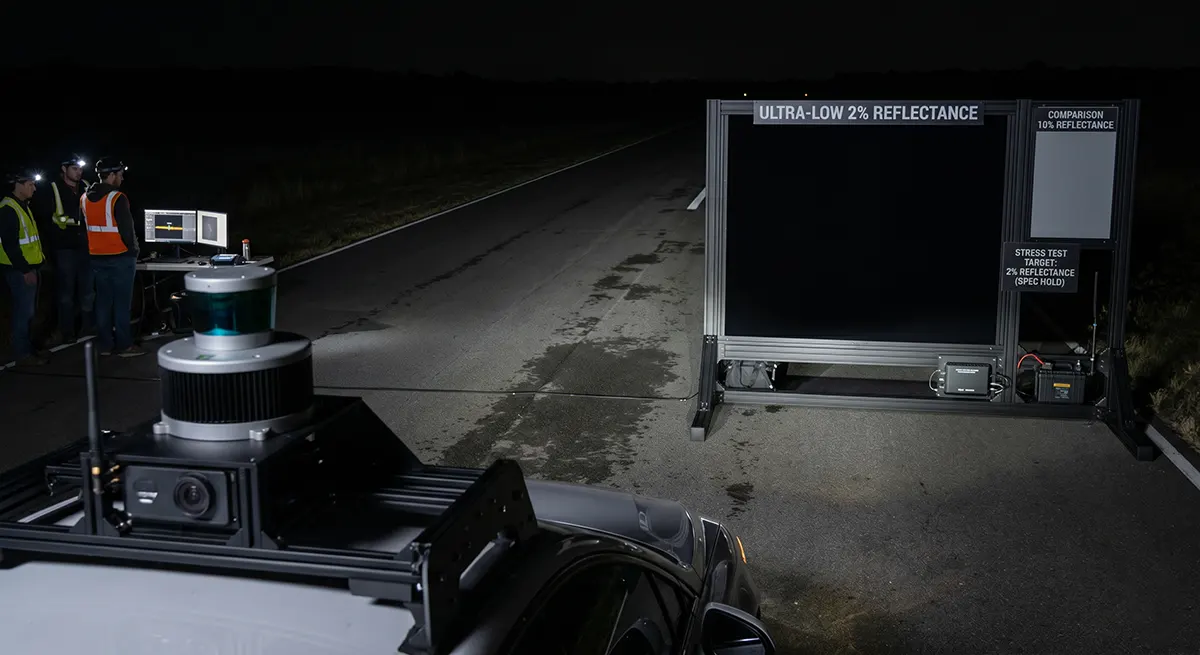
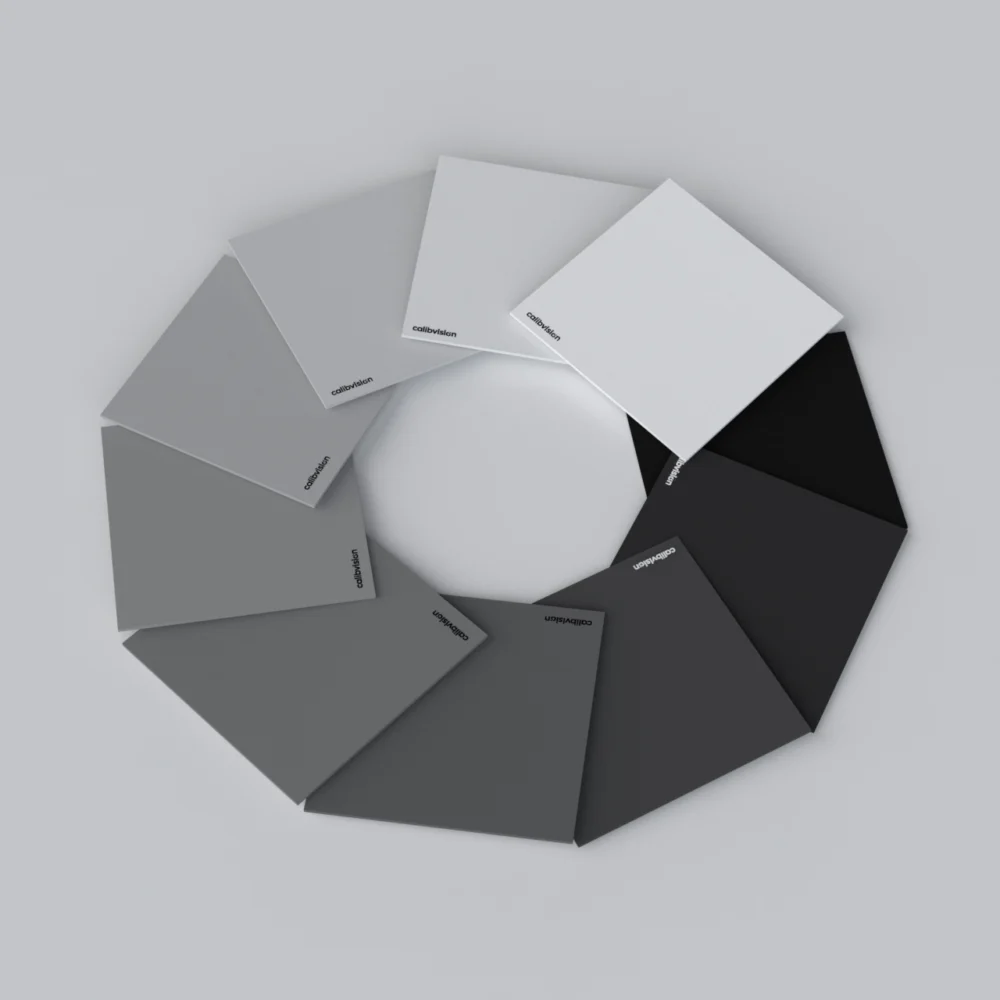
CalibVision manufactures 1550nm-calibrated diffuse reflectance targets in multi-zone configurations (10%/50%/90%) at sizes from 600×600mm up to 3m × 5m for outdoor test track applications. Custom reflectance values across the full 1-99% range, multi-wavelength characterization (1550nm + 905nm for cross-band testing programs), and weatherproof outdoor configurations are available as custom orders.
Every 1550nm target ships with a comprehensive Reflectance Calibration Report measured at 1550nm. For OEM acceptance testing requiring formal traceability, CMA-accredited and CNAS-aligned metrology institute certification is available.
Request a Custom 1550nm Quote → | Browse All Reflectance Standards → | Read the LiDAR Reflectance Targets Complete Guide →
What to Read Next
- The Complete Guide to LiDAR Reflectance Targets — main reference covering reflectance fundamentals across all LiDAR wavelengths.
- 905nm LiDAR Reflectance Target — Selection & Testing Guide — the contrast wavelength: what 905nm does well and where it falls short.
- Custom LiDAR Reflectance Targets — When Standard Sizes Aren’t Enough — guide to ordering custom 1550nm configurations for long-range and outdoor test programs.
- How to Test LiDAR Performance with Reflectance Targets — step-by-step lab setup applicable to both 905nm and 1550nm sensors.
- Lambertian vs Specular vs Retroreflective Targets — surface mode fundamentals for reflectance test work.
References
- Leishen LSLiDAR. (2022). 905nm vs 1550nm: Which Is Better for Automotive LiDAR?
- Inertial Labs. (2024). Why Have 905 and 1550 nm Become the Standard for LiDARs?
- IEC 60825-1:2014. Safety of Laser Products — Part 1: Equipment Classification and Requirements.
- Luminar Technologies. LiDAR Design Lab: Wavelength.
- EE Times. (2023). What’s the Direction for Automotive LiDAR — 905nm or 1550nm?