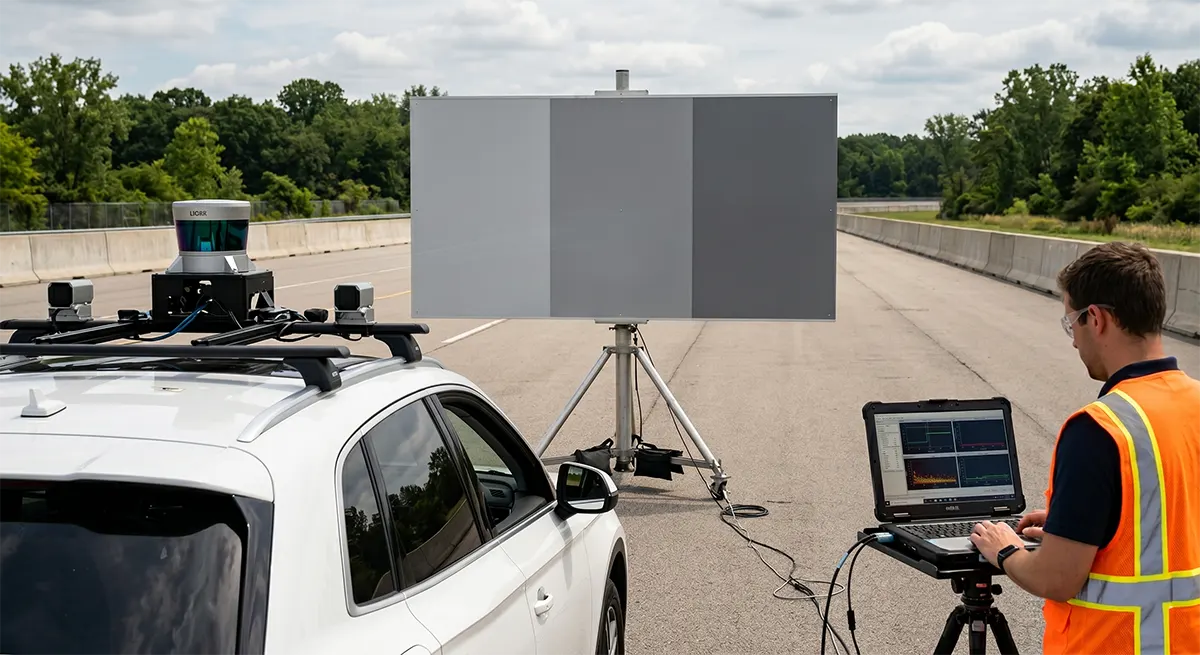
About 80% of LiDAR test programs run fine on standard 18″×36″ or 24″×48″ reflectance targets at the industry-standard 10%/50%/90% reflectance values, calibrated at 905nm. The other 20% have constraints — extreme test distances, non-standard wavelengths, specific reflectance values, custom mounting requirements, outdoor deployment — that don’t fit the standard product range. That 20% is where custom orders make sense.
This guide covers what’s actually manufacturable as a custom order, when custom is the right call (vs over-spec’ing a standard product), and what information you need to provide to get a usable target on the first delivery. I’ve spec’d custom orders at CalibVision for automotive Tier 1 suppliers, autonomous vehicle perception teams, robotics OEMs, and metrology institutes — the patterns below come from actual customer projects.
When Should You Order a Custom LiDAR Reflectance Target?
Custom orders make sense in six specific scenarios. If your situation matches one of these, ordering custom is faster and cheaper than trying to adapt a standard product:
1. Your test distance requires a target larger than 24″×48″. Standard sizes work for LiDAR test distances up to roughly 75 meters. Long-range automotive testing (200m+), drone LiDAR characterization, and outdoor test track work need targets at 1m × 1m or larger. Custom sizes scale up to 3m × 5m for the most demanding long-range applications.
2. Your sensor uses a non-standard wavelength. Targets calibrated at 905nm don’t give correct reflectance values when used with 1550nm, 1064nm, or other wavelengths. If you’re working at a non-standard wavelength — survey-grade 1064nm LiDAR, research-grade 1310nm sensors, or specialty defense applications — order a target characterized at your specific wavelength.
3. You need reflectance values outside the standard 10/50/90. Programs developing perception for low-light or twilight conditions sometimes specify 2% or 5% reflectance for stress testing. Spectrometer calibration and metrology work needs reflectance approaching 99%. Multi-zone configurations with 4 or 5 reflectance values (e.g., 10%/30%/50%/70%/90%) give finer characterization resolution. Any value between 1% and 99% is manufacturable.
4. You need threaded mount holes drilled to your fixture spec. Standard reflectance products ship with no mounting hardware or with fixed mounting points that almost never match your test fixture. Custom mount-hole patterns let the target bolt directly into your existing test rig — no adapter brackets, no field machining, no compromises.
5. Your target lives outside. Automotive OEM outdoor test tracks, drone test ranges, agricultural vehicle testing — any program where the reflectance target stays outside between tests needs weatherproof construction. Standard targets aren’t rated for sustained UV exposure, rain, or temperature cycling.
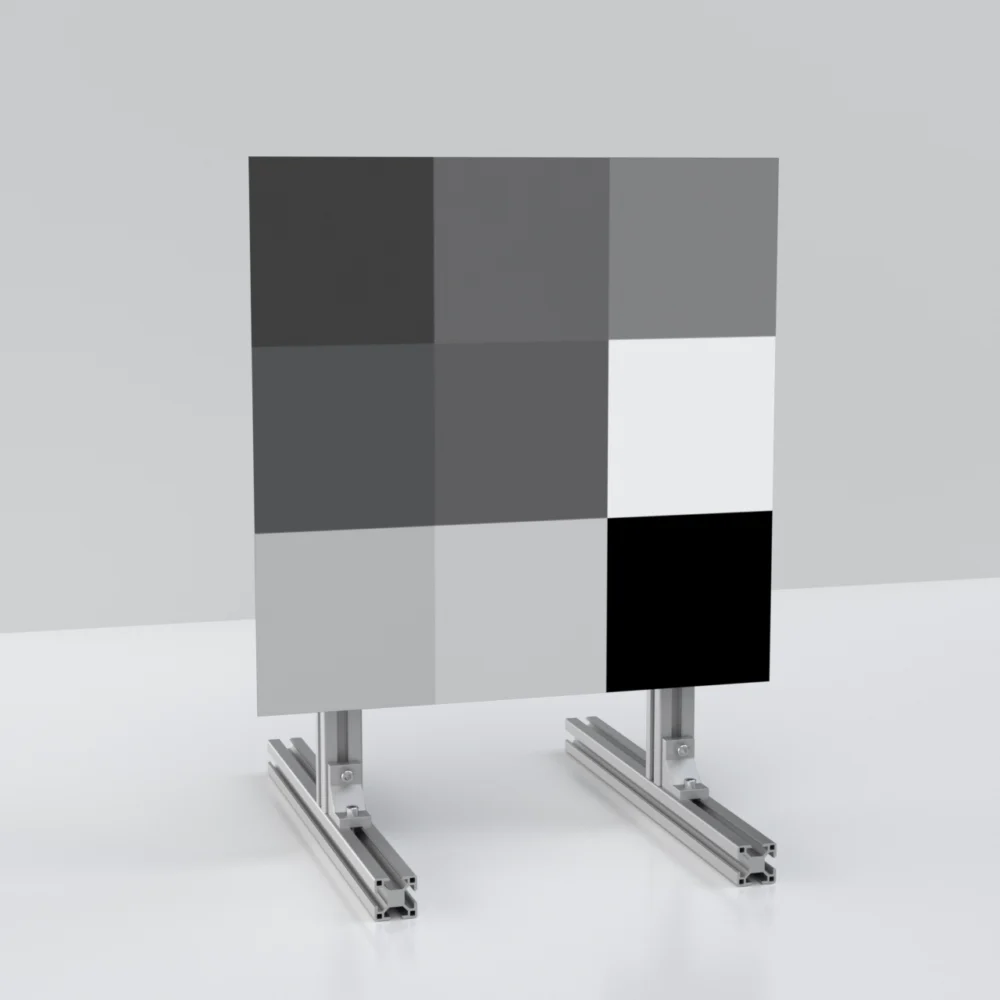
6. You need integrated mounting hardware as part of the system. Mobile floor stands, slide rail systems, fixed mount brackets, hard-shell transit cases — bundling these with the reflectance target itself simplifies procurement and ensures everything fits together correctly.
If your situation doesn’t match any of these six, a standard product is usually the right answer. Over-spec’ing a standard product wastes budget without improving test data quality.
What Custom Sizes Are Manufacturable?
Standard reflectance target sizes top out at 24″×48″ (610 × 1220 mm). Beyond that, custom manufacturing scales up significantly:
Up to 1500 × 1500 mm (≈59″×59″) — most common custom range. Used for automotive LiDAR testing at 100-150m distances, AGV navigation system testing, and large-fixture industrial vision setups. Production lead time is typically 10-14 business days.
1500 × 3000 mm (≈59″×118″) — extended automotive range. Used for long-range automotive LiDAR testing at 150-250m distances. The 3m dimension lets the target subtend enough angular size at long range that detection probability stays meaningful. Production lead time 14-21 days.
Up to 3000 × 5000 mm (≈118″×197″) — outdoor test track configurations. Used for OEM autonomous vehicle test programs at 250m+ distances, where the target needs to be visible from the LiDAR’s full beam divergence at maximum design range. These are essentially building-sized panels, typically deployed semi-permanently at outdoor test facilities. Production lead time 4-6 weeks.
Smaller than standard. Custom small sizes (under 200 × 200 mm) for tabletop testing, indoor robotics characterization, or fixture-mounted production-line applications. Production lead time 7-10 business days.
For any size, the substrate choice changes with scale. Solid aluminum plate works up to roughly 600 × 600 mm before flexing under its own weight. Beyond that, aluminum honeycomb composite substrate is required to maintain ≤1mm flatness across the full panel. Above 2m × 2m, multi-panel modular construction is sometimes used to ease shipping and handling.
What Custom Reflectance Values Are Available?
Reflectance values are continuously variable from 1% to 99% — what changes with the value is manufacturing complexity and cost.
Standard 10%, 50%, 90% values. These are the easiest to manufacture stably and represent the highest-volume production. A custom order at these values has the same lead time and cost structure as standard products.
Custom values in the 5% to 95% range. Easily manufacturable. Common requests include 30%/70% (for 5-zone multi-reflectance boards) and 25%/75% (matching specific OEM test protocols that diverge from 10/50/90). Lead time and cost are similar to standard production.
Sub-5% reflectance (1-5% range). Significantly harder to manufacture stably. Achieving consistent 2% reflectance across the full panel area requires specialty light-absorbing pigments and tighter QC procedures. Lead time adds 5-7 days; cost is moderately higher than mid-range values. Used for stress-testing perception against very dark scenes (deep shadows, dark vehicles in low-light, asphalt at night).
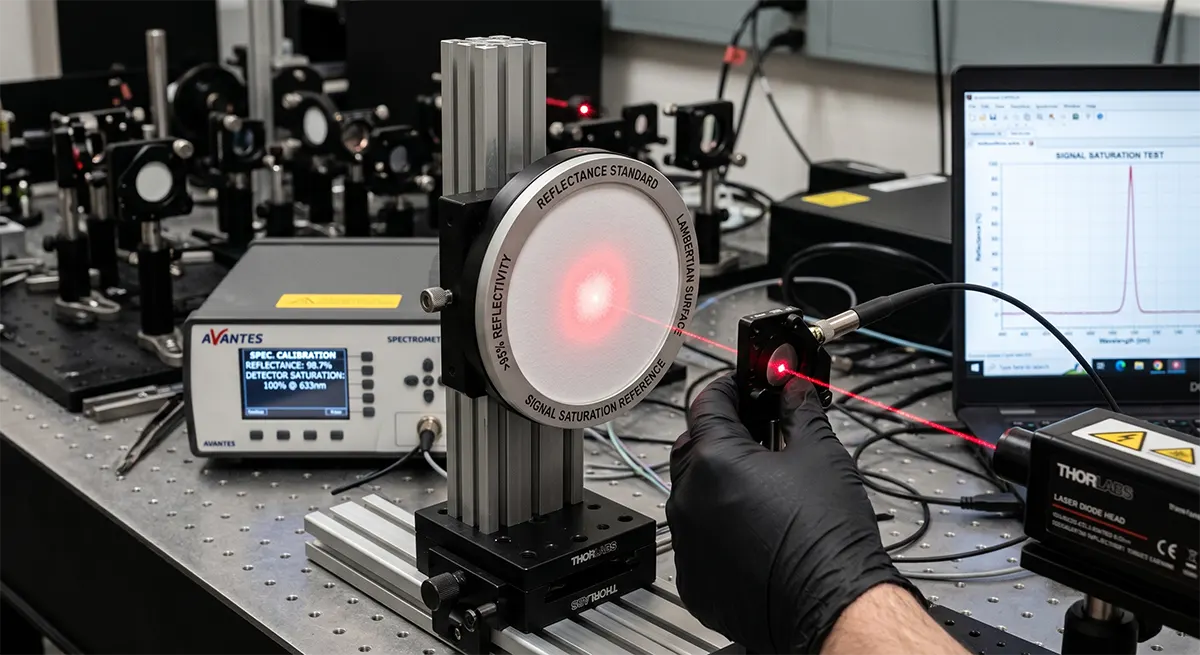
95-99% reflectance. Approaches the practical reflectance ceiling for engineered Lambertian coatings. For applications requiring this end of the range, sintered PTFE reference standards (sometimes called Spectralon or equivalent) reach 98-99% reflectance with near-perfect Lambertian behavior across 250-2500nm. These are typically small-format reference discs (30-300mm diameter) used for spectrometer calibration, laser power measurement, and metrology institute reference work — different product class from typical LiDAR test boards.
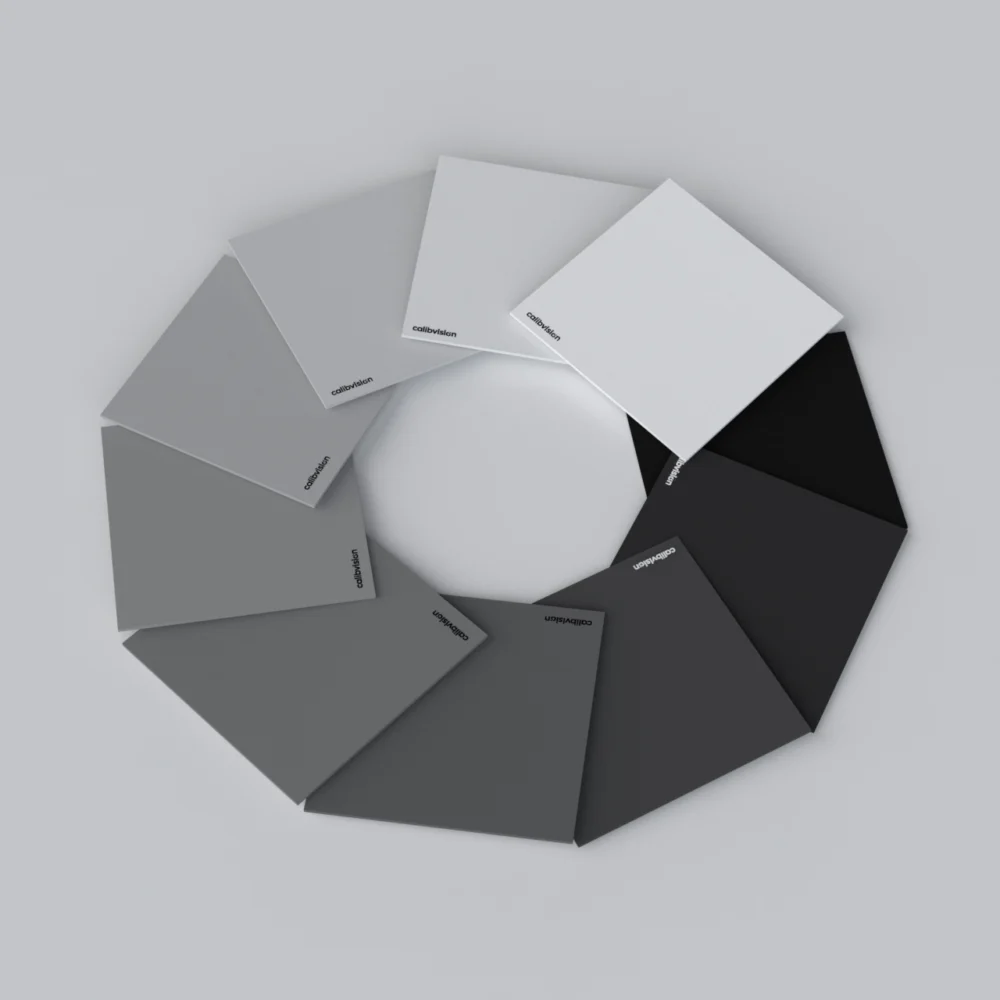
Multi-zone configurations. Single boards can combine any number of reflectance zones in any sequence. Common configurations include 3-zone (10/50/90 standard), 5-zone (10/30/50/70/90 fine-resolution), and 7-zone or 9-zone (custom protocols for specific characterization programs). Each additional zone adds modest cost; the full 9-zone gradient ladder costs roughly 60% more than a standard 3-zone board of the same size.
What Custom Wavelengths Can Be Calibrated?
Standard wavelengths covered without custom characterization are 905nm, 1550nm, 940nm, and 850nm — these cover the vast majority of commercial LiDAR.
For non-standard wavelengths, custom calibration is available at:
- 1064 nm — survey-grade terrestrial LiDAR (Leica, Trimble), aerial mapping LiDAR, military/research applications
- 1310 nm — research-grade LiDAR systems, fiber-coupled photonics applications
- 635 nm / 680 nm — visible-spectrum LiDAR (less common but used in specialty applications)
- Multi-wavelength characterization — same target characterized at 2-4 different wavelengths, for sensors that operate across multiple bands
For each non-standard wavelength, the manufacturing process is the same — what differs is the calibration measurement at the specific wavelength. Most coatings used in CalibVision targets show acceptable Lambertian behavior across 250nm to 2500nm; the calibrated reflectance value at any specific wavelength within that range is verifiable on a goniospectrophotometer.
For wavelengths outside 250-2500nm (deep UV, far-infrared, terahertz), specialty substrates and coatings are required. These are quoted on a project basis with longer lead times (6-8 weeks typical).
How Do You Specify a Custom Mount Hole Pattern?
This is the customization that separates a target that ships in a box from a target that’s ready to use on day one.
When specifying custom mount holes, provide:
1. A drawing or sketch showing hole positions. This can be a CAD file, a clearly-dimensioned hand sketch, or a photo of your existing test fixture with measurements. We confirm the pattern back to you before manufacturing starts. The drawing should show:
- Hole position relative to a corner or edge of the panel
- Distance between holes (center-to-center)
- Whether the pattern is on the front face, back face, or both
2. The thread specification. M6 is standard and most common. We also drill M4, M5, M8 metric and 1/4-20, 5/16-18, 3/8-16 imperial. Threaded inserts are bonded permanently into the honeycomb composite substrate.
3. The mount face. Front face mounting puts the threaded inserts into the reflective surface side, which simplifies fixture mounting but exposes inserts to view. Back face mounting hides the hardware behind the panel — preferred for applications where the visible front face needs to look clean. Both faces is also possible (for fixtures with both front and rear support).
4. Hole tolerance. Standard hole position tolerance is ±0.5mm, which is fine for mounting brackets and most fixtures. Tighter tolerance (±0.2mm) is available for precision-aligned setups; specify in the order if needed.
Standard custom hole drilling adds no extra time when specs are provided up front — drilling happens in parallel with the standard 10-14 business day production cycle. If hole specs come after manufacturing has started, expect 5-7 days additional lead time.
A note on substrate: custom mount holes automatically include the honeycomb composite substrate upgrade, because solid aluminum plate is too thin to hold threaded inserts reliably through repeated mount/dismount cycles. The substrate upgrade is included in the custom-quote price, not charged separately.
Can Custom Targets Be Built for Outdoor Use?
Yes, with weatherproof configuration. For outdoor test programs (automotive OEM test tracks, drone ranges, agricultural vehicle testing), targets need to maintain calibrated reflectance through:
- Sustained UV exposure — direct sunlight degrades standard coatings within months
- Rain and humidity — water infiltration affects coating uniformity and substrate integrity
- Temperature cycling — typical outdoor swings of -20°C to +60°C cause expansion/contraction stress
- Wind-driven dust and debris — abrasion damages the calibrated surface
Weatherproof construction layers a protective coating over the standard Lambertian surface. The protective layer is engineered to maintain reflectance values within ±2% of nominal through 2-3 years of outdoor exposure (depending on local climate). Substrate is upgraded to honeycomb composite or, for the largest panels, multi-section construction with sealed joints.
Weatherproof configuration adds 5-7 days to standard lead time and is quoted as a custom-order option. For test programs that move targets between indoor lab and outdoor test sessions, a weatherproof config is recommended even for sub-1-year deployments — repeated lab/outdoor transitions accelerate degradation faster than continuous outdoor exposure.
What Documentation Ships with a Custom Order?
Every custom order includes a comprehensive Reflectance Calibration Report consolidating all quality data for that specific panel into one signed deliverable:
- Per-zone reflectance measurement at the specified wavelength(s)
- Lambertian behavior verification across viewing angles up to 60° off-axis
- Substrate flatness data (per-panel measurement against ≤1mm spec for honeycomb composite)
- Manufacturing batch number and individual panel serial number
- Customer-specified parameters (size, reflectance values, wavelength, mount pattern)
For commercial workflows requiring legal-grade traceability, optional documentation is available:
- Bilingual (English/Chinese) traceability certificate suitable for ISO audits, peer-reviewed publication, and OEM quality submissions
- National metrology institute certification through CMA-accredited (China Metrology Accreditation) and CNAS-aligned laboratories — adds 2-3 weeks to standard lead time
- Extended wavelength characterization at additional points beyond the primary calibration wavelength
- Full BRDF characterization with goniospectrophotometer measurement, available for metrology-grade applications
The standard documentation is sufficient for most internal R&D and production QA work. Optional certification matters when test data must pass external audit — automotive OEM acceptance, regulatory submission, or peer-reviewed publication.
What Information Do You Need to Provide for a Quote?
To get an accurate custom quote on the first turnaround, send us:
Application context. What LiDAR system are you testing? What’s the test distance? What’s the operating environment (indoor lab, outdoor test track, production line)? The application drives the right substrate and configuration recommendations — over-specifying wastes budget; under-specifying produces a target that doesn’t work.
Size requirements. Overall panel dimensions in mm or inches, with tolerance if specific dimensions matter for fixture compatibility.
Reflectance values and zone configuration. Single-value, 3-zone (10/50/90), 5-zone (10/30/50/70/90), or custom multi-zone. Specify reflectance values for each zone, plus whether you need seamless zone transitions on a single board or separate panels.
Wavelength. 905nm, 1550nm, 940nm, 850nm, or custom (1064nm, 1310nm, etc.). Match to your sensor’s primary wavelength.
Mounting requirements. Threaded mount hole pattern (drawing or sketch), thread specification, mount face (front/back/both), tolerance, plus any additional accessories (mobile stand, slide rail, transit case, weatherproof coating).
Documentation requirements. Standard calibration report only, or do you need bilingual traceability, third-party metrology certification, extended wavelength characterization?
Quantity. Single unit, small batch (2-10 units), or production volume (10+). Volume pricing kicks in at small-batch and production scales.
Timeline. When do you need delivery? Lead times vary by configuration — confirming timeline up front lets us flag whether your requirements fit the schedule before manufacturing starts.
Custom quotes typically turn around in 1-2 business days when this information is provided. Quotes turn around faster than this if your specs match patterns we’ve manufactured recently; they take longer if specs require sourcing review or new tooling.
What Lead Times Should You Expect?
Production lead times depend on configuration complexity:
- Standard custom (size + reflectance value variation, single substrate): 10-14 business days
- Custom mount holes: included in the 10-14 day production cycle (no added time when specs are provided up front)
- Non-standard size (>1500mm in either dimension): 14-21 business days
- Non-standard wavelength characterization: adds 3-5 days for measurement
- Weatherproof outdoor configuration: adds 5-7 days
- Third-party metrology institute certification: adds 2-3 weeks beyond standard production
- Air freight delivery: 4-7 business days from shipment to most international destinations
For time-critical projects, expedited production is sometimes available at additional cost — typically reducing standard production by 3-5 days. Discuss timing requirements during the quote process; we’ll flag what’s possible before you commit to an order.
FAQs
What’s the maximum size you can manufacture?
Standard custom range goes up to 1500 × 3000 mm. For outdoor test track applications, we manufacture up to 3000 × 5000 mm (≈10ft × 16ft). Above this size, multi-panel modular construction is used. The constraint is shipping logistics and on-site assembly more than manufacturing capability.
Can I order a custom reflectance value lower than 1%?
Reflectance values below 1% require specialty light-absorbing materials (carbon-black coatings, vantablack equivalents) rather than standard Lambertian pigments. We’ve manufactured 0.3% reflectance targets for specialty perception research, but lead time and cost are significantly higher than standard custom orders. Discuss your application during quoting — there’s usually a way to achieve what you need.
Do you ship internationally?
Yes. CalibVision ships to North America, Europe, Asia-Pacific, and Latin America via DHL, FedEx, and UPS air freight. DDP (Delivered Duty Paid) is the standard incoterm for most destinations — you receive the target with all import duties and taxes included in the quote. Express courier is available for time-critical orders.
What’s the minimum order size?
Single units are fine for most custom configurations. There’s no formal minimum quantity. Volume pricing starts at 2+ units of identical configuration; significant production volume discounts begin at 10+ units.
Do you offer custom orders for academic research?
Yes. We work regularly with university research programs and have flexible pricing and documentation arrangements for academic projects. If your research requires specific methodology disclosure or co-authorship considerations, mention it during quoting.
Can custom targets match a specific competitor’s product specifications?
Sometimes — if the competitor’s spec is technically achievable. Many “competitor-specific” requests turn out to match our standard capabilities; some require workarounds for proprietary materials. Send the spec sheet during quoting and we’ll tell you what’s matchable.
How do I confirm my custom order specifications before manufacturing starts?
After quote acceptance, we send a manufacturing specification sheet summarizing every parameter (size, reflectance values, wavelength, mount pattern, documentation) for your written confirmation. Manufacturing begins only after explicit sign-off on this specification. This eliminates miscommunication errors that would otherwise cause re-work.
Do custom orders include warranty?
Yes. Standard 12-month warranty against manufacturing defects, dimensional issues, and coating failures under normal indoor lab use applies to custom orders identically to standard products. Reflectance calibration is guaranteed at delivery; long-term drift is industry-typical and not covered (typical drift is under 1% per year in dark indoor storage).
Get a Custom LiDAR Reflectance Target from CalibVision
CalibVision manufactures custom LiDAR reflectance targets across the full range described above — from 200mm tabletop targets to 3m × 5m outdoor test track panels, at any reflectance value from 1% to 99%, calibrated at 905nm, 1550nm, 940nm, 850nm, or non-standard wavelengths.
Standard custom orders ship in 10-14 business days. Quotes turn around in 1-2 business days when specifications are provided up front.
Request a Custom Quote → | Browse Standard 905nm Targets → | View All Reflectance Standards →
What to Read Next
- The Complete Guide to LiDAR Reflectance Targets — main reference covering reflectance fundamentals, materials, and applications.
- 10%, 50%, and 90% Reflectance Targets — Which Do You Need? — when to use standard reflectance values and when to consider custom.
- How to Test LiDAR Performance with Reflectance Targets — step-by-step lab setup guide using calibrated targets.
- Lambertian vs Specular vs Retroreflective Targets — fundamentals of reflective surface modes for test targets.