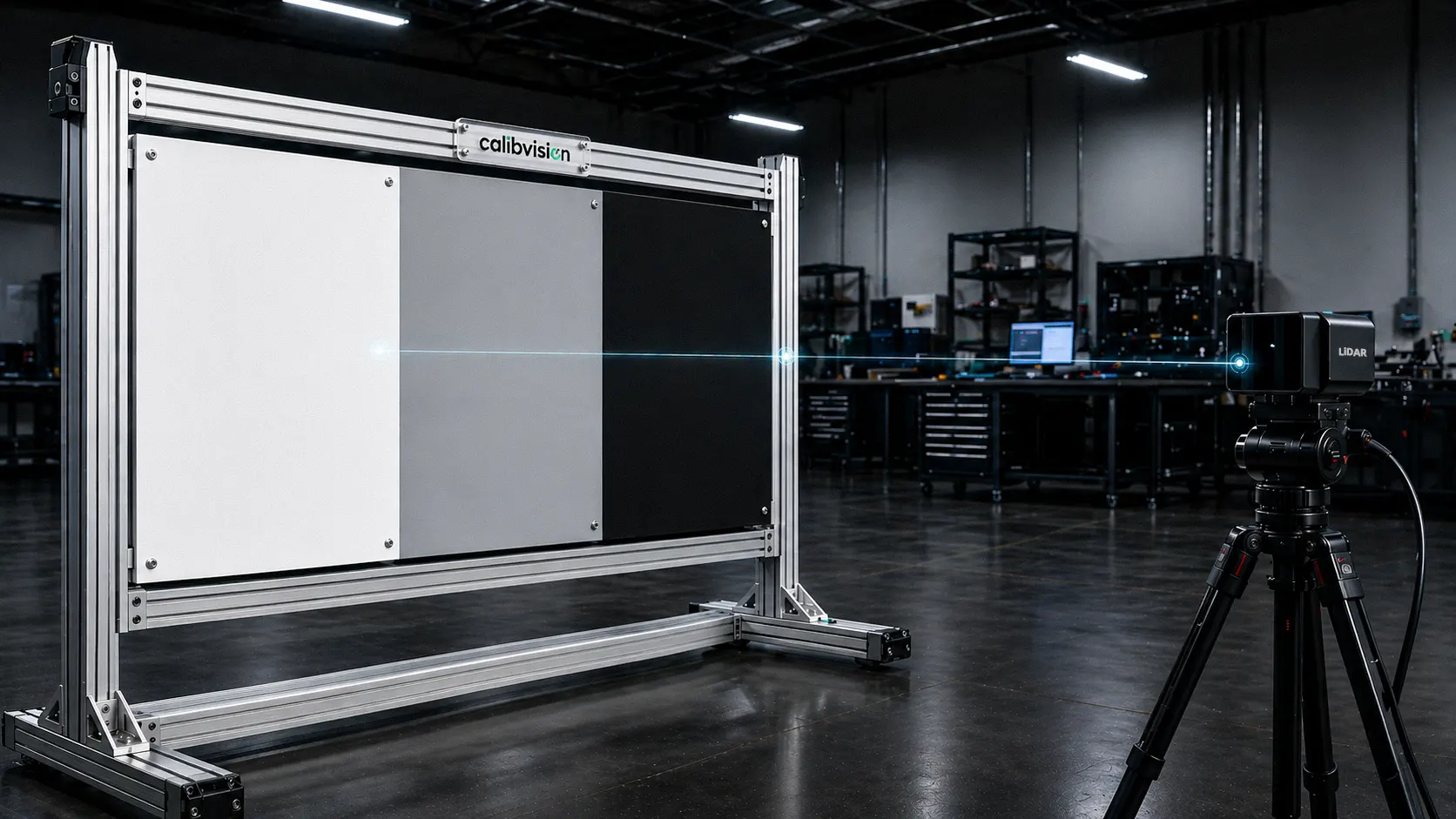
For LiDAR performance testing, the industry-standard reflectance values are 10%, 50%, and 90%. The 10% target stress-tests detection range against worst-case dark surfaces. The 50% target characterizes typical real-world performance. The 90% target verifies behavior with bright surfaces and signal saturation limits. Most professional LiDAR test programs use all three values together as a multi-reflectance set, because each one tells you something different about how your sensor performs in conditions you’ll actually encounter.
This guide walks through what each reflectance value represents, when you’d use each, why “all three” is usually the right answer, and when you should consider custom values beyond the standard trio.
I’ve helped LiDAR engineers spec test targets at CalibVision for years, and the reflectance-value question comes up in almost every quote conversation. Below is the practical decision guide.
What does reflectance percentage actually mean?
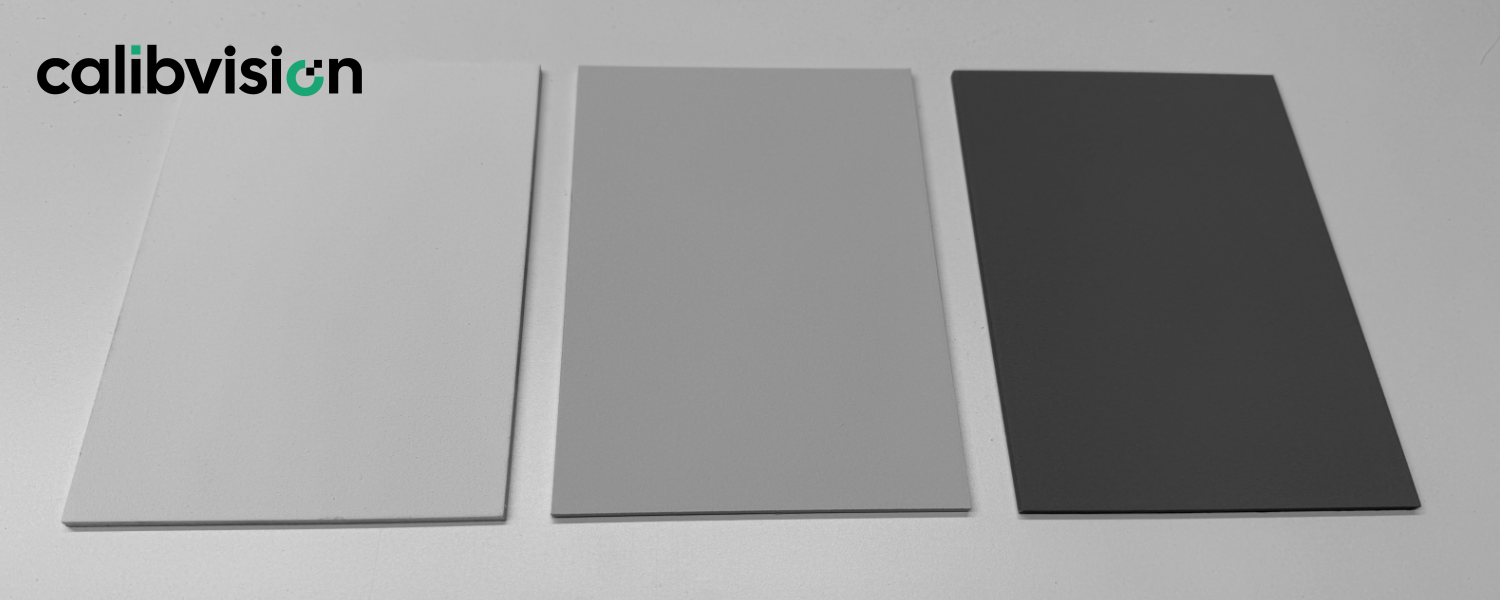
When we say a target is “10% reflectance,” we mean the surface reflects 10% of the light that hits it, measured at the wavelength your LiDAR uses. The other 90% is absorbed or scattered in non-useful directions.
A few clarifications that catch people new to this:
Reflectance is wavelength-specific. A surface that reflects 50% at visible light might reflect 60% at 905nm and 40% at 1550nm. Reflectance values are always specified at a wavelength — for LiDAR test targets, that’s typically 905nm, 1550nm, 940nm, or 850nm depending on your sensor.
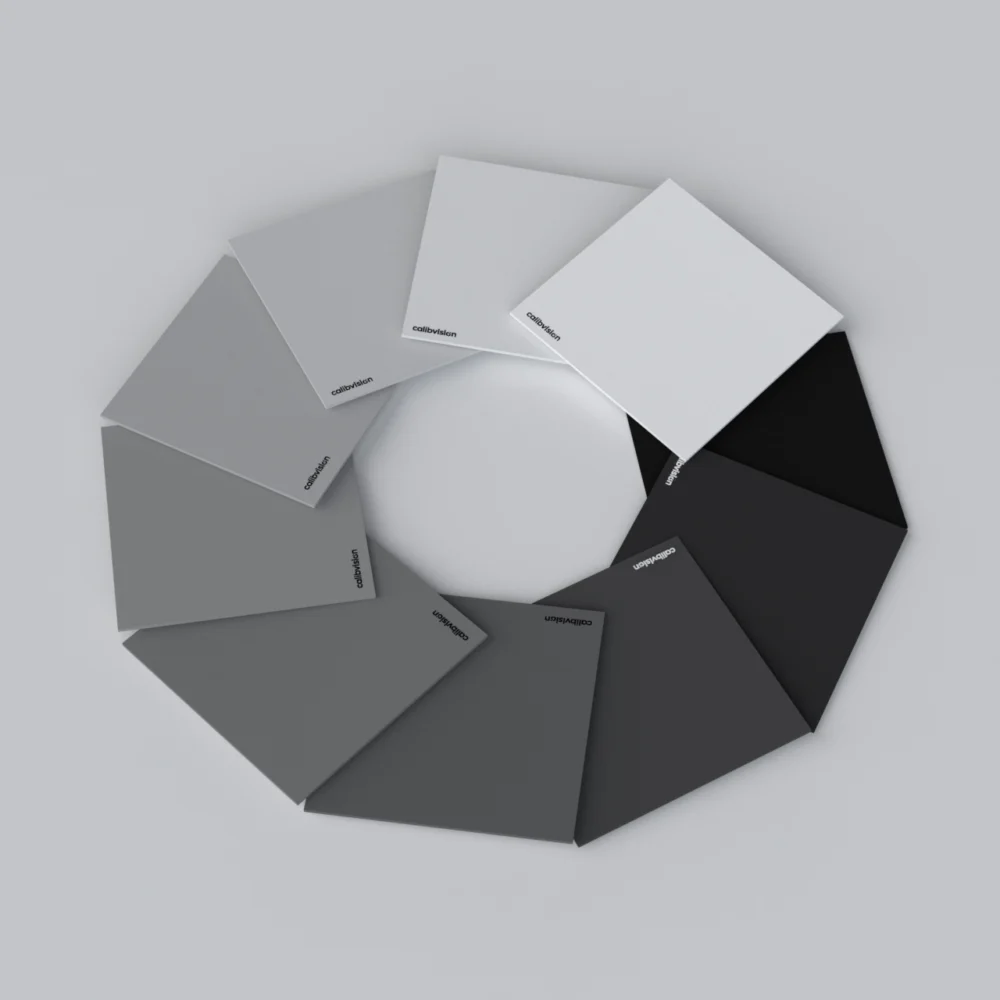
Reflectance is not the same as “color.” A “white” surface to the human eye is just a surface that reflects most visible-light wavelengths. A LiDAR target at 50% reflectance will look mid-gray under visible light, but its actual color appearance and its 905nm or 1550nm reflectance value are independent of each other. We engineer the reflectance to a specific value at a specific wavelength — visual appearance is whatever falls out of that engineering.
Reflectance describes what the surface does, not what the LiDAR detects. Detection depends on reflectance plus distance, beam intensity, atmospheric conditions, sensor sensitivity, and signal-processing thresholds. The reflectance value is a property of the target alone — your LiDAR detection performance depends on the rest of the system too.
Why did 10%, 50%, and 90% become the LiDAR industry standard?
The 10/50/90 trio wasn’t picked at random. Each value represents a meaningful real-world condition the LiDAR will actually encounter, and the spacing between them is chosen for measurement resolution at the part of the curve that matters most.
The history is automotive. When LiDAR systems first moved into autonomous driving development, OEMs needed test protocols that mapped to actual driving scenarios. Engineers measured the typical reflectance of common scene materials and clustered them into three bands:
- Low reflectance (5-15%) — dark vehicles, fresh asphalt, dark clothing, wet road surfaces, deep shadows
- Medium reflectance (40-60%) — concrete, average vehicle paint, building facades, mid-toned vegetation, gray surfaces in general
- High reflectance (80-95%) — white vehicles, road markings, snow, light surfaces, road signs (excluding retroreflectors)
10%, 50%, and 90% landed at the middle of each cluster. They became the de facto industry standard because they’re simple to remember, easy to verify with off-the-shelf measurement equipment, and they cluster around the LiDAR detection-range non-linearity that defines real-world performance.
The spacing matters too. 10% to 50% is a 5x ratio. 50% to 90% is a 1.8x ratio. This non-linear spacing gives you more resolution where detection range falls off most steeply — at the dark end. Doubling reflectance from 10% to 20% changes detection range by roughly the square root, which is a meaningful improvement. Doubling from 50% to 100% changes detection range by a similar ratio but at the easy end of the curve, where most real-world performance is already adequate.
When do you need a 10% reflectance target?
The 10% reflectance target is your stress test. It defines the worst-case detection range of your LiDAR — the distance at which your sensor can still reliably detect the darkest realistic targets.
Use a 10% target when:
- You’re characterizing maximum useful range for a new LiDAR system. Datasheet “max range” claims are typically measured against 10% targets — using anything brighter inflates the number and misrepresents real-world capability.
- You’re testing detection of dark vehicles, dark pedestrians, or low-albedo road surfaces. Black cars, dark clothing, fresh asphalt, and wet roads are the realistic edge cases that cause real-world detection failures. If your LiDAR can’t see a 10% target at the distances you need, it will miss real obstacles in the field.
- You’re stress-testing perception algorithms. Computer-vision and machine-learning perception pipelines that work fine at 50%+ reflectance often degrade in unexpected ways at 10%. Testing at 10% surfaces these failure modes before deployment.
- You’re running automotive certification testing. Industry standards from SAE J3088 and similar OEM specifications require minimum detection performance against 10% targets at specified distances.
In practice, the 10% target is usually the hardest of the three to detect. If your test setup detects a 10% target reliably at the distance you need, the other two will work fine. The 10% is what defines whether your sensor passes or fails.
A note on what 10% doesn’t simulate: the very darkest engineered surfaces (carbon-black coatings, certain matte plastics, light-absorbing foams) reach 1-3% reflectance. Most real-world vehicle paints and road surfaces don’t go below about 5-7% even at their darkest. 10% is an aggressive but realistic floor for “things you’ll actually encounter.”
When do you need a 50% reflectance target?
The 50% reflectance target is your typical-case characterization. It maps to the average reflectance of real-world surfaces your LiDAR will see most of the time.
Use a 50% target when:
- You’re characterizing nominal detection accuracy. Most accuracy specifications (range precision, angular precision) are measured against mid-reflectance targets because that’s where most real-world data points come from.
- You’re matching specifications across multiple LiDAR units. Production-line acceptance testing typically uses 50% targets to verify unit-to-unit consistency without the dynamic range stress that 10% or 90% targets introduce.
- You’re calibrating intensity output. LiDAR intensity values (the “how reflective is this point” output) are typically calibrated against a 50% reference because it sits in the middle of the sensor’s usable signal range — neither saturated nor near the noise floor.
- You’re training perception classifiers. Most real-world training data falls in the 30-70% reflectance range, so a 50% target is the most representative point for classifier validation.
The 50% target is usually the easiest to detect of the three. It produces strong signal returns without saturating the sensor, sits in the middle of the dynamic range, and gives you the cleanest measurement at most distances. This makes it the right reference for nominal-condition performance characterization.
When do you need a 90% reflectance target?
The 90% reflectance target serves two related purposes: testing performance against bright real-world surfaces, and stress-testing the sensor’s behavior at signal saturation.
Use a 90% target when:
- You’re testing detection of road signs, light vehicles, or snow. Painted road signs, white cars, light pavement markings, and fresh snow can all reach 80-95% reflectance. Your LiDAR must handle these without artifacts or false positives.
- You’re characterizing close-range saturation behavior. When a 90% target is close to the sensor (say, 5-15m), the returning signal can saturate the LiDAR’s photodetector. Saturation can cause spurious returns, distance-measurement errors, and in some sensor designs, “blooming” artifacts that affect adjacent pixels. The 90% target reveals these failure modes.
- You’re testing automotive systems against real-world worst-case bright targets. A 90% target close to the sensor approximates the real-world scenario of an oncoming white vehicle or a sunlit white wall — both of which can produce saturation artifacts in production LiDAR.
- You’re verifying intensity dynamic range. The ratio of intensity readings between a 90% target and a 10% target should be approximately 9:1 if the sensor’s intensity output is well-calibrated. Departures from this ratio indicate compression, clipping, or non-linearity.
A 90% target isn’t usually a detection test — modern LiDAR detects 90% targets at extreme range without difficulty. Instead, it’s a behavior test, characterizing what the sensor does when signal returns are at the upper end of its dynamic range.
Why do professional LiDAR labs use all three reflectance values?
You’ll notice a pattern from the three sections above: each reflectance value tests a different sensor behavior. You can’t substitute one for the others, and using only one gives you an incomplete picture of LiDAR performance.
Here’s the typical professional test sequence:
- Detection range measured at 10%, 50%, and 90% — at increasing distances, until detection probability drops below 90% across multiple frames at each value
- Range accuracy measured at fixed distances against all three values — to verify accuracy is consistent across the dynamic range
- Intensity calibration verified across all three values — to confirm intensity output scales correctly with reflectance
- False positive rate characterized under each condition — sometimes 90% targets at certain distances cause false returns from sensor saturation
A test program with only one reflectance value can pass that single test while harboring serious failure modes at the other reflectance values. This is why automotive OEM acceptance testing, professional LiDAR characterization, and most academic research use the full 10/50/90 set — it’s the minimum information set.
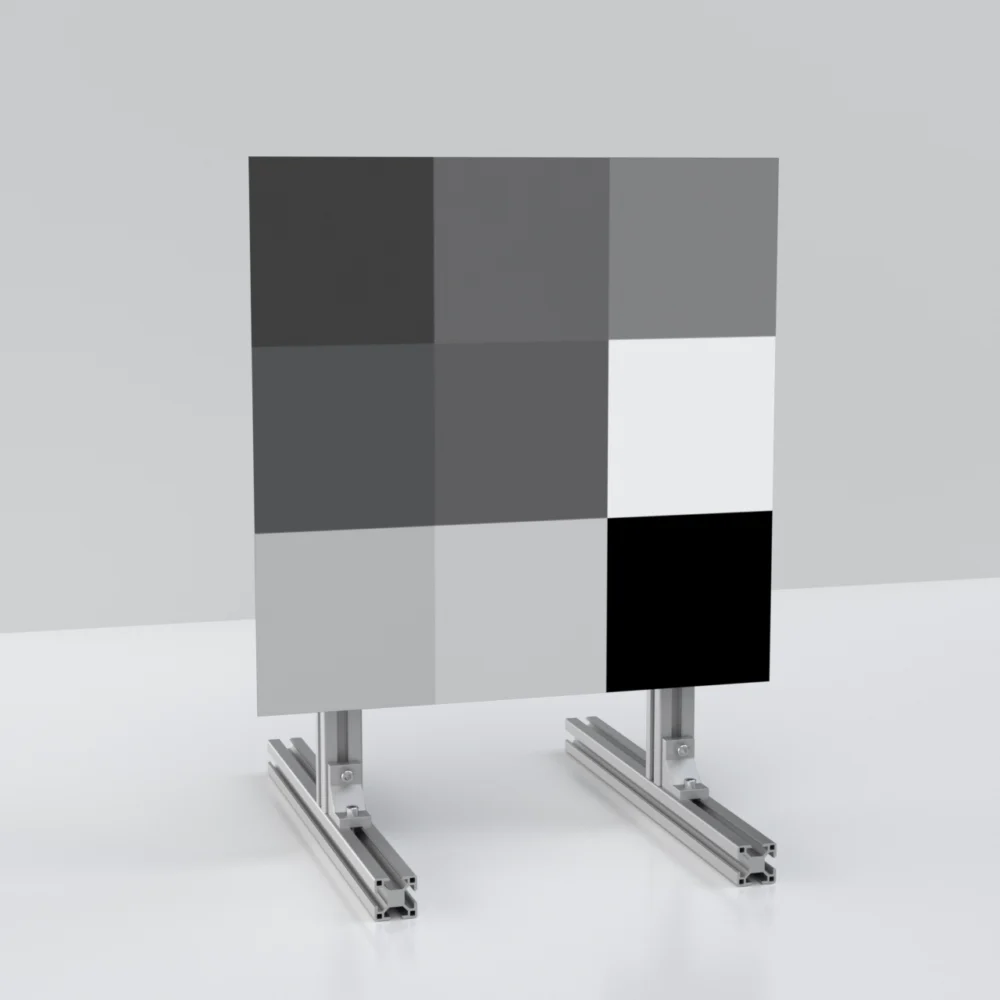
For this reason, multi-reflectance boards that combine all three values into a single rigid panel (10/50/90 zones side-by-side) have become the standard purchase format. Three separate panels work fine but add positioning and alignment overhead during testing. A single multi-zone board lets you collect data on all three values without re-aligning between measurements.
When do you need custom reflectance values beyond 10%/50%/90%?
Some test programs need finer reflectance resolution than the standard three-step trio. Common scenarios:
4-zone or 5-zone configurations — Adding 30% and 70% gives you finer coverage of the typical-case range, which matters for intensity-calibration work or for training perception classifiers that need detailed reflectance gradient data. A 5-zone board with 10/30/50/70/90 is a more thorough characterization tool than three values, at moderate additional cost.
Sub-10% values for stress testing — Programs developing perception for very challenging conditions (deep shadows, dark vehicle detection in twilight, autonomous driving in low-light environments) sometimes specify 2% or 5% reflectance targets. These are significantly harder to manufacture stably than 10% — most consumer-grade reflectance products don’t go below 10%, but engineered Lambertian surfaces can be made stable down to 1-2%.
Above 90% for specialty work — Spectrometer calibration, laser-power measurement, satellite remote-sensing reference, and some optical metrology work need reflectance approaching 100%. Sintered PTFE reference standards reach 98-99% reflectance and serve these applications, though they’re typically used as small reference discs rather than large LiDAR test boards.
Non-standard wavelengths — A target characterized at 905nm but used to test 1550nm sensors will give incorrect reflectance values. If you’re working at 850nm, 940nm, 1064nm, 1550nm, or other custom wavelengths, you need targets characterized at those specific wavelengths — not interpolated from a 905nm spec.
Custom reflectance values are quoted on a per-order basis. The capability exists for any value between 1% and 99% — what changes is lead time and cost, not whether it’s possible.
How do you decide which reflectance values to buy?
A practical decision tree:
If you’re testing a LiDAR for the first time and need to characterize basic performance → Buy a 10/50/90 multi-zone board. This is the right starting point for 90% of LiDAR test programs.
If you only have budget for a single value → Get 10%. Worst-case detection range is the metric most often misrepresented in datasheets and most often surprising in real-world deployment. 10% testing catches problems before they reach the field.
If you’re doing high-precision intensity-calibration work or perception-classifier training → Add 30% and 70% to make a 5-zone board (10/30/50/70/90). The extra resolution pays off for these specific applications.
If you’re stress-testing detection at the dark end → Add a 2% or 5% target for worst-case stress testing alongside the standard trio.
If you’re calibrating a spectrometer, doing laser-power measurement, or running satellite remote-sensing reference work → You need a high-reflectance reference standard (typically 95%+ sintered PTFE), not a typical LiDAR test target. Different product class.
If your LiDAR operates at a wavelength other than 905nm → Order targets characterized at your specific wavelength. Cross-wavelength shift varies by reflectance value and is most significant at the high-reflectance end.
FAQs
What’s the most important reflectance value for LiDAR testing?
For most applications, 10% is the most important — it defines worst-case detection range, which is the performance metric most often misrepresented in datasheets and most often surprising in real-world deployment. If you can only buy or test one reflectance value, 10% catches more problems than 50% or 90%.
Are 10%, 50%, and 90% standardized internationally?
These values are de facto industry standards used in automotive LiDAR testing, OEM acceptance protocols, and academic research, but they’re not codified in a single mandatory ISO standard. SAE J3088 (developing automotive LiDAR characterization standard) references these values. Different OEMs and certification bodies may specify variations (some use 5% / 25% / 75% / 95%), but the 10/50/90 trio is the most widely adopted convention.
Is a 50% reflectance target the same as 18% gray cards used in photography?
No. Photography 18% gray cards are designed for visible-light camera exposure metering and reflect approximately 18% of visible light. LiDAR 50% targets are calibrated at near-infrared (typically 905nm) and reflect 50% specifically at that wavelength. Using a photography gray card as a LiDAR reference will give incorrect reflectance values and inconsistent results.
How do I know if my reflectance target is calibrated correctly?
Reputable manufacturers ship a per-target calibration report documenting the measured reflectance value at the specified wavelength, with traceable measurement methodology (typically D50/2° illumination on a calibrated spectrophotometer). If your target shipped without documentation of measured values, treat its reflectance specification as a manufacturer claim rather than verified performance.
Why do some LiDAR specs reference 10% reflectance and others reference different values?
Different manufacturers and applications choose reference values that match their use case. Automotive sensors typically reference 10% (worst-case dark vehicles). Industrial AGV and warehouse sensors might reference 50% (typical pallet and box surfaces). Specialty applications use whatever value is most relevant to their operating environment. When comparing LiDAR specifications across manufacturers, always note the reflectance assumption — a “150m max range” claim at 90% reflectance is not the same as 150m at 10%.
Can I make my own reflectance target with paint or fabric?
Possible but not recommended for any work where results matter. Achieving truly flat, calibrated, Lambertian reflectance requires engineered materials and characterized manufacturing. DIY targets typically have ±15-20% reflectance variance from their nominal value, plus angle-dependent behavior that contaminates measurements. The cost of a professionally calibrated target is small compared to the cost of incorrect performance data.
How much does a multi-reflectance set cost compared to single panels?
A multi-zone board (10/50/90 on a single panel) typically costs less than three separate single-value panels, because you only pay for one substrate, one mounting setup, and one shipping cost. The trade-off is less flexible — you can’t position the three values at different distances during testing. For most lab and production-line work, the cost savings and simplified handling of a multi-zone board outweigh the flexibility limitation.
What reflectance value do automotive OEMs require for testing?
Most automotive OEMs require performance characterization at 10%, 50%, and 90% as a minimum, with additional values (often 5% and 95%) for specific test protocols. Tier 1 LiDAR suppliers building for OEM acceptance typically purchase comprehensive multi-reflectance setups with traceable metrology certification. The OEM’s specific requirements will be in the technical specifications they provide to suppliers.
Get LiDAR Reflectance Targets from CalibVision
CalibVision manufactures LiDAR reflectance targets across the full 1% to 99% reflectance range at all four major LiDAR wavelengths (905nm, 1550nm, 940nm, 850nm). For most applications, our standard 10/50/90 multi-zone board on aluminum or honeycomb composite substrate is the right starting point.
For specialty applications requiring custom reflectance values, sub-10% stress targets, sintered PTFE high-reflectance standards, or non-standard wavelengths, we manufacture to specification with quoted lead times.
Shop 905nm LiDAR Reflectance Targets → | Browse All Reflectance Standards → | Request Custom Quote →
What to Read Next
- The Complete Guide to LiDAR Reflectance Targets — the main reference covering reflectance fundamentals, materials, and applications.
- 905nm LiDAR Reflectance Target: Selection and Testing Guide — deep-dive into the most common LiDAR wavelength.
- How to Test LiDAR Performance with Reflectance Targets — step-by-step lab setup guide.
- Lambertian vs Specular vs Retroreflective Targets: Which to Choose? — fundamentals of LiDAR-grade reflective surfaces.