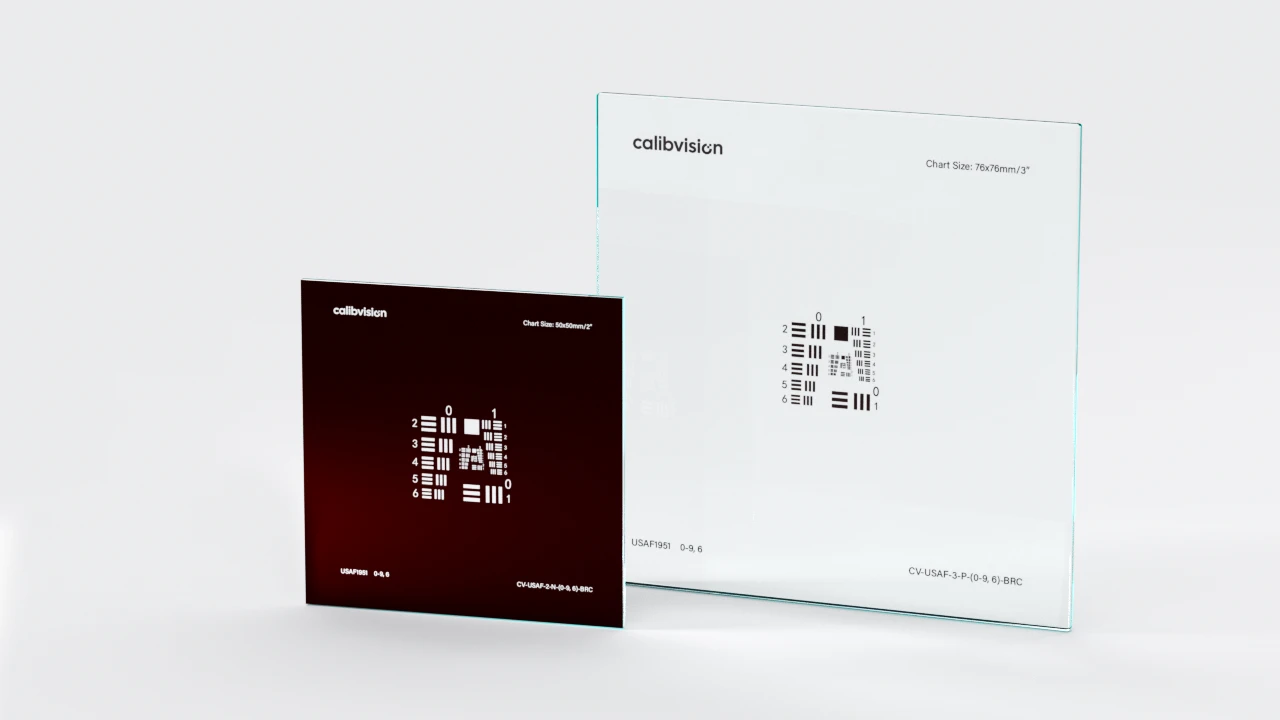
A USAF 1951 resolution target comes in two polarities, and choosing the wrong one is a common, avoidable mistake. A positive target has opaque chrome bars on a clear background; a negative target has clear bars cut into a chrome field. They resolve identically — the same group and element gives the same line pairs per millimetre either way — so the decision is not about resolution. It is about contrast polarity, and which one your illumination and detection method needs.
This guide explains how each images, which to pick for brightfield, darkfield, camera MTF, microscopy, collimators and backlit setups, and why the substrate still sets your accuracy ceiling. For the pattern and formula themselves, see what a USAF 1951 target is and how to read one.
What is a positive USAF 1951 target?
A positive target is chrome (opaque) bars on a clear glass background. In transmission, the bars read dark against a bright field — the same way ink reads on white paper. This is the polarity most people picture when they think of a resolution chart, and it is the default for standard, front-of-mind use.
What is a negative USAF 1951 target?
A negative target is the inverse: clear bars cut into a chrome field. In transmission the bars read bright against a dark field. Because the light comes through only the bars themselves, a negative target excels wherever the signal is the light passing through the pattern — backlit, illuminated, or emission-based setups.
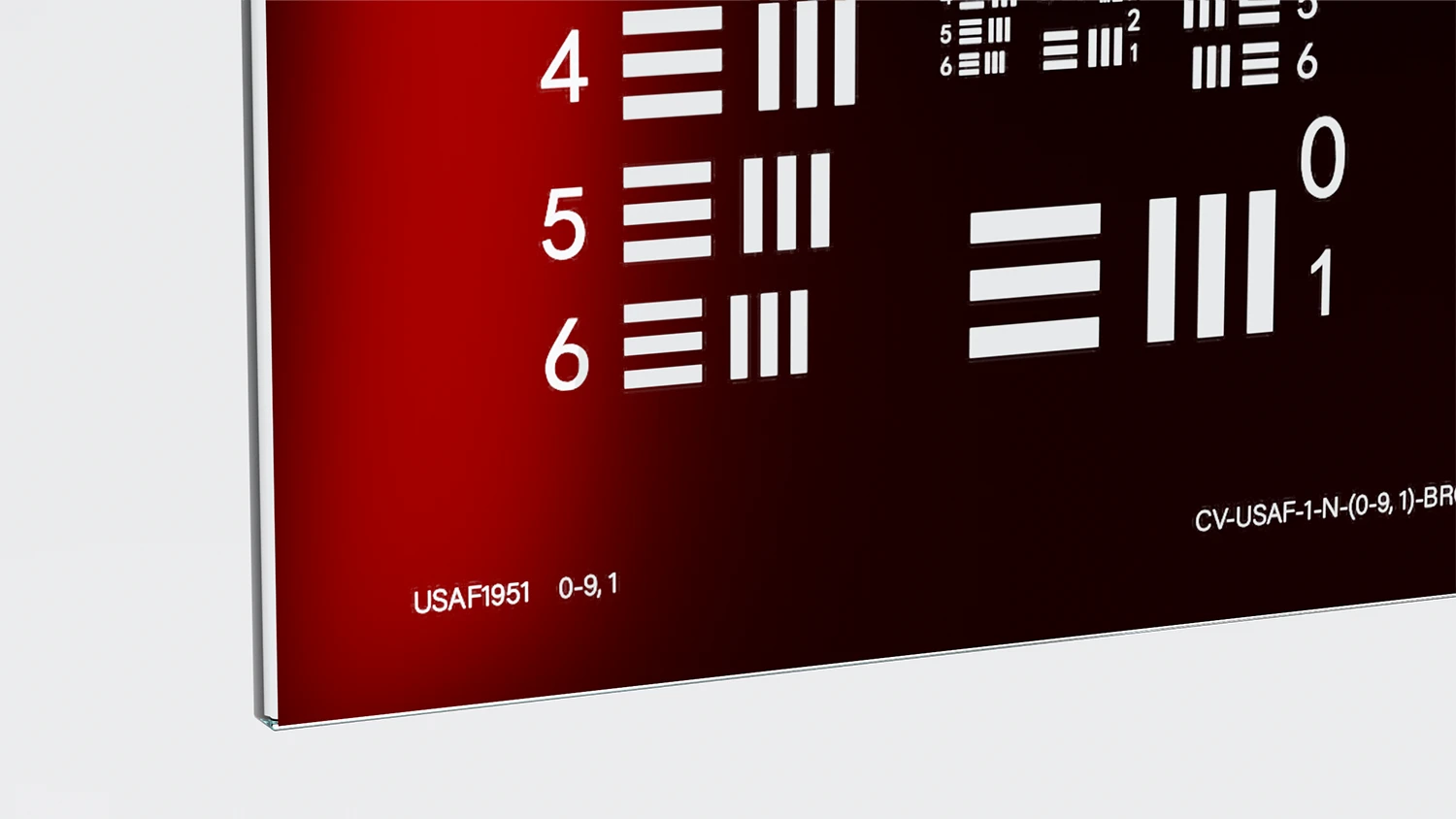
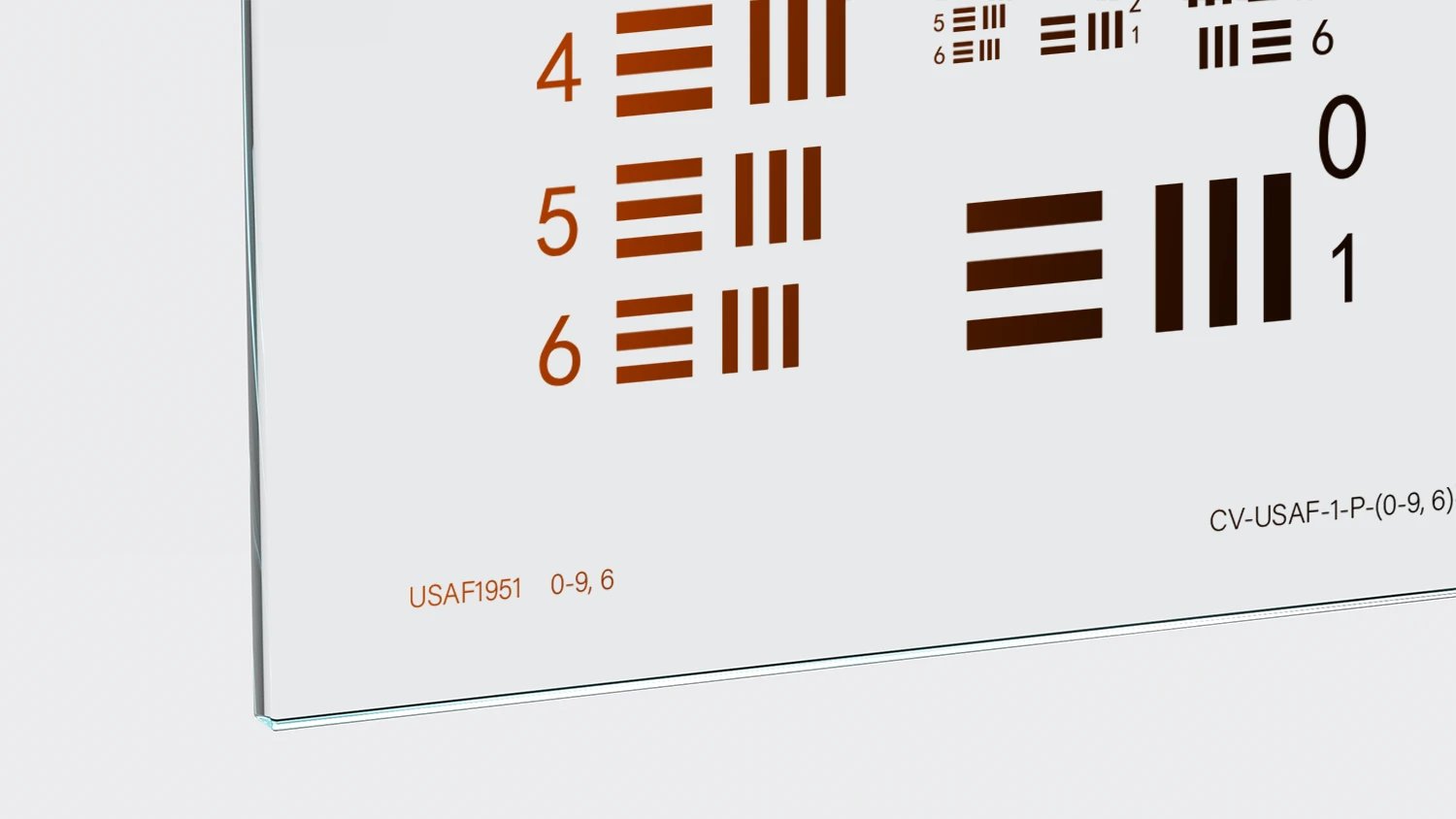
Which one should you use?
Match the polarity to your illumination and detection method:
| Use / method | Choose | Why |
|---|---|---|
| Brightfield microscopy | Positive | Dark bars on a bright field is the native brightfield contrast |
| Camera / lens MTF testing | Positive | Standard high-contrast bars for resolution and MTF work |
| Microscope & magnifier QC | Positive | Recommended for quality control of magnifying optics |
| Darkfield microscopy | Negative | Bright features on a dark field match the darkfield signal |
| Phase contrast / DIC | Negative | Suits the contrast mechanism of these techniques |
| Collimator alignment | Negative | Ideal for collimators and other illuminated test equipment |
| Backlit / fluorescence / NIR | Negative | Bright bars glow against dark, so the emitted or transmitted signal is the pattern |
The short rule: positive for brightfield and camera work, negative for darkfield, illuminated, and emission-based work. If your setup shines light through the pattern and you read the transmitted or emitted light as the signal, a negative target usually gives cleaner contrast; if you view the pattern against a bright background, use a positive.
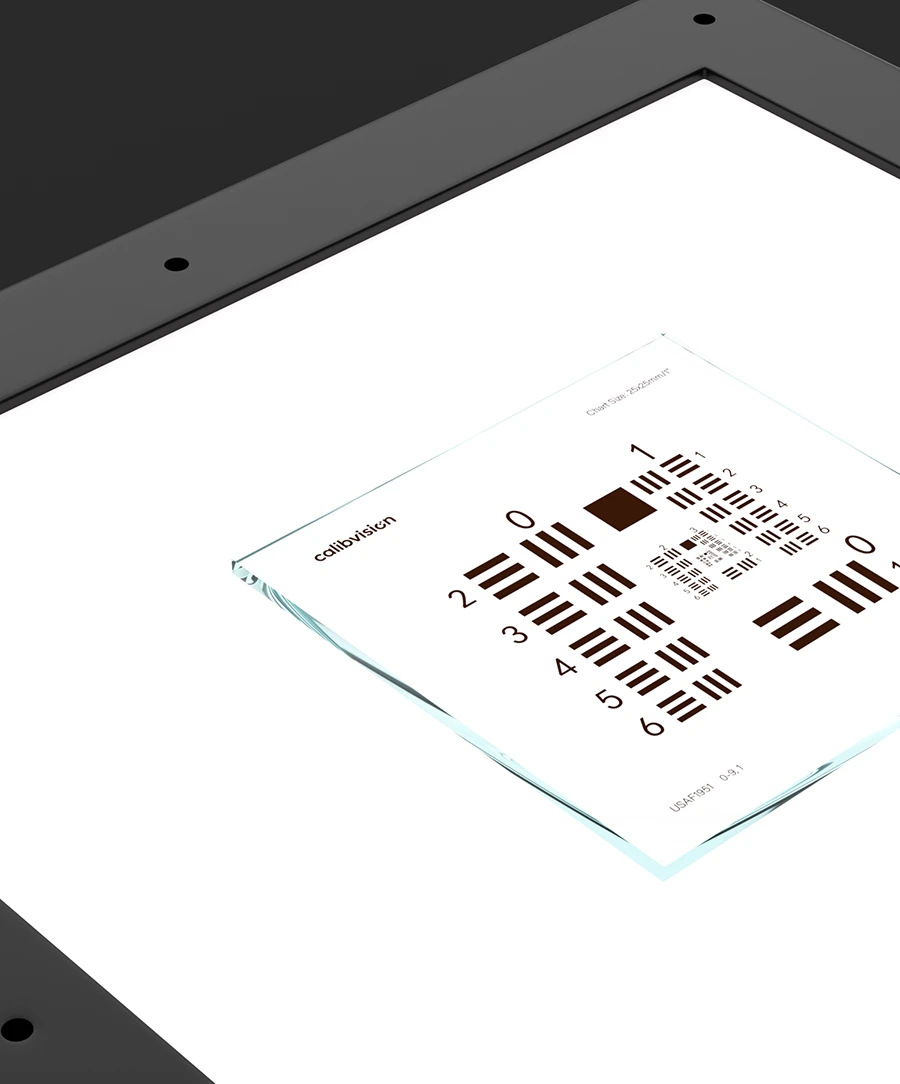
Do positive and negative differ in resolution or accuracy?
No. Polarity does not change the geometry — a Group 4 Element 3 element is 20.16 lp/mm and a 24.80 µm bar width on both. What sets accuracy is the same thing it always is: the substrate and the fabrication tolerance, not the contrast direction.
The substrate still sets your accuracy ceiling
Whichever polarity you choose, the resolution figure is only as trustworthy as the target’s fabrication. Chrome-on-glass, photolithographically produced, gives sub-micron bar edges that a printed chart cannot approach:
| Substrate | Line-edge tolerance | Best for |
|---|---|---|
| Soda-lime glass + brown chrome | ±50 nm | Standard use, through about Group 8 |
| Quartz glass + blue chrome | ±20 nm | Group 9 (912.30 lp/mm) and UV transmission |
Above Group 8, the ±50 nm tolerance of soda-lime becomes a significant fraction of the bar width, so quartz with blue chrome is required for accurate measurement toward Group 9 Element 3. Every CalibVision USAF 1951 target — positive or negative — ships with a serial-numbered inspection report; measurements are NIST/NIM-traceable, with product-level traceability under CNAS L0579 and ILAC-MRA, and accredited third-party calibration is available on request. See testing microscope objective quality for a worked application, and USAF 1951 chart PDF & printable for why printed charts fall short.
How do I order the right one?
Tell us your illumination and method — brightfield or darkfield, camera or collimator, transmitted or emitted — plus the top group you need to resolve, and we will confirm polarity, substrate and size. CalibVision USAF 1951 targets are available positive or negative, on soda-lime or quartz glass, MIL-STD-150A compliant, each with a serial-numbered inspection report. See specifications and request a quote.