A single flat chart can only be the right size, distance, and focus at one part of a wide field of view. Wide-angle and fisheye lenses have a curved focal field and see the edges of the frame at a steep oblique angle, so one planar chart is out of focus and foreshortened in the corners. Multiple SFRreg registration targets solve this: each small target is placed at the field position you want, at the correct distance, and tilted to face the lens — and all of them are captured and analyzed in a single image.
What SFRreg is
SFRreg is a slanted-edge target built around a registration mark — typically a four-quadrant circle. The edges between the quadrants are the slanted edges the SFR algorithm uses to compute MTF (sharpness) and lateral chromatic aberration, while the circular mark lets the software automatically find the target at any position and angle in the frame.
The key property is freedom of placement: an SFRreg target can sit at an arbitrary position and orientation. You can rotate it to the ISO 5° tilt, or align it to the sagittal and tangential directions of a radial field. That freedom is exactly what a single large chart cannot give you.
The core problem: one flat chart can’t cover a wide field
To measure sharpness across the frame with a single planar chart, that chart has to be sharp, correctly sized, and squarely imaged everywhere at once. On a wide or ultra-wide lens, it can’t be:
1. Field curvature and focus. Wide-angle and fisheye lenses focus different field positions at different distances — the focal surface is curved, not flat. A flat chart placed for best center focus is defocused in the corners (and vice versa). You’d be measuring defocus, not the lens’s real corner MTF. With separate targets, each one is placed at the distance that is in focus for its field position.
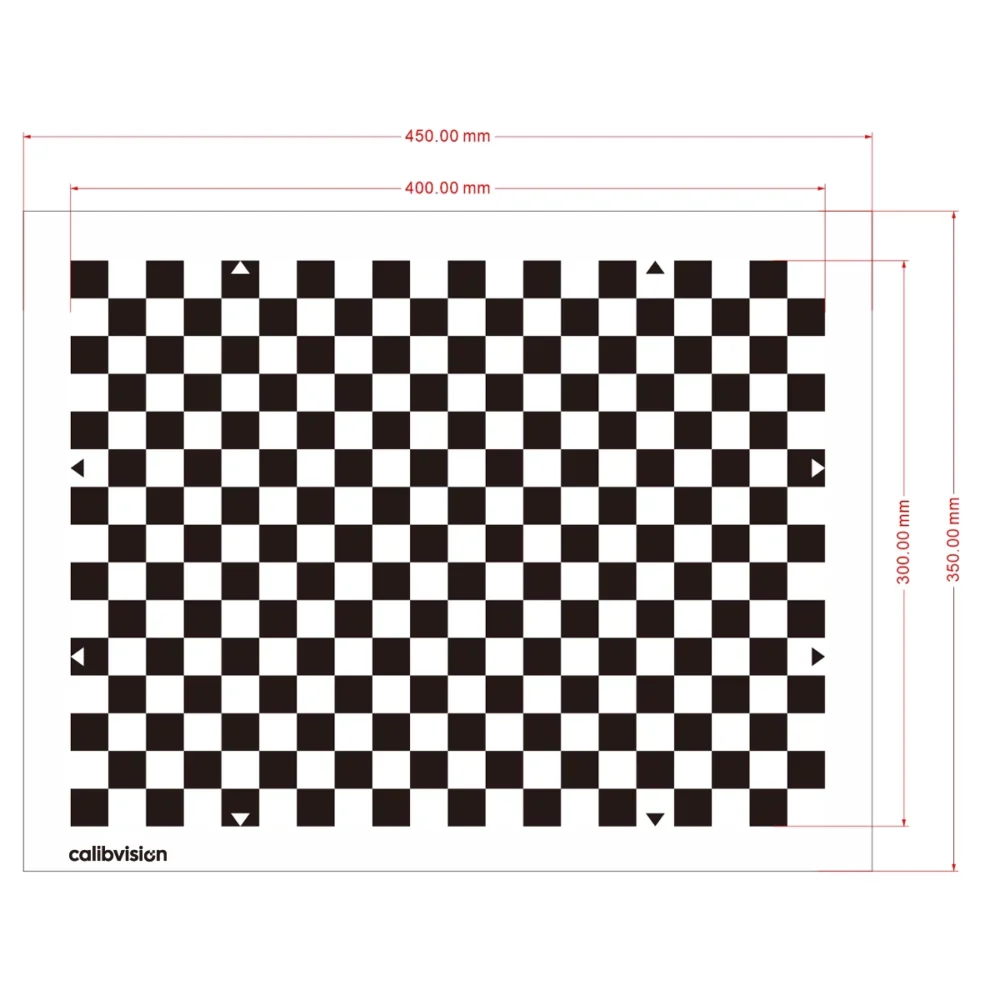
2. Size and working distance. Filling a 120°–180° field with a flat chart means either an enormous chart or placing it very close. Both are impractical, and a chart placed close to a wide lens is itself distorted by the geometry. A handful of small targets at the right angles cover the field positions you care about without a wall-sized chart.
3. Oblique viewing at the edges. Near the edge of a wide field, a flat chart is seen at a steep angle, so its edges are foreshortened and degraded — the worst possible condition for a slanted-edge measurement. Each SFRreg target can instead be tilted to face the lens, presenting a clean edge at every field position.
4. Control of field position and orientation. With one chart you measure whatever edges happen to land at a given point. With SFRreg targets you put a measurement exactly where you want it — center, 0.5 field, 0.7, corners — and orient each one to read the direction you care about.
Sagittal vs tangential: why orientation matters off-axis
Off-axis, a lens does not resolve equally in all directions. Astigmatism means the sagittal (radial) and tangential directions can have very different MTF, and the gap grows toward the corners. Because each SFRreg target can be oriented independently, you can align marks to measure sagittal and tangential MTF at the same field height — something a single fixed chart cannot do cleanly. The same per-channel edge analysis also yields lateral chromatic aberration, which is largest off-axis and therefore best measured at the field positions where it actually matters.
How a multi-target setup works in practice
A typical arrangement places one target at the center and one in each corner — five marks angled toward the lens — so a single capture covers center and corner field positions at once. (Add marks along the diagonals at, say, 0.3 / 0.5 / 0.7 / 0.9 field for denser sampling.)
In one image, the software:
- Auto-detects each registration mark wherever it lands in the frame,
- Computes MTF and lateral CA from the slanted edges of each, and
- Reports the results mapped to field position.
That single-shot efficiency is why this approach is standard for automotive cameras, security/surveillance optics, fisheye and 360° systems, and endoscopes — anywhere the field is wide and the corners matter.
For long-distance or infinity testing, circular SFRreg targets also drop into collimators, so each field angle can be simulated independently — again, impossible with one flat chart.
When a single chart is actually fine
Multiple targets earn their extra setup only when the field demands it. If you are testing a normal or narrow FoV lens with a reasonably flat field at moderate resolution, a single planar chart — an eSFR ISO or full-field slanted-edge chart — is simpler and perfectly adequate. Reach for a multi-target SFRreg setup when you have wide/ultra-wide FoV, strong field curvature, long working distances, or a need to control field position and orientation precisely.
Contrast still follows the low-contrast rule
SFRreg targets are slanted-edge targets, so the same contrast logic applies as for any ISO 12233 MTF measurement: use a low-contrast edge — 4:1 (ISO-preferred) or 10:1 — not a high-contrast black/white edge, which clips and triggers sharpening and inflates the result. (See our article on why ISO 12233 slanted-edge MTF needs a low-contrast target and the optical-density-to-contrast conversion.)
How to source SFRreg targets for a multi-point setup
For a multi-target arrangement, the one thing that matters beyond the individual target quality is consistency between marks — every target in the set should have the same contrast and the same edge quality, or your field-to-field comparison is meaningless.
That points to glass-based targets made as a matched set: a controlled-density chrome-on-glass (well suited to 10:1) or a precisely controllable optical coating on glass (the better route to 4:1). Both are photolithographic/coated processes, so unlike film targets they carry no grain and no ppi limit — which is what you want when you’re reading fine corner detail. (See film vs chrome-on-glass and why grain structure matters for MTF.)
FAQ
Why not just use one big chart for a wide-angle lens?
Because a wide lens has a curved focal field and sees the corners obliquely. A single flat chart can’t be in focus and squarely imaged everywhere at once, so corner results reflect defocus and foreshortening rather than the lens. Multiple SFRreg targets are each placed and angled correctly for their field position.
What does an SFRreg target measure?
MTF (sharpness) and lateral chromatic aberration at a specific field position and orientation, using the slanted edges of a four-quadrant registration mark.
How many SFRreg targets do I need?
At minimum, center plus four corners (five) to cover the key field positions in one shot. Add marks along the diagonals for denser field sampling.
Can SFRreg measure sagittal and tangential MTF?
Yes. Because each target can be oriented independently, you can align marks to the sagittal and tangential directions at a given field height — useful for characterizing astigmatism off-axis.
What contrast should an SFRreg target be?
The same as any slanted-edge target: low contrast, 4:1 (ISO-preferred) or 10:1. Avoid high-contrast edges, which inflate MTF through clipping and sharpening.