Optical density (OD) and contrast ratio describe the same thing two ways. They are linked by one equation:
Contrast ratio = 10^(ΔOD) and ΔOD = log₁₀(contrast ratio)
where ΔOD is the optical-density difference between the dark and light regions of a target. So a 10:1 target needs a density difference of ΔOD = 1.0, and a 4:1 target needs ΔOD ≈ 0.6. A common and costly mistake is to read “OD 3” as 10:1 — it is not. OD 3 is 1000:1.
What optical density (OD) is
Optical density measures how strongly a material attenuates light, on a logarithmic scale:
OD = log₁₀(1 / T) = −log₁₀(T)
where T is transmittance (the fraction of light that passes through). Each whole unit of OD means another factor of ten of attenuation, which is why density is convenient: filters and coatings add in OD (stack two OD-1 layers and you get OD 2, i.e. 100×).
| Optical density (OD) | Transmittance (T) | Light passing |
|---|---|---|
| 0 | 100% | all of it |
| 0.3 | 50% | half |
| 0.6 | 25% | a quarter |
| 1.0 | 10% | a tenth |
| 2.0 | 1% | a hundredth |
| 3.0 | 0.1% | a thousandth |
| 4.0 | 0.01% | a ten-thousandth |
Standard opaque chrome on glass sits around OD 3–4 — it blocks essentially all the light. That is exactly why it is the wrong material for a low-contrast target.
What contrast ratio is
Contrast ratio is simply the brighter level divided by the darker level:
Contrast ratio (CR) = L_max / L_min
For a backlit (transmissive) target, that is the transmittance of the light region divided by the transmittance of the dark region. A “10:1” target means the bright areas pass ten times as much light as the dark areas.
The equation that links them
If the light region has density OD_light and the dark region has density OD_dark, then:
CR = T_light / T_dark = 10^(OD_dark − OD_light) = 10^(ΔOD)
So contrast is set entirely by the difference in density, ΔOD. Rearranged:
ΔOD = log₁₀(CR)
When the bright region is clear glass (OD ≈ 0), the math is even simpler: the dark region’s OD equals log₁₀ of the contrast ratio. A 10:1 clear-glass target just needs a dark region at OD 1.0.
Conversion table: contrast ratio ↔ ΔOD ↔ modulation
Datasheets switch between three numbers for the same edge. Michelson modulation is the third: M = (CR − 1)/(CR + 1).
| Contrast ratio | ΔOD (= dark OD if bright is clear) | Modulation (M) |
|---|---|---|
| 2:1 | 0.30 | 0.33 |
| 4:1 | 0.60 | 0.60 |
| 6:1 | 0.78 | 0.71 |
| 10:1 | 1.00 | 0.82 |
| 45:1 | 1.65 | 0.96 |
| 100:1 | 2.00 | 0.98 |
| 1000:1 (opaque chrome) | 3.00 | ≈1.00 |
To go the other way: CR = 10^(ΔOD) and CR = (1 + M)/(1 − M).
Worked examples
1. “I need a 10:1 target. What density?” ΔOD = log₁₀(10) = 1.0. With a clear-glass bright side, the dark coating is OD 1.0 (10% transmission).
2. “My coating measures OD 0.6. What contrast does that give?” CR = 10^0.6 = 4:1 (with a clear bright region). That is the ISO 12233 preferred edge contrast.
3. “Can I use standard opaque chrome for a 10:1 edge?” No. Opaque chrome is roughly OD 3, i.e. CR = 10^3 = 1000:1 — a hundred times too high. A 10:1 edge needs a controlled partial-density layer at OD 1.0, not full opacity.
4. Gray-on-gray (both regions coated): Light region OD 0.5, dark region OD 1.1 → ΔOD = 0.6 → CR = 4:1. The contrast comes from the 0.6 difference; the absolute densities set the mean level (see next section).
Contrast ratio sets the ratio — absolute OD sets the mean level
A subtlety that trips people up: contrast ratio only tells you the ratio between the two tones, not where they sit on the brightness scale. Two targets can both be 4:1 yet look very different — one bright (OD 0.1 vs 0.7) and one dark (OD 0.8 vs 1.4).
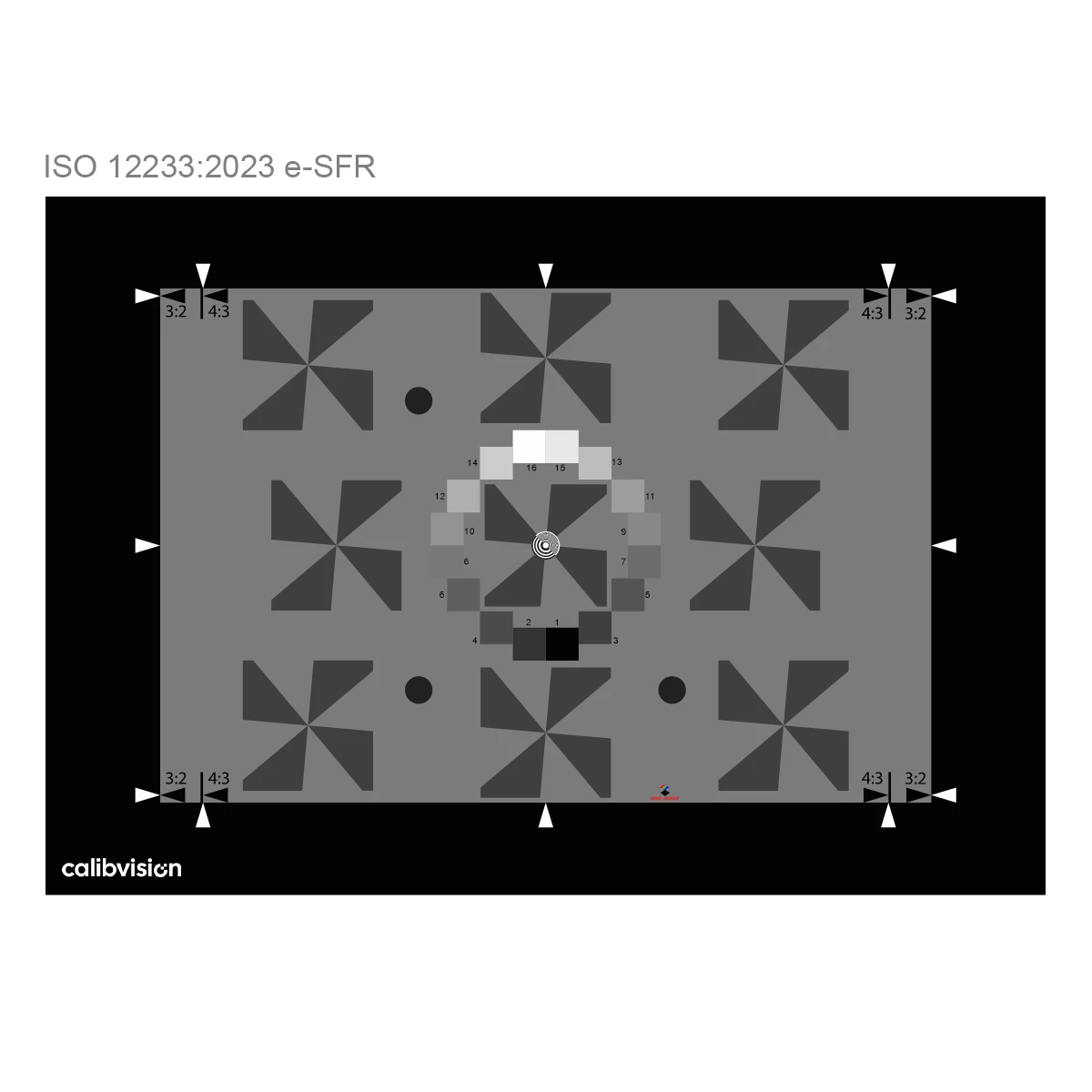
That second number matters for measurements like ISO 12233 slanted-edge MTF, which specify not just a ~4:1 ratio but also a controlled mean level (an active-area transmittance around 0.15–0.25), so neither side of the edge clips. When you spec a low-contrast target, give both the contrast ratio and the intended mean level or the two absolute ODs.
A note on transmissive vs reflective
OD applies to both transmission density (backlit targets such as chrome-on-glass) and reflection density (front-lit printed targets). The CR = 10^(ΔOD) relationship holds either way; just be consistent about which density you mean. Chrome-on-glass targets are inherently transmissive, so their contrast is a transmission-density difference.
Why this matters when you order a target
Specifying contrast in OD removes ambiguity between you and your supplier:
- “10:1” alone can be misread. “ΔOD 1.0, dark region OD 1.0 on clear glass” cannot.
- It tells the supplier whether your tones are achievable with their process. A continuous controlled-density chrome layer can hold OD ~1.0 cleanly (10:1); pushing to OD ~0.6 (4:1) is better served by a precisely controllable optical coating.
- It separates contrast (ΔOD) from mean level (absolute OD), the two numbers a low-contrast MTF target actually needs.
For why low contrast is required in the first place, see our companion article on why ISO 12233 slanted-edge MTF needs a low-contrast target. For why the coating must be continuous rather than dithered, see the article on film vs chrome-on-glass and grain structure.
FAQ
How do I convert optical density to contrast ratio?
Contrast ratio = 10^(ΔOD), where ΔOD is the density difference between the dark and light regions. ΔOD 1.0 = 10:1; ΔOD 0.6 ≈ 4:1.
What optical density gives a 10:1 contrast ratio?
A density difference of 1.0. With a clear-glass bright region, that means a dark region at OD 1.0 (10% transmission).
Is OD 3 the same as 10:1?
No. OD 3 is a density difference of 3, which is 10^3 = 1000:1. A 10:1 edge is ΔOD 1.0.
What’s the difference between contrast ratio and modulation?
Modulation M = (CR − 1)/(CR + 1). A 4:1 ratio is M = 0.60; 10:1 is M = 0.82. Both describe the same edge.
Why can’t opaque chrome make a low-contrast target?
Opaque chrome is OD 3–4 (≈1000:1 to 10000:1). A 4:1 or 10:1 target needs a controlled partial density (ΔOD 0.6–1.0), so the dark layer has to be only partially attenuating, not fully opaque.