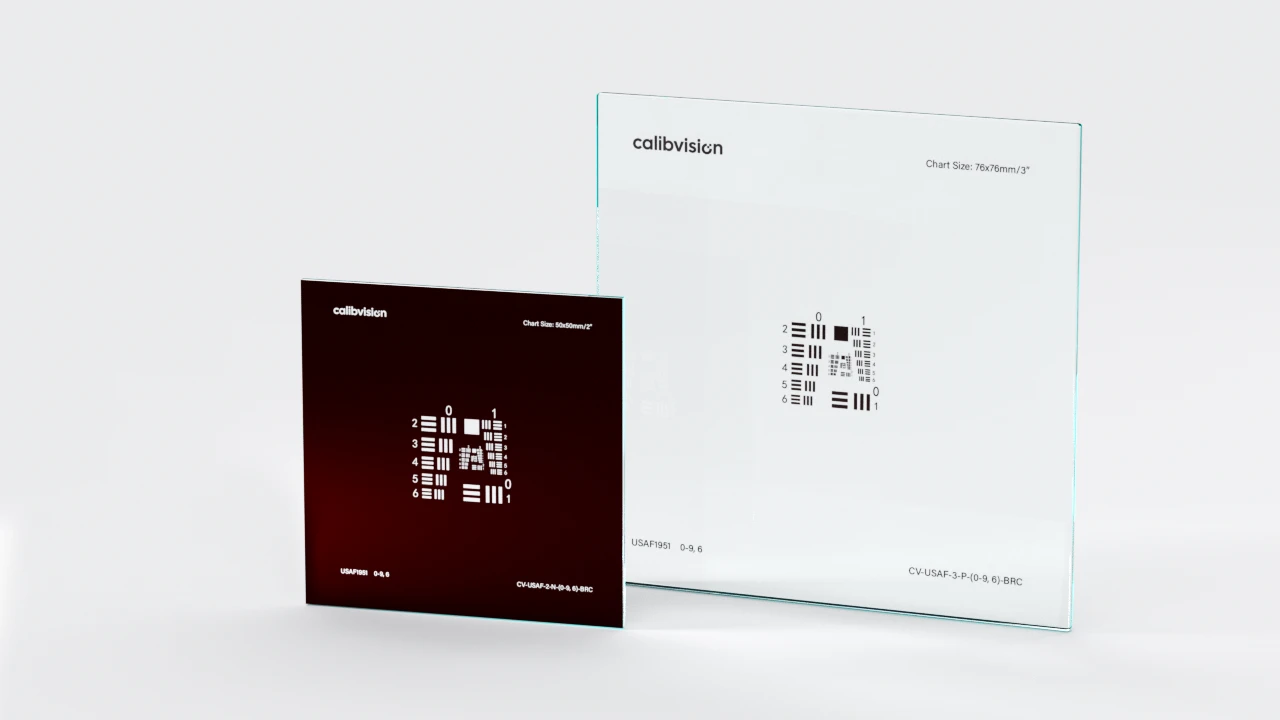
You can download a USAF 1951 chart as a PDF and print it, but a printed target is limited by your printer’s resolution — realistically to around Group 4–5 (roughly 16–32 lp/mm) with soft, uneven edges. That’s fine for a quick visual check or teaching, but not for measuring real optical resolution, which needs a chrome-on-glass target reaching up to 912.30 lp/mm.
New to Group and Element numbers? See our guide to reading a USAF 1951 chart first.
Can I just print a USAF 1951 target?
Yes — for coarse, low-resolution work. A home or office printer lays down ink at a fixed dot pitch, and the finest line it can render cleanly is several dots wide. Even a 1200–2400 dpi printer struggles to produce clean bars below roughly 30–60 µm, which caps a printed target well short of the fine end of the pattern. The bar edges are also fuzzy and the substrate (paper or film) expands with humidity and temperature, so the geometry drifts.
That makes a printed chart usable for:
- Teaching and demonstrations
- Rough “is it roughly in focus?” checks
- Very low-magnification, low-resolution systems
Free printable USAF 1951 chart (PDF)
Need a chart today? Get our free, print-ready USAF 1951 PDF — laid out to MIL-STD-150A, ideal for layout reference, teaching, and quick focus checks. Enter your email and we’ll send the download link.
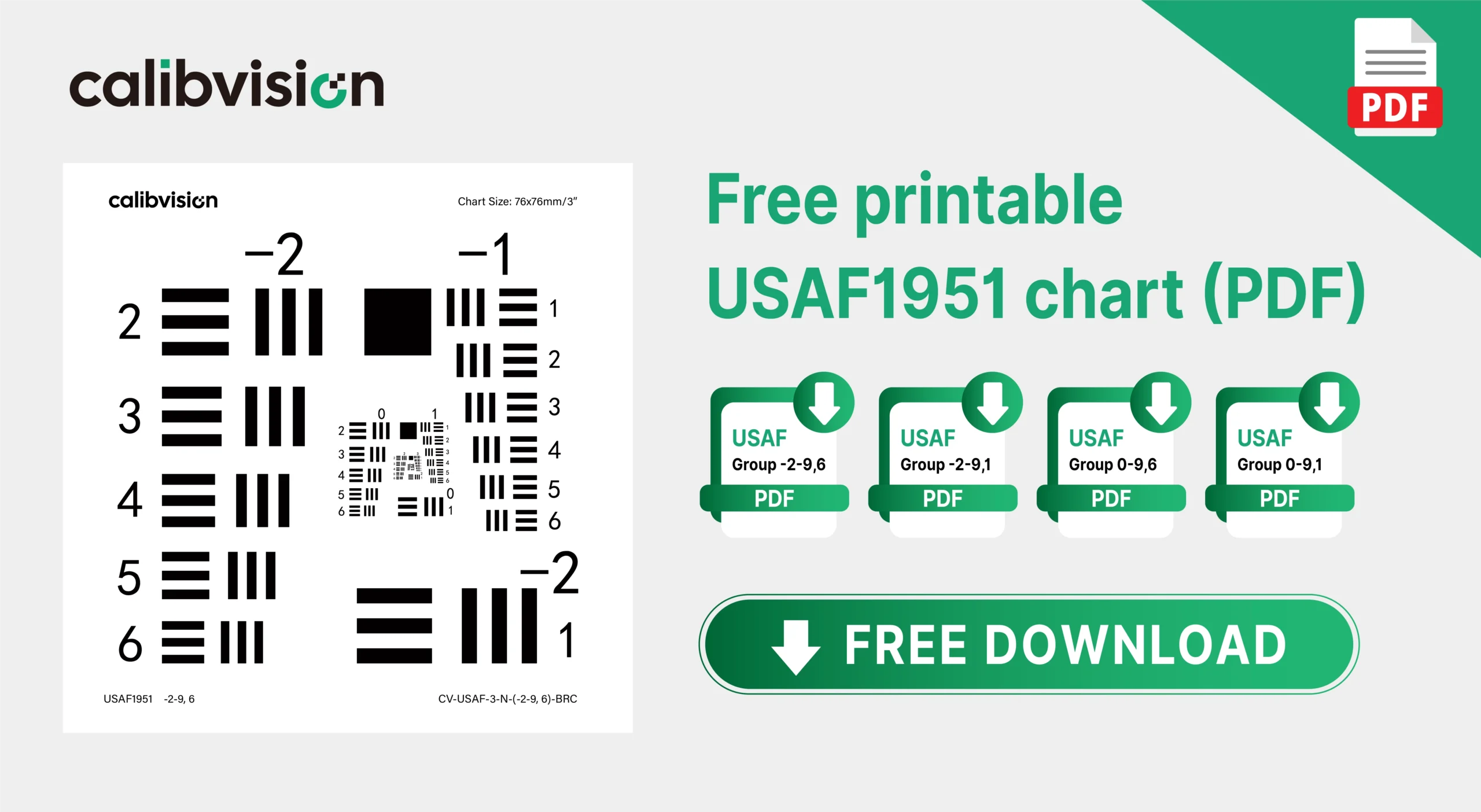
Note: printed resolution is limited by your printer and this PDF is not a calibrated measurement reference. For quantitative testing, use a chrome-on-glass target (below). Need Free printable USAF 1951 chart files, please contact sales@calibvision.com
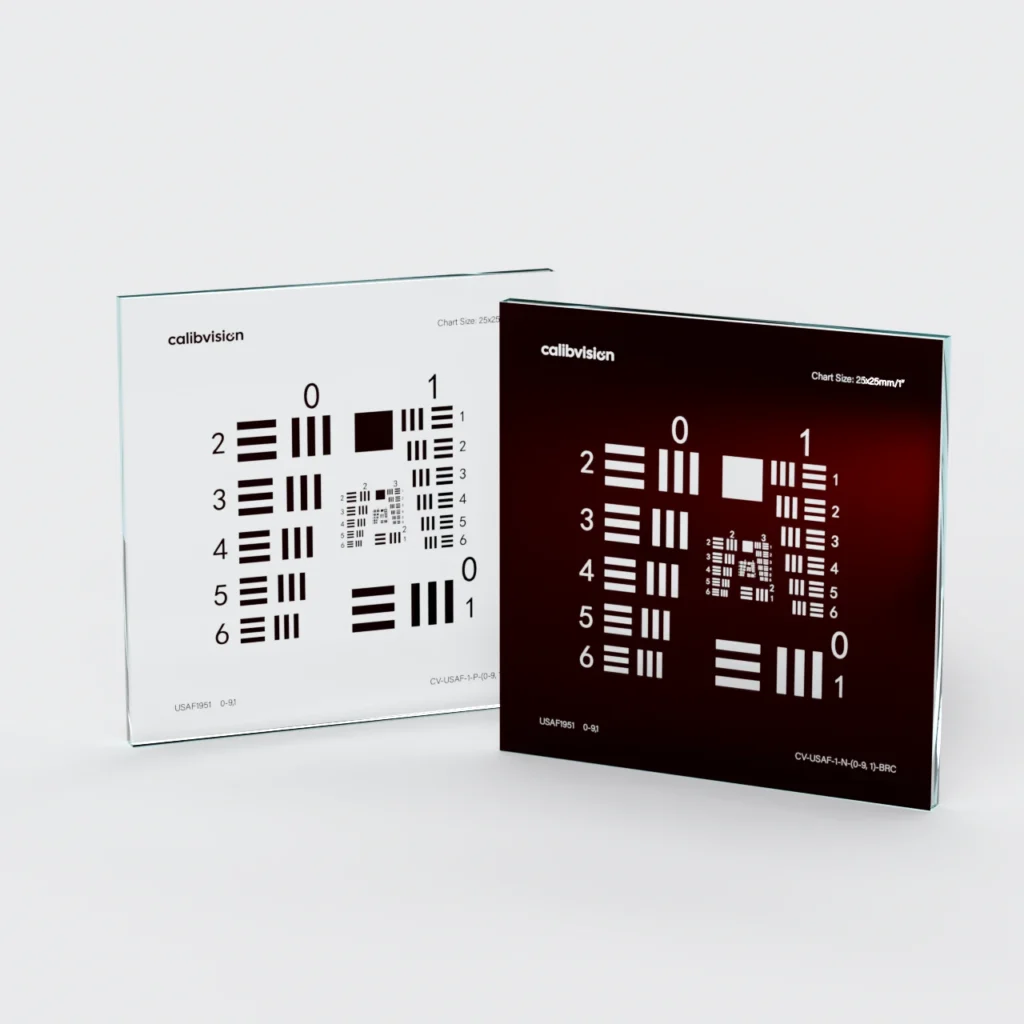
- MIL-STD-150A compliant — three-bar patterns from Group 0 Element 1 up to Group 9 Element 6 (912.30 lp/mm), with extended Group −2 (down to 0.25 lp/mm) on 3″ targets.
- Industry-leading 0.55 µm line width — our Group 9 Element 6 targets resolve to 912.30 lp/mm (0.55 µm line width). Most manufacturers stop at Group 9 Element 1 (512 lp/mm, ~1 µm line width). Custom orders down to 0.1 µm for semiconductor wafer calibration.
- Quartz Glass (Fused Silica) substrate — every target on premium fused silica for superior thermal stability, UV transmission, and flatness. Chrome coating ≥ OD3.
- Two coating options — Brown Chrome across the full range, or Blue Chrome for standard 512 lp/mm targets (enhanced contrast under reflected light).
- Positive & Negative versions for both bright-field/transmission and dark-field/reflection applications.
- 3 standard sizes — 1″ (25×25 mm), 2″ (50×50 mm), 3″ (76×76 mm with extended Group −2 patterns) — all 2.3 mm thick. Optional NIM-traceable metrology-institute calibration available (additional fee).
Why printed charts fail for real resolution testing
Resolution measurement depends on two things a printed target can’t hold: fine, sharp edges and dimensional stability. When the target’s own edges are softer than the optics under test, you measure the target — not your lens. And because paper and film move with the environment, repeat measurements don’t agree.
| Printed / film target | Chrome on glass target | |
|---|---|---|
| Max usable resolution | ~Group 4–5 (16–32 lp/mm) | Group 9 Element 6 (912.30 lp/mm) |
| Edge quality | Soft, ink-spread | Lithographic, sub-micron sharp |
| Dimensional stability | Drifts with humidity/temperature | Stable on fused silica |
| Line width floor | ~30–60 µm | Down to ~0.55 µm (custom to 0.1 µm) |
| Best use | Demos, coarse checks | Metrology, lens/camera/microscope testing |
When do you need a chrome-on-glass target instead?
If you are testing a real lens, camera, microscope objective, or machine-vision system — anything where the result feeds a spec, a report, or a pass/fail decision — you need a chrome pattern on fused silica (quartz glass). It resolves far finer than the system under test, holds its geometry, and gives repeatable readings. A printed PDF simply cannot reach the resolution or edge quality these measurements require.
Is there a free USAF 1951 chart PDF?
Free PDF versions of the pattern exist online, and they’re useful for learning the layout or a rough check. Just treat them as what they are: a low-resolution reference, not a measurement tool. For any quantitative resolution work, the printed version’s limits will dominate your result.